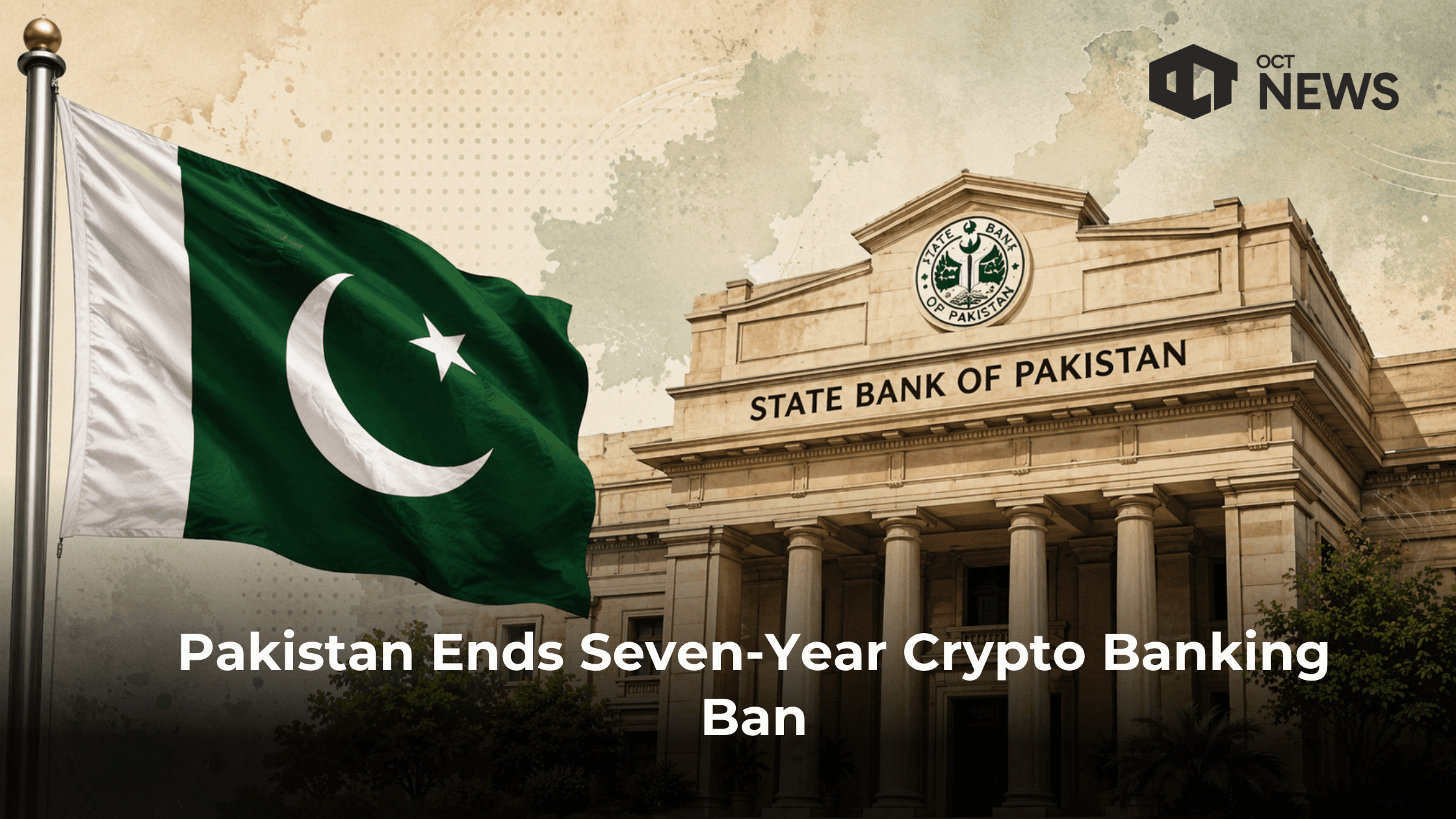
Pakistan central bank lifts its seven-year crypto banking ban, allowing licensed VASPs to access banking services under strict rules.

Author: Kritika Gupta
Steady attention without excessive speculation.
16th April 2026– Pakistan crypto banking ban lifted is the key development reshaping the country’s digital asset landscape this week. Pakistan’s central bank has officially ended its seven-year restriction on banking services for crypto firms, marking one of the most important regulatory shifts for the local market since 2018. The State Bank of Pakistan (SBP) announced that banks can now open accounts for virtual asset service providers (VASPs) that hold licenses from the Pakistan Virtual Assets Regulatory Authority (PVARA). The update came through BPRD Circular Letter No. 10 of 2026, issued on April 14, and it takes effect immediately.
High Signal Summary For A Quick Glance

Ledger Man 🎩
@strivex_

JUST IN: 🇵🇰Pakistan’s Central Bank has removed its ban on crypto services for banks and financial institutions, unlocking access for over 259 million people and bringing a massive new wave of adoption to the market. https://t.co/6G6FoVTNvV

07:31 AM·Apr 16, 2026

Marcus Frederick Nero
@Marcus_F_Nero
One country at a time. 🚀 Pakistan lifts its 8-year ban, allowing banks to serve Bitcoin and crypto firms. Banks must keep customer funds separate and cannot use them for crypto. https://t.co/hUH7y9hDFr

12:11 PM·Apr 15, 2026
The Pakistan crypto banking ban lifted update directly follows the enactment of the Virtual Assets Act 2026, which created PVARA as the country’s dedicated statutory regulator for digital assets. Under this framework, PVARA now licenses, regulates, and supervises all virtual asset activities in the country. Since the authority can now issue licenses and no-objection certificates to compliant VASPs, the SBP has updated its policy to bring these entities into the formal financial system under controlled regulatory oversight.
Notably, this is the first time since 2018 that crypto businesses have regained formal banking access. Back in April 2018, the SBP imposed a blanket ban on banks dealing with virtual currencies. At the time, regulators cited concerns around volatility, fraud, cybersecurity risks, and compliance with FATF standards during Pakistan’s grey-list period.
However, the ban did not eliminate crypto activity. Instead, the market shifted underground. Trading volumes continued to grow through peer-to-peer platforms, informal channels, and offshore exchanges. Pakistan emerged as one of the world’s leading markets for retail crypto adoption, with millions of users and significant annual transaction volumes, despite operating largely outside formal oversight.
Industry leaders across Pakistan’s crypto and fintech sectors have widely welcomed the move. PVARA Chairman Bilal Bin Saqib described the development as a “foundational milestone,” emphasizing that it could help bring underground crypto activity into the formal economy.
Meanwhile, representatives from licensed exchanges and local fintech firms expect faster user onboarding, stronger liquidity, and smoother fiat on-ramp and off-ramp services. In addition, global observers and local analysts see the policy as a pragmatic regulatory evolution.
Many also point to Pakistan’s large unbanked population and remittance-driven economy as key areas that could benefit from the change. Over time, formal banking access may attract institutional capital and accelerate innovation in remittances, tokenized assets, and blockchain-based financial services.
Despite the opportunities, implementation challenges remain. Banks will need time, systems, and staff training to manage enhanced due diligence requirements for VASPs. At the same time, the speed at which PVARA issues licenses will likely determine how quickly the sector can scale.
Furthermore, regulators must ensure strong AML and counter-terror financing compliance to protect Pakistan’s international regulatory standing and avoid future setbacks. If authorities execute the framework effectively, Pakistan could emerge as a more structured and competitive player in South Asia’s digital asset landscape.
Given the country’s estimated 20 million-plus crypto users, the combination of a dedicated regulator and restored banking access could transform a previously informal market into a supervised and innovation-driven sector while maintaining safeguards against illicit finance risks.
Our Crypto Talk is committed to unbiased, transparent, and true reporting to the best of our knowledge. This news article aims to provide accurate information in a timely manner. However, we advise the readers to verify facts independently and consult a professional before making any decisions based on the content since our sources could be wrong too. Check our Terms and conditions for more info.


Securitize Stocks Launches Tokenized Equities on Solana
OCC GENIUS Act Final Rule Sets U.S. Stablecoin Rules
Stellar Settles First Institutional Repo Using Tokenized Treasury Collateral
Kelsier Ventures Wallets Fall From $300M to Under $2M
Securitize Stocks Launches Tokenized Equities on Solana
OCC GENIUS Act Final Rule Sets U.S. Stablecoin Rules
Stellar Settles First Institutional Repo Using Tokenized Treasury Collateral
Kelsier Ventures Wallets Fall From $300M to Under $2M