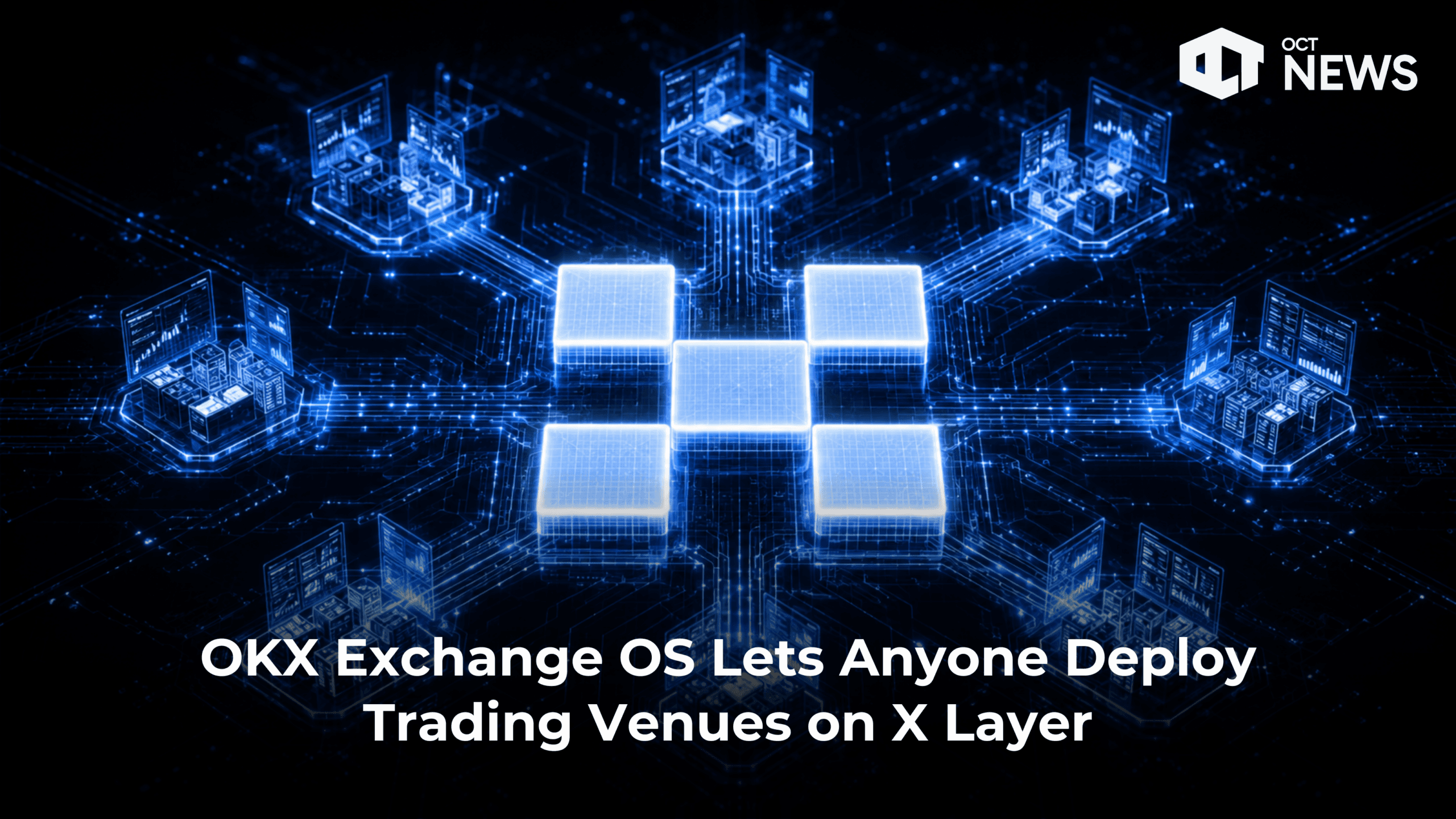
OKX Exchange OS upgrades X Layer with permissionless trading venues, unified liquidity, and self-custodial infrastructure.

Author: Akshay
26th May 2026 – OKX has announced Exchange OS, a major protocol upgrade that transforms its X Layer L2 into open, permissionless market infrastructure where anyone can deploy trading venues.
High Signal Summary For A Quick Glance

Myntis
@myntisai

@okx Exchange OS turns the exchange itself into deployable infrastructure. Builders now get institutional-grade tools without rebuilding the stack, that’s how crypto markets mature.
Introducing Exchange OS, a major upgrade to X Layer. Deploy institutional-grade or Web3-native trading venues on open, permissionless infrastructure without rebuilding from scratch, and use customizable compliance controls to fit your framework. Read the whitepaper: https://t.co/0xzVSdhFWa
03:29 AM·May 26, 2026

Trireme
@triremetrading
@okx The customizable compliance layer stands out here. Institutions want open infrastructure, but they also need configurable controls that fit regulated environments.
Introducing Exchange OS, a major upgrade to X Layer. Deploy institutional-grade or Web3-native trading venues on open, permissionless infrastructure without rebuilding from scratch, and use customizable compliance controls to fit your framework. Read the whitepaper: https://t.co/0xzVSdhFWa
02:38 AM·May 26, 2026

Ted Scheckler
@ImGregPartlow
@okx I think it is cool that we can build trading venues from scratch now because I once tried to build a sandwich from scratch and ended up just planting a lot of wheat.
Introducing Exchange OS, a major upgrade to X Layer. Deploy institutional-grade or Web3-native trading venues on open, permissionless infrastructure without rebuilding from scratch, and use customizable compliance controls to fit your framework. Read the whitepaper: https://t.co/0xzVSdhFWa
02:17 AM·May 26, 2026
High attention and emotional sentiment detected.
The upgrade, revealed today alongside a v1.0 whitepaper, allows builders who stake OKB to launch spot, perpetual, and prediction markets on X Layer. The process does not require OKX approval. Instead, deployers set their own asset listings, oracles, risk parameters, leverage caps, fee models, and user access rules.
Star Xu, CEO and founder of OKX, introduced the upgrade in a statement on the OKX Learn page. “Today, we are introducing Exchange OS, a major protocol upgrade built on X Layer that enables developers, institutions, and enterprises to build their own markets with unprecedented flexibility and efficiency,” he said.
Exchange OS uses a split architecture. User funds stay in self-custodial smart contracts on X Layer’s EVM. No one, including OKX, can access them. Meanwhile, a separate high-speed execution layer called TradeZone handles order matching, margin calculations, liquidations, and settlement.
According to the whitepaper, TradeZone delivers up to 300,000 transactions per second with millisecond matching latency. Traders pay zero gas fees inside TradeZone. Native state synchronization keeps the EVM and TradeZone in sync at all times.
As a result, all venues on Exchange OS share a unified account system. Users get one balance and one margin account across every market. That means capital flows freely between venues, so traders can run cross-market strategies without moving funds manually.
Each venue operator decides which assets to list, which oracles to use, and what risk parameters to enforce. They also choose whether their venue requires KYC or runs fully permissionless. On top of that, deployers configure leverage caps, fee structures, and liquidity sharing rules.
The protocol enforces hard limits above deployer choices. According to the whitepaper, these include maximum leverage ceilings and oracle deviation checks. If a deployer misbehaves, on-chain governance slashes their staked OKB.
OKX described the system as letting builders “deploy institutional-grade or Web3-native trading venues on open, permissionless infrastructure without rebuilding from scratch.”
X Layer currently holds approximately $91.85 million in total value locked, according to DefiLlama data. That figure rose 1.28% in the past 24 hours and follows a 30-day growth streak of roughly 230%.
Beyond TVL, the chain’s stablecoin market cap sits at about $1.47 billion. DEX aggregator volume over the past 24 hours reached approximately $18.3 million. L2Beat reports roughly $10.22 million in canonically bridged total value secured.
Still, these numbers reflect the pre-Exchange OS state of X Layer. The team has not deployed any Exchange OS-specific contracts yet, since the open deployment phase targets Q3 2026.
OKB saw an immediate price reaction after the announcement. According to reporting from Odaily, the token broke above $98 with a 17% gain in 24 hours. In the past, X Layer upgrades and the 2025 OKB burn drove rallies between 55% and 450%.
The August 2025 token burn destroyed 65.26 million OKB, reducing total supply to a fixed 21 million. After that upgrade, OKB also became the sole gas token for X Layer.
The first Exchange OS venue will be a simulated 2026 World Cup outcomes market, expected to launch in June 2026. After that, open market deployment targets Q3 2026 through the XIP-Exchange OS governance process. External builders will then deploy their own venues.
Looking further ahead, X Layer’s roadmap calls for additional protocol upgrades in Q4 2026. The chain originally launched in April 2024 as a Polygon CDK ZK L2 and later migrated elements to OP Stack. The August 2025 PP Upgrade boosted base throughput to approximately 5,000 TPS with near-zero gas fees.
The upgrade positions X Layer against protocols like Uniswap, dYdX, and Hyperliquid. Uniswap offers permissionless trading but fragments liquidity across pools and lacks native perpetuals or unified accounts. In contrast, dYdX runs its own appchain but operates as a single venue.
Hyperliquid similarly runs a dedicated chain for perpetuals. Exchange OS differs by creating a shared infrastructure layer where multiple independent venues coexist. Because all venues share one account system and composable liquidity, this design could create network effects as more deployers join.
The trade-off, however, is trust. Exchange OS relies on OKX-built infrastructure, and the TradeZone execution layer operates outside the main EVM. Users must trust that state synchronization between the two layers works as the whitepaper describes.
Exchange OS vs major on-chain exchange infrastructure models (May 2026)
Early reaction on X skews positive. Amber Group called the announcement “a massive leap forward for the onchain ecosystem.” Multiple users described OKX Exchange OS as a “game-changer” and praised the combination of permissionless deployment with configurable compliance.
At the same time, some skepticism exists. One user questioned whether liquidity on Exchange OS venues would be genuine or primarily wash trading. Others noted that the OKB staking requirement and protocol hard limits make the system less permissionless than pure DeFi alternatives.
One reply characterized the customizable compliance features as “defi compliance cop mode unlocked.” So far, no major institutional pushback or regulatory statements have surfaced.
Several key details remain unclear. The exact OKB staking amounts and slot auction mechanics appear in the protocol spec but the team has not publicly detailed them. Fee structures and revenue sharing models for deployers also lack clarity.
In addition, no external deployers or institutional partners have stepped forward beyond social media endorsements. The full governance parameters for XIP-Exchange OS, supported oracle lists, and detailed regulatory tooling specifications remain unpublished.
The team has not yet deployed Exchange OS contracts to testnet or mainnet. All performance claims, including the 300,000 TPS figure, come from whitepaper specifications rather than production data. The first real test comes with the World Cup venue in June.
This article is for informational purposes only and does not constitute financial advice. Always do your own research before making investment decisions.
Our Crypto Talk is committed to unbiased, transparent, and true reporting to the best of our knowledge. This news article aims to provide accurate information in a timely manner. However, we advise the readers to verify facts independently and consult a professional before making any decisions based on the content since our sources could be wrong too. Check our Terms and conditions for more info.


Floyd Mayweather FLOYD Token Post Deleted After Dump
Chirp 3.11 Adds Lens Cameras and One-Click Solutions
Binance to ShutDown Binance Pool and Cloud Mining on Nov 10
Solana Tokenized Equities Volume Reclaims Top Spot
Floyd Mayweather FLOYD Token Post Deleted After Dump
Chirp 3.11 Adds Lens Cameras and One-Click Solutions
Binance to ShutDown Binance Pool and Cloud Mining on Nov 10
Solana Tokenized Equities Volume Reclaims Top Spot

OKB