
Author: Tanishq Bodh
Steady attention without excessive speculation.
April 4, 2026 – Concerns around quantum computing are moving from theory to active discussion as researchers warn that future machines could break today’s cryptographic systems. For blockchain networks built on long-term immutability, that risk carries unique implications. Against this backdrop, Naoris Protocol has launched its mainnet, positioning itself as a post-quantum Layer-1 network.
High Signal Summary For A Quick Glance
On April 3, 2026, Naoris activated its mainnet with a focus on quantum-resistant security. The network uses post-quantum cryptographic algorithms approved by National Institute of Standards and Technology, including CRYSTALS-Dilithium signatures.
The protocol enforces a mechanism where accounts that adopt quantum-safe keys can no longer use classical cryptography. This prevents mixed security states and forces a clean transition.
The network launched in an invite-only phase with a limited validator set. According to the team, it has already processed more than 100 million transactions using post-quantum methods.
Naoris also reported testnet performance of over 70,000 transactions per second, supported by its distributed Proof-of-Security consensus and AI-driven validation system.
Quantum computing poses a long-term threat to existing blockchain security. Research suggests that sufficiently advanced machines could break widely used cryptographic schemes, potentially exposing wallets and transaction signatures.
For networks like Bitcoin and Ethereum, this risk creates a structural challenge. Since blockchain data is permanent, future decryption could compromise past transactions.

Naoris attempts to address this by building quantum resistance at the base layer rather than upgrading later. This approach removes the need for gradual migration, which can leave systems partially exposed.
For developers and institutions, the launch introduces a new category of infrastructure focused on long-term cryptographic resilience.
The concept of “Q-Day” refers to the moment when quantum computers can break current encryption standards. While timelines remain uncertain, some experts estimate meaningful risks could emerge before the end of the decade.
Projects across the crypto ecosystem are exploring solutions, including quantum-resistant wallets and signature schemes. However, most major networks still rely on classical cryptography.
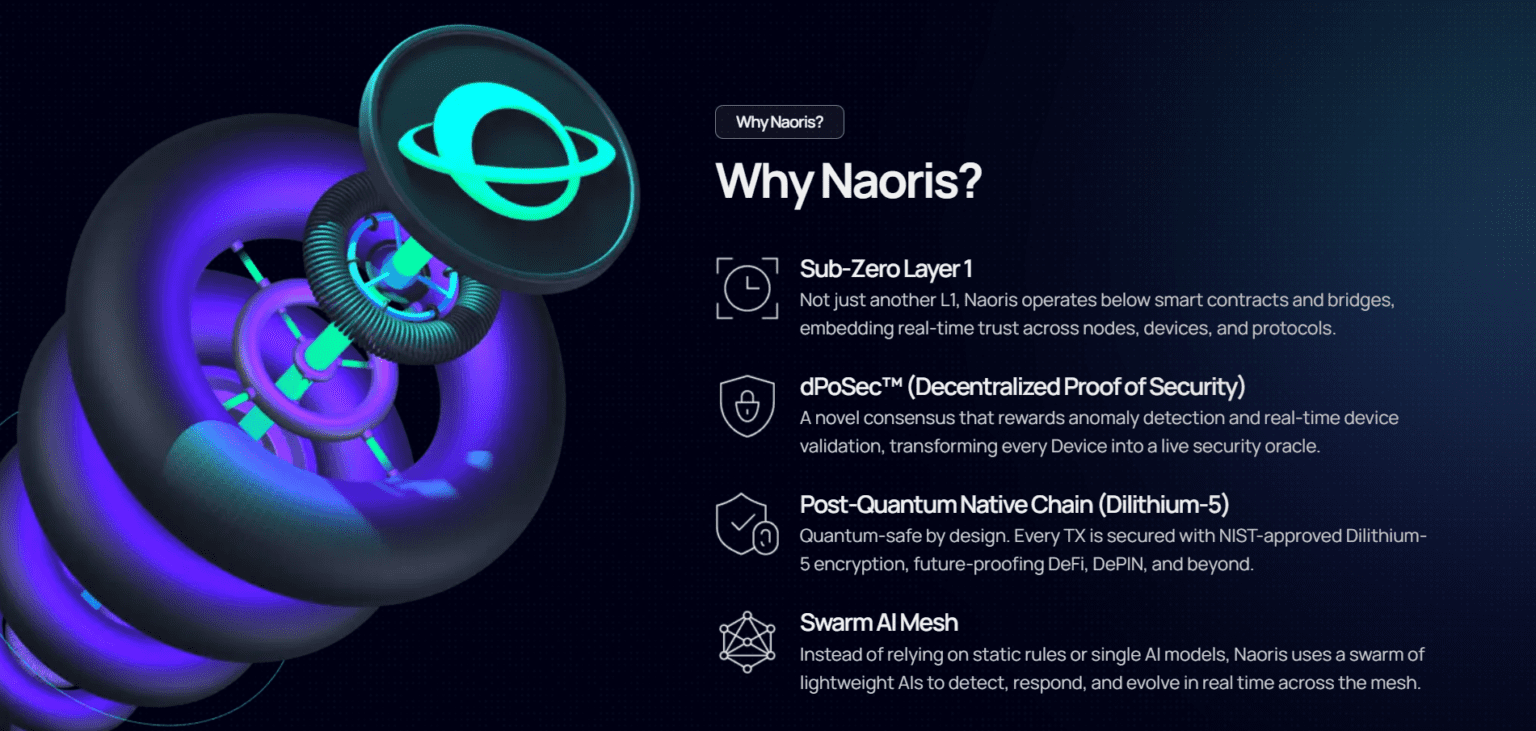
Naoris positions itself as an early mover in this space. Its architecture is designed to expand beyond its own chain, with plans to integrate quantum-safe security into wallets, exchanges, and DeFi systems.
The launch reflects a broader shift in crypto. As the industry matures, focus is expanding from scalability and speed to long-term security and survivability.
Our Crypto Talk is committed to unbiased, transparent, and true reporting to the best of our knowledge. This news article aims to provide accurate information in a timely manner. However, we advise the readers to verify facts independently and consult a professional before making any decisions based on the content since our sources could be wrong too. Check our Terms and conditions for more info.