
Morgan Stanley Spot Bitcoin ETF filed with 0.14% fee, targeting NYSE Arca listing and reshaping Bitcoin ETF competition.

Author: Akshat Thakur
Steady attention without excessive speculation.
March 31, 2026- Morgan Stanley Spot Bitcoin ETF enters the spotlight as the bank files an amended S-1 revealing a 0.14% annual fee, the lowest among existing spot Bitcoin ETFs. The filing outlines plans for the Morgan Stanley Bitcoin Trust (MSBT), positioning the firm to directly compete in an $83 billion market.
High Signal Summary For A Quick Glance

Michael Tan 🥇 | STRATO tokenized Gold
@mikebtan

@BitcoinNewsCom Bullish to say the least, especially during a bear market. Goes to show the amount of institutional demand that they want to capture for their clients https://t.co/M4MIgneGBQ
NEW: Morgan Stanley launch its Bitcoin ETF with a 0.14% fee, the lowest fee rate in the industry. https://t.co/Do4GwvYNbs
04:27 PM·Mar 30, 2026

ECOOPEX
@Ecoopex
@BitcoinNewsCom Institutions making it easier every day.
NEW: Morgan Stanley launch its Bitcoin ETF with a 0.14% fee, the lowest fee rate in the industry. https://t.co/Do4GwvYNbs
03:33 PM·Mar 30, 2026

M̷̷O̷̷O̷̷N̷̷S̷̷H̷̷O̷̷T̷ S̷̷CO̷U̷T̷💸
@Moonshot_scout
@BitcoinNewsCom Lowest fee, biggest push. Morgan Stanley is making Bitcoin ETFs cheaper for everyone. 🟠⚡️
NEW: Morgan Stanley launch its Bitcoin ETF with a 0.14% fee, the lowest fee rate in the industry. https://t.co/Do4GwvYNbs
03:03 PM·Mar 30, 2026
The update was shared following an amended S-1 filing submitted on March 27, confirming the proposed fee structure and operational setup for the fund. The ETF is expected to list on NYSE Arca, with custody handled by Coinbase and administrative services provided by Bank of New York Mellon.
This marks a notable shift, as Morgan Stanley becomes one of the first major U.S. banks to launch its own spot Bitcoin ETF rather than relying on third-party products. Analysts suggest trading could begin as early as April, pending final regulatory approval per Bitcoin News.
Spot Bitcoin ETFs first launched in January 2024 and quickly gained traction, attracting over $83 billion in assets. The space became highly competitive almost immediately, largely because these products offer similar exposure and differ mainly in fees and distribution strength.
BlackRock’s iShares Bitcoin Trust emerged as the dominant player, while Grayscale introduced lower-cost alternatives to stay competitive. Fee compression became the central theme, with issuers gradually lowering costs to attract long-term capital.
Morgan Stanley, managing around $6.2 trillion in assets, previously offered Bitcoin exposure through external ETFs. By launching its own product, the firm shifts from distributor to issuer, allowing it to retain fees internally and control client allocation more directly.
This move also reflects a broader trend where traditional financial institutions are no longer just facilitating crypto access but actively building products within the ecosystem.
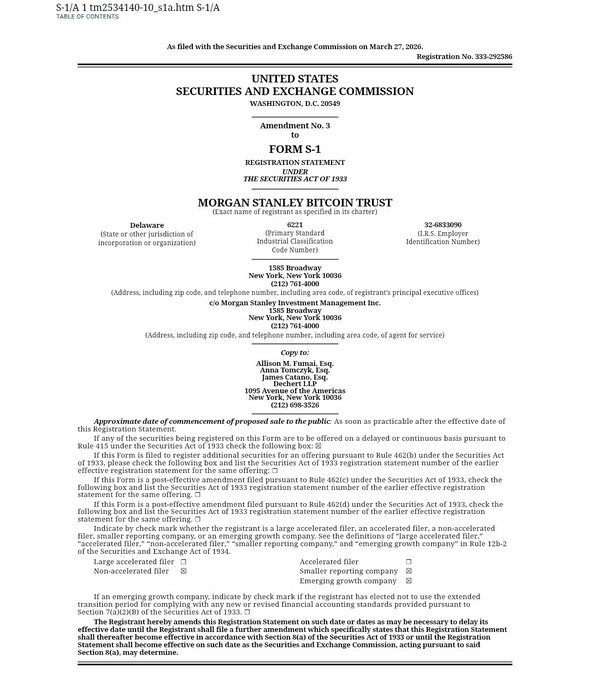
The Morgan Stanley Spot Bitcoin ETF is structured as a standard spot product that holds actual Bitcoin and tracks its price minus a 0.14% annual fee. This fee is deducted daily in Bitcoin and represents the only ongoing cost for investors.
Coinbase will act as the custodian, securing the underlying Bitcoin, while Bank of New York Mellon will handle fund administration. Shares will trade on NYSE Arca, allowing investors to buy and sell exposure through traditional brokerage accounts.
The structure itself is not new, but the pricing is. At 0.14%, the ETF undercuts all major competitors, including Grayscale’s 0.15% and BlackRock’s 0.25%.
Morgan Stanley’s internal distribution network is where the real advantage lies. Its thousands of financial advisors can now recommend an in-house product, potentially driving significant inflows without relying on external issuers.
Despite the aggressive pricing, success is not guaranteed. The Bitcoin ETF market is already crowded, with established players holding strong positions and brand recognition.
Fee competition can also compress margins across the industry, potentially leading to a race to the bottom where profitability becomes a concern for issuers.
There is also the question of actual inflows. While Morgan Stanley has a large advisor network, adoption depends on client demand, regulatory clarity, and broader market conditions. If Bitcoin enters a volatile phase, inflows could slow regardless of pricing advantages.
Additionally, reliance on custodians like Coinbase introduces external dependencies, which remain a key consideration for institutional investors evaluating risk.
The next key milestone is final SEC approval, which would clear the path for trading to begin. Early inflow data will be the most important signal, especially whether Morgan Stanley’s internal network drives immediate adoption.
Competitor response is another factor. Firms like BlackRock and Grayscale may adjust their fee structures to remain competitive, potentially triggering another round of fee reductions across the sector.
Longer term, market share shifts will reveal whether pricing alone is enough to disrupt incumbents or if brand dominance continues to hold. Analysts will also track whether more traditional banks follow this model and launch their own in-house crypto products.
Our Crypto Talk is committed to unbiased, transparent, and true reporting to the best of our knowledge. This news article aims to provide accurate information in a timely manner. However, we advise the readers to verify facts independently and consult a professional before making any decisions based on the content since our sources could be wrong too. Check our Terms and conditions for more info.