MoonPay open-sources Open Wallet Standard for AI agents, aiming to standardize wallets but raising questions around security and control.

Author: Akshat Thakur
Steady attention without excessive speculation.
March 24, 2026- MoonPay Open-Sources Open Wallet Standard to give AI agents a unified way to manage wallets, store keys, and sign transactions across multiple blockchains. The move targets a real gap in the agent economy, but it also introduces new questions around security tradeoffs, standard adoption, and long-term control of wallet infrastructure.
High Signal Summary For A Quick Glance

Kamakura
@KamakuraCrypto

@moonpay i was just researching how to implement proper wallet management lol didn't want to pay for privy but I needed a good auth system right on time ty https://t.co/f26GCqnrmx

https://t.co/goQUMZ414r
04:51 PM·Mar 23, 2026

connoisseur.eth
@ensconnoisseur
@moonpay Huge milestone for the agent economy! Finally a unified standard instead of fragmented key management. By the way, securing ows.eth would be the perfect native identity for the official smart contracts or the foundation’s treasury. If the team is looking into this, my DMs are
https://t.co/goQUMZ414r
04:38 PM·Mar 23, 2026

ticketguy ⧉
@0xticketguy
@moonpay This is 🔥🔥 I think i can build with this
https://t.co/goQUMZ414r
04:02 PM·Mar 23, 2026
MoonPay confirmed the release through its official X account, describing the Open Wallet Standard as a shared wallet layer for AI agents and developer tools.
The standard introduces a single encrypted vault and unified interface designed to work across major blockchain ecosystems. It aims to remove fragmentation in how wallets are created, stored, and accessed by AI systems.
MoonPay has focused on simplifying crypto access through fiat on-ramps and infrastructure. More recently, it has shifted toward the agent economy, where autonomous systems handle payments, API usage, and on-chain actions.
Protocols like x402 and similar payment layers already enable agents to transact. What they lack is a standardized wallet layer.
Most current implementations assume the wallet already exists. In practice, developers still need to build or integrate custom solutions for key storage and signing. (Source: Open Wallet Docs)
That fragmentation slows down development and introduces inconsistent security practices.
MoonPay Open-Sources Open Wallet Standard at a time when AI agents are moving toward real economic activity. As agents shift to local-first environments, reliance on centralized key management systems becomes less practical.
The standard attempts to solve that by keeping keys local while still offering a shared interface across tools. The backing from major organizations adds weight. Founding contributors include PayPal, OKX, Ripple, Solana Foundation, Ethereum Foundation, and others.
This level of alignment could accelerate adoption. However, standardization in crypto rarely happens smoothly. Competing frameworks and ecosystem preferences often slow down universal adoption.
Security remains the biggest concern. Local-first key storage removes reliance on centralized systems, but it also shifts responsibility to developers and users. Poor implementation at the edge could expose private keys.
The design limits exposure by encrypting keys and minimizing in-memory access, but no system is risk-free. There is also ecosystem fragmentation risk. Even with strong backing, multiple wallet standards could emerge. If competing approaches gain traction, the benefit of a unified layer weakens.
Another question is control. Although the standard is open-source, early influence from large players could shape how it evolves. Over time, that could affect neutrality and decision-making.
Finally, adoption is uncertain. The standard only becomes useful if developers actually integrate it. Without widespread usage, it risks becoming another well-designed but underused framework.
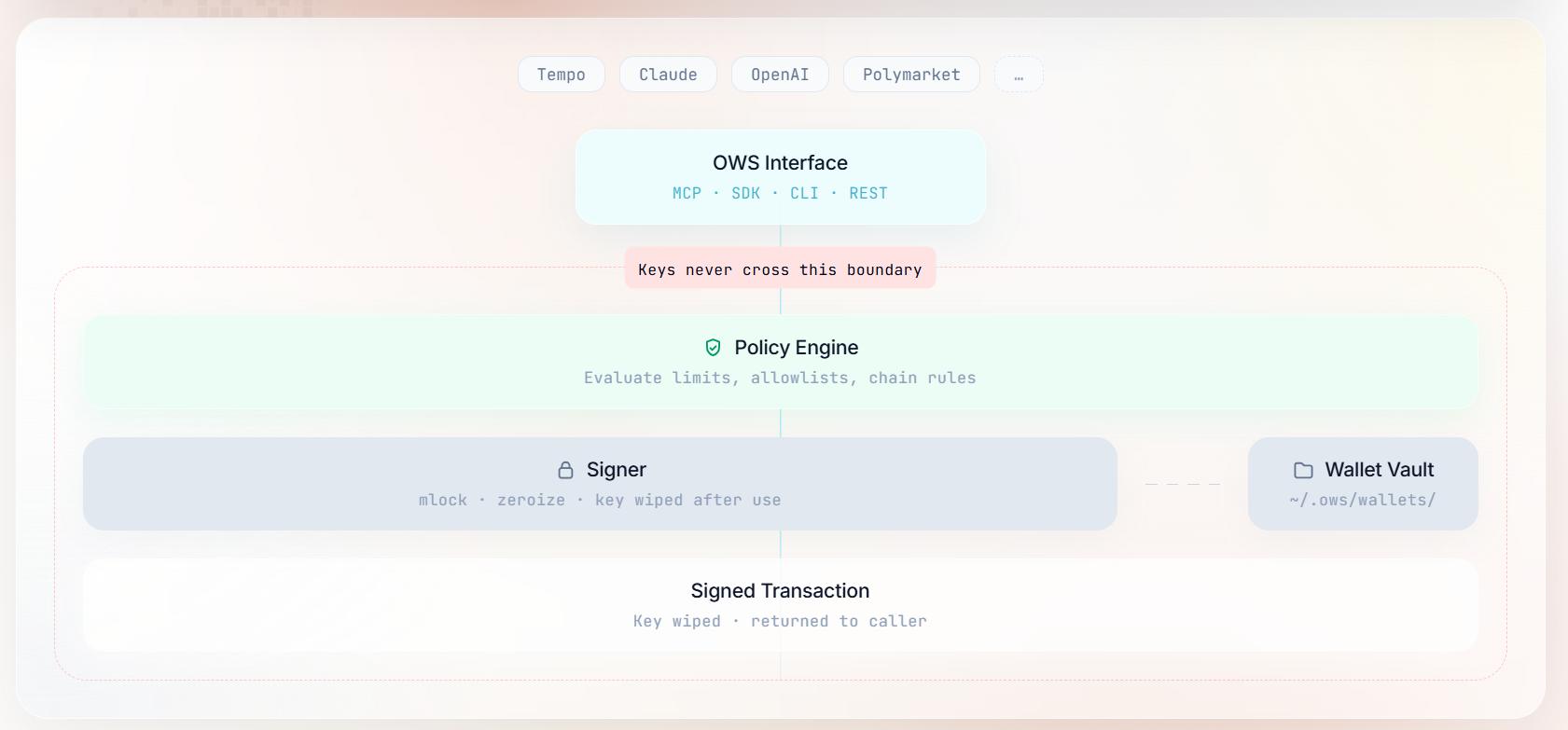
The system centers around a single seed phrase. It uses BIP-39 to derive accounts across multiple chains including EVM networks, Solana, Bitcoin, Tron, TON, and Cosmos. Keys are encrypted using AES-256-GCM and stored in a format similar to Ethereum Keystore v3. (Source: Open Wallet Docs)
When a transaction is signed, the key is decrypted briefly, used in memory, and then cleared immediately. The architecture includes modules for storage, signing, access control, and lifecycle management. Developers interact with the system through simple APIs, avoiding the need to build custom wallet infrastructure.
The standard is live and available for immediate use. Developers can install it through package managers or directly from the repository (Source: GitHub)
Early adoption will likely come from AI agent frameworks and payment protocol builders. Over time, wallet providers and infrastructure teams may integrate it if it proves reliable.
Key signals to watch include: Integration across major SDKs, Real-world agent deployments using the standard and any reported security issues or edge cases.
Our Crypto Talk is committed to unbiased, transparent, and true reporting to the best of our knowledge. This news article aims to provide accurate information in a timely manner. However, we advise the readers to verify facts independently and consult a professional before making any decisions based on the content since our sources could be wrong too. Check our Terms and conditions for more info.