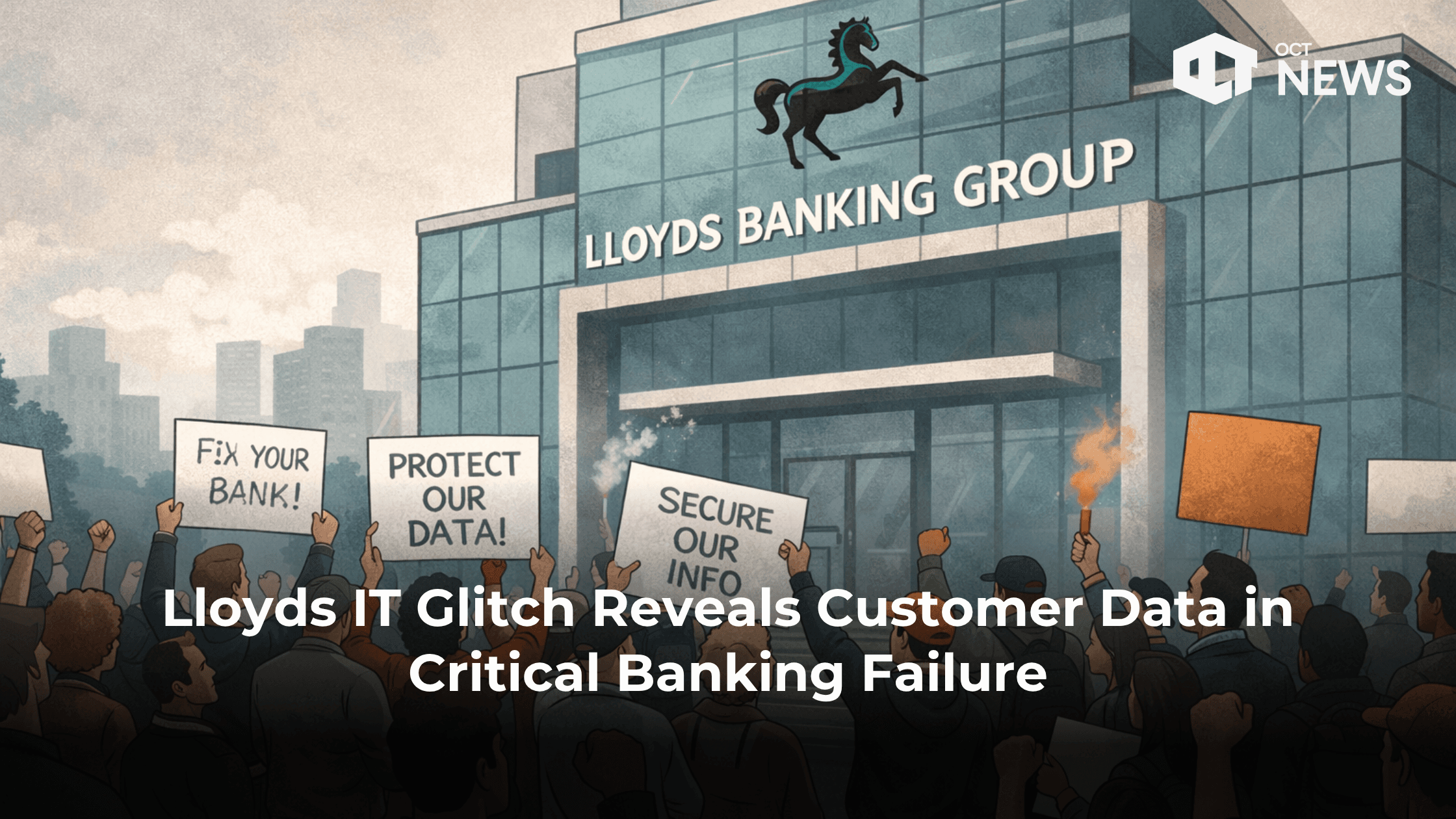
Lloyds IT glitch exposed data of 447,000 customers, raising privacy concerns, regulatory scrutiny, and risks across digital banking systems.

Author: Kritika Gupta
Steady attention without excessive speculation.
30th March 2026- The Lloyds IT glitch revealed a major failure at Lloyds Banking Group on 12 March 2026, exposing the personal and transaction data of up to 447,936 customers across its Lloyds, Halifax, and Bank of Scotland apps. Specifically, a mobile banking error briefly allowed users to view other customers’ payments, account details, national insurance numbers, and payment references. Although no funds were moved and no accounts were directly accessed, 114,182 users clicked into the visible transactions and may have seen sensitive information. As a result, the bank has already paid £139,000 in compensation to 3,625 customers and continues to cooperate with parliamentary scrutiny.
High Signal Summary For A Quick Glance

DustyBC Crypto
@DustyBC

🚨 Lloyds hit by IT glitch exposing transaction data and personal details of ~450,000 customers https://t.co/KNqsXGx7TS

04:32 PM·Mar 29, 2026
Initially, a software defect introduced during an overnight update between 11 and 12 March triggered the issue. Between 03:28 and 08:08, a programming error caused transaction data to display across different accounts when multiple users accessed the app simultaneously. During this period, around 1.67 million of the bank’s 21.5 million mobile users logged in, although the exposure occurred only in brief, fraction-of-a-second windows.
Importantly, Lloyds identified and fixed the issue the same morning. The bank clarified that this was an internal technical failure rather than a cyberattack. However, this type of cross-account data exposure represents a more serious privacy breakdown than previous incidents.
For context, Lloyds experienced several IT outages in early 2025 that disrupted online banking services. However, those events involved downtime and access issues rather than data visibility between users. Therefore, the March 2026 glitch marks a different category of operational risk.
From a market perspective, Lloyds shares remained resilient during the 2025 outages due to strong fundamentals such as higher interest margins. In contrast, news of the March 2026 incident led to a modest share price decline of about 2 percent, reflecting increased sensitivity to data security failures.
Following the incident, the UK Treasury Select Committee requested a detailed explanation. In response, Lloyds submitted a report outlining the root cause and corrective actions. At the same time, the Information Commissioner’s Office received immediate notification and has begun reviewing the case for compliance with data protection laws.
Furthermore, Lloyds issued a public apology, launched an internal investigation, and committed to strengthening software testing procedures. The bank emphasized its focus on customer privacy and confirmed that it is working closely with regulators to prevent similar incidents. However, authorities have not announced any fines yet.
This incident highlights a key contrast between traditional banking systems and blockchain-based systems. In centralized banking, a single software failure can expose sensitive user data across accounts. In contrast, public blockchains separate identity from wallet addresses and rely on cryptographic verification rather than shared account databases.
However, crypto platforms are not immune to risk. While blockchain networks themselves are secure by design, centralized exchanges and custodial wallets can still suffer from data leaks or internal errors similar to this case.
Therefore, this event reinforces several broader implications:
Overall, the Lloyds glitch serves as a reminder that financial system reliability depends not only on security against attackers but also on the integrity of internal software systems.
Our Crypto Talk is committed to unbiased, transparent, and true reporting to the best of our knowledge. This news article aims to provide accurate information in a timely manner. However, we advise the readers to verify facts independently and consult a professional before making any decisions based on the content since our sources could be wrong too. Check our Terms and conditions for more info.