Liquity Protocol Faces Backlash after April Fools post triggered $LQTY price spike and raised concerns over market manipulation

Author: Akshat Thakur
April 2, 2026- Liquity Protocol Faces Backlash after a now-deleted April Fools-style announcement claiming an acquisition by Circle triggered a sharp price spike in $LQTY. The post briefly moved markets before being clarified as a joke, sparking criticism across the community.
High Signal Summary For A Quick Glance

Yashish | Lucidly Labs
@0xYashish

@LiquityProtocol DWF wants to know your location https://t.co/UaO1NxM66d

BREAKING: Circle has acquired Liquity. This acquisition will enable Circle to offer its users a non-freezable stablecoin and directly distribute yield under the Clarity Act. https://t.co/M6BHeYr3RK
02:00 PM·Apr 1, 2026

Calavera
@0xCalavera
@LiquityProtocol they dump on us https://t.co/rgNYUJSkOE
BREAKING: Circle has acquired Liquity. This acquisition will enable Circle to offer its users a non-freezable stablecoin and directly distribute yield under the Clarity Act. https://t.co/M6BHeYr3RK
09:47 AM·Apr 1, 2026

OdailyNews
@OdailyChina
@LiquityProtocol 🫠🫠You really got me https://t.co/K6tWy2qgpQ
一年一度的“保留节目”愚人节❓ 散户: 不看内容,只看关键词 ⚠️目前暂未看到其他任何官方信息表明Circle 已收购 Liquity 4 月 1 日,Liquity @LiquityProtocol 官方在社交媒体上发文表示,稳定币巨头 Circle @circle 已收购 Liquity。并表示「此次收购将使 Circle https://t.co/VUL4WDowWM https://t.co/8vaT1k28oh
06:48 AM·Apr 1, 2026
Steady attention without excessive speculation.
The situation began when Liquity shared a post suggesting Circle had acquired the protocol, framing it as a move to offer a non-freezable stablecoin under evolving regulation. The announcement appeared credible, complete with a polished graphic and references to real policy developments.
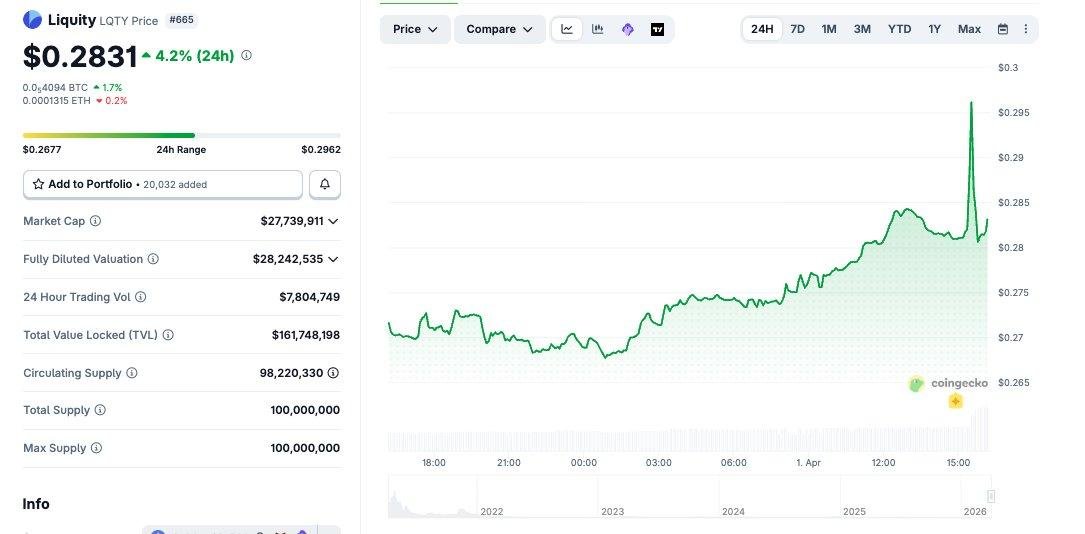
The market reacted quickly. $LQTY rose around 11 percent to roughly $0.295 as the news spread across crypto Twitter.
Hours later, the team clarified the post as an April Fools joke, stating that USDC “pretends to be non-freezable” for one day while Liquity’s BOLD does so year-round. By that point, the initial reaction had already played out in the market.
Liquity operates as a decentralized borrowing protocol on Ethereum, allowing users to mint its stablecoin BOLD by depositing collateral such as staked ETH.
What differentiates the protocol is its design. BOLD is non-custodial and cannot be frozen, making it stand out in a market where many stablecoins are subject to centralized controls.
Over time, Liquity built a reputation for simplicity and resilience, avoiding complex governance structures while maintaining a focus on capital efficiency.
The April Fools post tapped directly into this narrative, tying the fake acquisition to ongoing regulatory discussions like the Clarity Act. That connection made the announcement believable enough to influence trading behavior.
The Liquity Protocol Faces Backlash narrative centers on timing and presentation.
The initial post looked like legitimate breaking news. It referenced a major entity, aligned with current regulatory themes, and was formatted in a way that resembled official announcements.
This triggered rapid speculation and buying pressure, pushing the token price higher within a short window.
The clarification came roughly three hours later, reframing the entire announcement as a joke. By then, traders who acted on the initial information had already entered positions based on a false premise.
There is no evidence suggesting direct profit by the team, but the sequence created a scenario where price movement was influenced by misleading information, even if temporarily.
The backlash highlights how sensitive the market has become to information that can influence price.
Crypto has a long history of April Fools jokes, but the context has changed. With more retail participation and increased regulatory scrutiny, even short-lived misinformation can carry consequences.
In this case, the issue was not just the joke itself but its impact. A double-digit price move tied to a fabricated announcement crosses into territory where users begin questioning intent, regardless of whether it was meant humorously.
For a protocol like Liquity, which has built credibility around trustless design and transparency, this creates a disconnect between product philosophy and communication style.
The Liquity Protocol Faces Backlash situation puts focus on perception rather than fundamentals.
The protocol itself continues to function as designed, and nothing about its core product has changed. However, trust in communication plays a key role in how users and investors engage with a project.
Some community members have already framed the incident as irresponsible, with calls for clearer boundaries around what teams should or should not post when a token is actively trading.
Short term, the main impact will likely be on sentiment. Traders who entered during the spike may face losses, and that often translates into negative feedback that can linger beyond the event itself.
Our Crypto Talk is committed to unbiased, transparent, and true reporting to the best of our knowledge. This news article aims to provide accurate information in a timely manner. However, we advise the readers to verify facts independently and consult a professional before making any decisions based on the content since our sources could be wrong too. Check our Terms and conditions for more info.