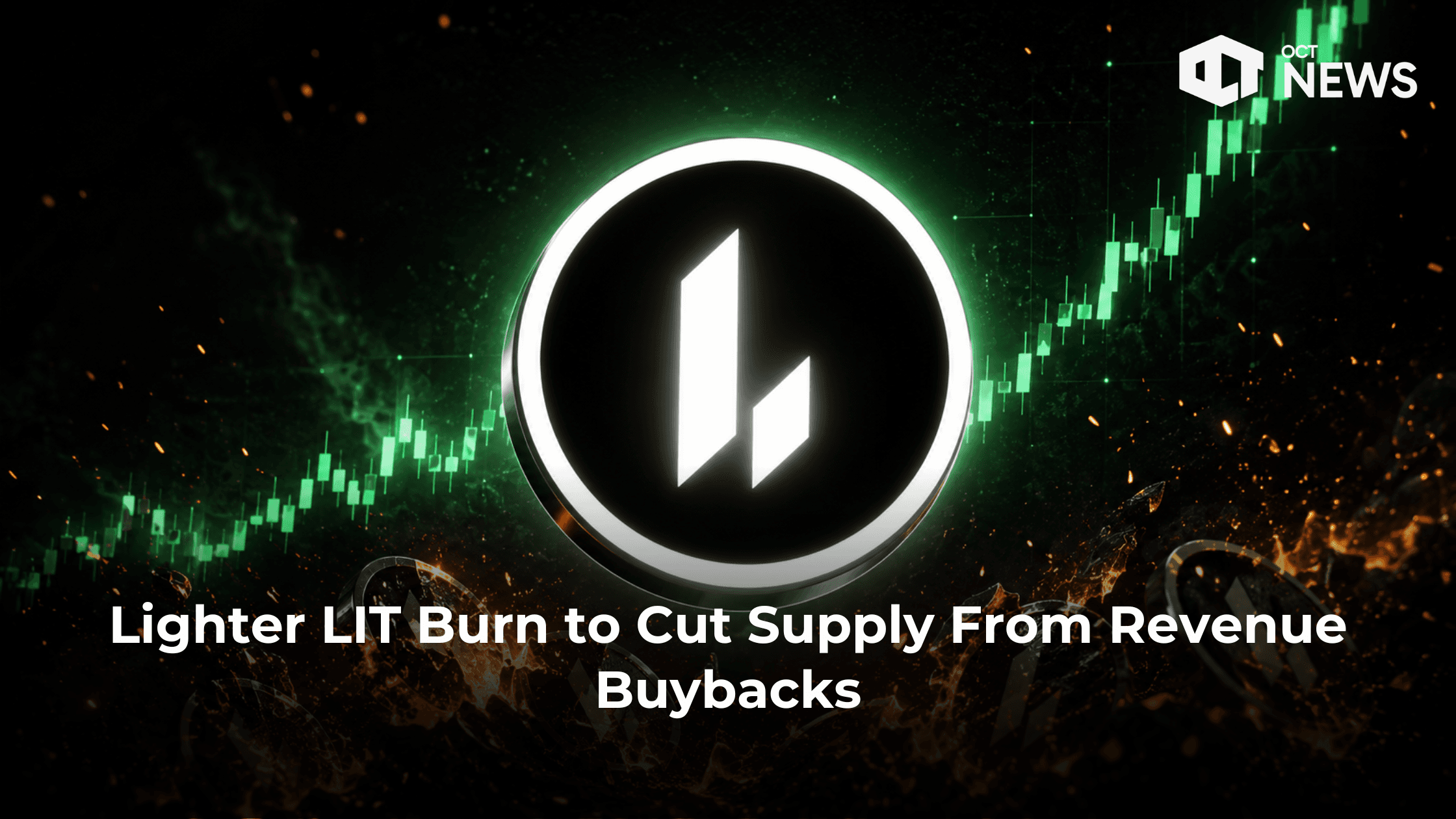
Lighter LIT burn update explains how revenue-backed buybacks, permanent token burns, and staking changes reshape LIT tokenomics.

Author: Kritika Gupta
2nd July 2026 – Lighter will now permanently burn every LIT token it buys back with exchange revenue. The team confirmed the shift on June 30, and the first burn will remove about 15.5 million LIT.
High Signal Summary For A Quick Glance

Prophet: News
@ProphetIntel

@bitget Will the $LIT token decrease by 2% or more by the end of July 3, 2026, based on its closing price on CoinGecko or CoinMarketCap? https://t.co/isHd1YkKDu
$LIT is soaring 📈 Up 13% after the announcement that all future buyback tokens will be permanently burned to reduce the total token supply. https://t.co/Bl7nOV5IHi
09:09 AM·Jul 2, 2026

Global Macro Signals
@GlobalMacroSigs
@bitget $LIT’s 13% jump says the market cares less about the buyback headline and more about the permanent burn turning it into an explicit supply shrink.
$LIT is soaring 📈 Up 13% after the announcement that all future buyback tokens will be permanently burned to reduce the total token supply. https://t.co/Bl7nOV5IHi
08:08 AM·Jul 2, 2026

Rashford4
@Rashford_ola4
@bitget MICHAEL OLISE 🇫🇷 IS THE BLUE WHO HAS COVERED THE MOST DISTANCE SINCE THE START OF THE WORLD CUP! 🏃♂️🥵 He has covered 40.9 km since the start of the competition. 😮💨
$LIT is soaring 📈 Up 13% after the announcement that all future buyback tokens will be permanently burned to reduce the total token supply. https://t.co/Bl7nOV5IHi
07:51 AM·Jul 2, 2026
Steady attention without excessive speculation.
The move turns Lighter’s buyback program deflationary. Previously, the protocol bought back LIT and simply held it. Now, those tokens head to a burn address on Ethereum instead.
According to a June 30 post from the Lighter team on X, the buybacks run automatically. The protocol places hourly limit orders funded by trading fees and revenue. Because the process is programmatic, no one picks each purchase by hand.
So far, Lighter has bought back roughly 15.5 million LIT since its December 2025 launch. That figure equals about 6.3% of the circulating supply, the team said.
The buybacks also stay non-discretionary. In other words, code and revenue drive them, so the team cannot pause or time each purchase for effect.
Until now, those tokens sat in a treasury. Under the new policy, Lighter withdraws them from the exchange and sends them to an Ethereum burn address. As a result, the supply drops for good.
Lighter is a decentralized perpetual futures exchange, or perps DEX. It uses a custom zero-knowledge design that settles trades on Ethereum, so users keep self-custody while trading at high speed.
LIT is the protocol’s token. It covers governance, staking, and value accrual, and it competes for attention with rivals such as Hyperliquid and dYdX.
The exchange reports heavy trading volume and tens of millions in annualized fees. Those fees now fund the buybacks, so the burn program scales with real usage.
The first burn should land a few weeks after the second quarter closes, according to Lighter. After that, burns continue as the protocol keeps repurchasing tokens.
The team also flagged one nuance. In some cases, a burn may use undistributed ecosystem LIT rather than the exact tokens it repurchased. Still, Lighter argues the two approaches are economically equivalent.
Since TGE, the Lighter protocol has programmatically bought back ~15.5 million LIT using exchange revenues, representing ~6.3% of the circulating supply. We are happy to announce that buybacks will be used to permanently reduce the LIT supply through burns.
The old model kept things flexible. Lighter bought back LIT with revenue, but it parked those tokens in a treasury. So the supply never actually fell.
Community members pushed for clarity for months. They wanted to know where the bought-back tokens went, and how the protocol funded staking. This update answers both questions at once.
The timing also fits a broader trend. Right now, the market rewards tokens with real revenue and real yield, rather than heavy emissions. As a result, revenue-funded burns give Lighter a cleaner story to tell.
Key milestones related to the Lighter LIT burn update
Lighter launches LIT and begins using exchange revenue for programmatic token buybacks.
The protocol repurchases around 15.5M LIT, equal to roughly 6.3% of circulating supply.
Lighter confirms that all future revenue-funded LIT buybacks will be permanently burned on Ethereum mainnet.
Bitget highlights the buyback-and-burn shift, pushing the supply-reduction narrative to a wider trading audience.
LIT moves roughly 13% higher as traders price in the revenue-backed burn model.
The key confirmation will be LIT moving from Lighter-controlled wallets to an Ethereum burn address.
Revenue-backed burns tie the token supply directly to how much the exchange earns. Therefore, if trading volume grows, buybacks grow, and the burns grow with them.
For LIT holders, the logic stays simple. Fewer tokens can meet the same demand, so the model adds deflationary pressure over time. Still, that effect depends on sustained revenue.
The first burn of 15.5 million LIT looks modest next to the 1 billion max supply. However, it signals an ongoing commitment rather than a one-time event.
Analysts also note a clear catch. The deflationary pressure only grows if trading volume and fees hold up over the long run. So the burn matters most as a recurring flow, not as a single headline.
Lighter is also moving staking rewards to an ecosystem token allocation. The team set an initial target near 6% APY, which it can adjust later.
This separates staking incentives from the buyback flow. So revenue can fund the burns while a dedicated allocation funds the yield.
LIT climbed after the news. Bitget amplified the update on July 2 and cited a move of about 13%. According to CoinGecko, LIT traded near $2.11 on the day, with 24-hour volume around $150 million. That put the market cap near $525 million.
Not everyone is convinced, though. Some observers question the use of undistributed tokens instead of the exact repurchased LIT. Others raised concerns about future unlocks and short-term hype.
The broader mood still leans positive. Many traders have framed the Lighter LIT burn as proof of real revenue, rather than emissions dressed up as yield.
The next milestone is on-chain proof. Once the first burn executes, anyone can verify it on Etherscan through the LIT contract at 0x232ce3bd40fcd6f80f3d55a522d03f25df784ee2.
Until those transactions appear, the policy remains a commitment rather than a completed action. So readers can track the LIT contract and Lighter’s announcements page for the first confirmed burn.
This article is for information only and is not financial advice. Always do your own research before trading.
Our Crypto Talk is committed to unbiased, transparent, and true reporting to the best of our knowledge. This news article aims to provide accurate information in a timely manner. However, we advise the readers to verify facts independently and consult a professional before making any decisions based on the content since our sources could be wrong too. Check our Terms and conditions for more info.


Walrus Console Goes Live as Managed Layer for AI Data
Solana Goes Live With x402 Batch Payments for AI Agents
WLFI App Ready to Release, Folkman Says at Token2049
ether.fi to Launch USD Stablecoin on $300M Deposits via Ethena
Walrus Console Goes Live as Managed Layer for AI Data
Solana Goes Live With x402 Batch Payments for AI Agents
WLFI App Ready to Release, Folkman Says at Token2049
ether.fi to Launch USD Stablecoin on $300M Deposits via Ethena

Lighter