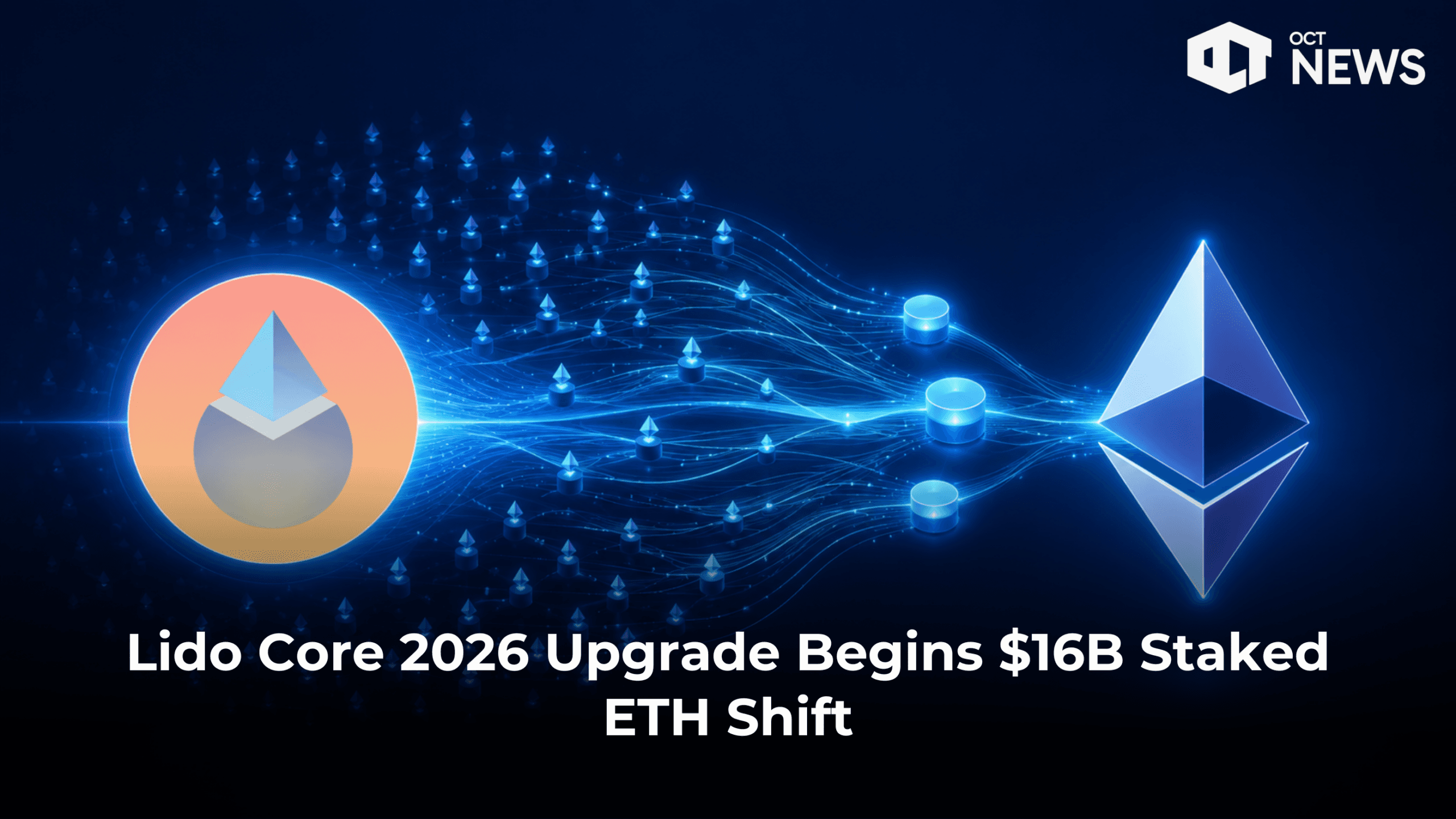
Lido Core 2026 Upgrade migrates 8M+ ETH to 0x02 validators, cutting Ethereum's validator count by a third while adding operator bonds.

Author: Akshat Thakur
Lido has kicked off the biggest change to its staking setup since Lido V2. On Monday, July 27, 2026, the Lido Core 2026 Upgrade went live on Ethereum mainnet. It begins moving more than 8 million ETH, worth roughly $16.5 billion, onto leaner validators. As a result, Ethereum’s total validator count could fall by about a third.
High Signal Summary For A Quick Glance

Nowhere 💜 (Mainnet Arc)
@Nowhere_nad

@LidoFinance And the people still believes crypto will get nowhere, the fact that meaningful upgrades like this says otherwise
Lido Core 2026 Upgrade The biggest evolution of Lido Core brings improvements across the staking modules to keep the protocol aligned with Ethereum’s roadmap and ensure long-term protocol sustainability. No action is required from stakers - the upgrade is protocol-level. ↓ https://t.co/VS5M59QiGh
05:08 PM·Jul 27, 2026

Thales Melo
@ThalesMelo_
@LidoFinance Road to 10$
Lido Core 2026 Upgrade The biggest evolution of Lido Core brings improvements across the staking modules to keep the protocol aligned with Ethereum’s roadmap and ensure long-term protocol sustainability. No action is required from stakers - the upgrade is protocol-level. ↓ https://t.co/VS5M59QiGh
03:05 PM·Jul 27, 2026
High attention and emotional sentiment detected.
The upgrade rolls out three parts. These include Curated Module v2, Community Staking Module v3, and Staking Router v3 support. Together, they let Lido consolidate many small validators into fewer large ones. Stakers need take no action, because the change happens at the protocol level.
The old setup ran on legacy 0x01 validators, each capped at 32 ETH. The new 0x02 credentials lift that cap to 2048 ETH. This became possible after Ethereum’s Pectra upgrade activated EIP-7251 in May 2025. So Lido can now merge many validators into one.
The migration touches more than 265,000 curated validators. Lido will move them onto post-Pectra 0x02 validators over time. According to The Block, the share of Lido’s 0x02 validators should rise from about 32% to about 52%. In short, the validator set gets much leaner.
Under 0x02, rewards compound automatically up to the new cap. The protocol then merges a source validator into a larger target. The source validator exits, and the move is final. A dedicated queue on Ethereum handles each consolidation request.
Governance cleared the path first. Lido DAO approved the upgrade in an on-chain vote held July 15 to 18. Snapshot support arrived back in June, and audits wrapped before launch. So the code shipped only after a full review.
The change reaches beyond Lido. Reports from CoinDesk say the migration could cut Ethereum’s total validator count by roughly a third. That means a drop from about 880,000 to around 628,000, before new deposits. Fewer validators also means fewer messages on the network.
Each validator must attest every epoch, and attestations drive most of that traffic. So a smaller set eases the load. Lido estimates the upgrade could reduce attestation messages by about 29% per epoch once complete. As a result, the network gains breathing room on peer-to-peer and state overhead.
On-chain, Lido’s core contracts handle the process directly. The stETH token and the Staking Router coordinate deposits and exits. Trackers such as beaconcha.in showed Lido near 241,000 active validators just before launch. That number should shrink sharply as consolidations proceed.
The Lido Core 2026 Upgrade also adds real financial accountability. For the first time, all 34 curated node operators must post locked ETH bonds. Lido can slash these bonds for downtime, weak performance, or reward violations. Before now, the curated model rested mainly on reputation.
Isidoros Passadis, Chief of Staking at the Lido Labs Foundation, called it a major shift. He said this is the biggest change to Lido Core staking since Lido V2. Operators now back their stake with their own capital. So the set underpinning Lido Core stays leaner and better secured, in his words.
Will Shannon, Head of Node Operator Mechanisms at the foundation, added context on the bonds. He said the bonds do not replace the reputation model. Instead, they add real economic accountability on top of it. All 34 operators plan to make the switch, and none are exiting.
The migration carries a small cost during the transfer. Lido estimates annual staking rewards could dip by about 0.28%. One estimate points to roughly 738.5 ETH in missed protocol rewards over up to six months. Still, validators keep earning until they exit, so the losses stay limited to brief transfer windows.
Everyday stakers do not need to lift a finger. The protocol handles the consolidation for them. Meanwhile, stETH held its peg near 1:1 around launch, trading close to $1,900. LDO showed no sharp single-day move tied to the news.
Key milestones in Lido’s 0x02 Validator Migration
Ethereum’s Pectra upgrade goes live, activating EIP-7251 (MaxEB) — raising the max effective balance to 2,048 ETH and introducing 0x02 compounding credentials and native consolidations.
Snapshot signaling for LIP-35 / Staking Router v3 passes in late June; on-chain vote (July 15–18) and Dual Governance clear the path with no veto triggered.
Curated Module v2 goes live on mainnet. Lido begins migrating 8M+ ETH to 0x02 validators; first 0x02 deposits start immediately.
Consolidation of 265,000+ curated validators begins in earnest. Operators submit batches via the new pipeline, constrained by Ethereum’s consolidation queue throughput.
All legacy 0x01 validators in the curated module expected to have consolidated, completing the operator migration and sunsetting the old module.
Not everyone cheers a leaner Lido. Critics have long worried about Lido’s large share of staked ETH. Today, Lido holds roughly 62% of liquid staking value, according to DefiLlama. So some question whether fewer, larger validators help or hurt decentralization.
Lido frames the upgrade as a net gain for the network. The team points to bonds, operator classification, and a leaner set as steps forward. Earlier, some builders feared the bonds might push away established operators. Yet all 34 plan to stay, according to Lido.
The rollout runs in phases well into 2027. First 0x02 deposits start this week, and the first consolidations target September 2026. Lido expects the full curated migration to finish around Q1 2027. The consolidation queue sets the pace, so timing could stretch to six months.
For now, the Lido Core 2026 Upgrade marks a clear bet on a leaner, better-secured Ethereum. Watch the consolidation queue and the first September merges for early signs of progress. None of this is financial advice, and readers should always do their own research.
Our Crypto Talk is committed to unbiased, transparent, and true reporting to the best of our knowledge. This news article aims to provide accurate information in a timely manner. However, we advise the readers to verify facts independently and consult a professional before making any decisions based on the content since our sources could be wrong too. Check our Terms and conditions for more info.


Lido DAO