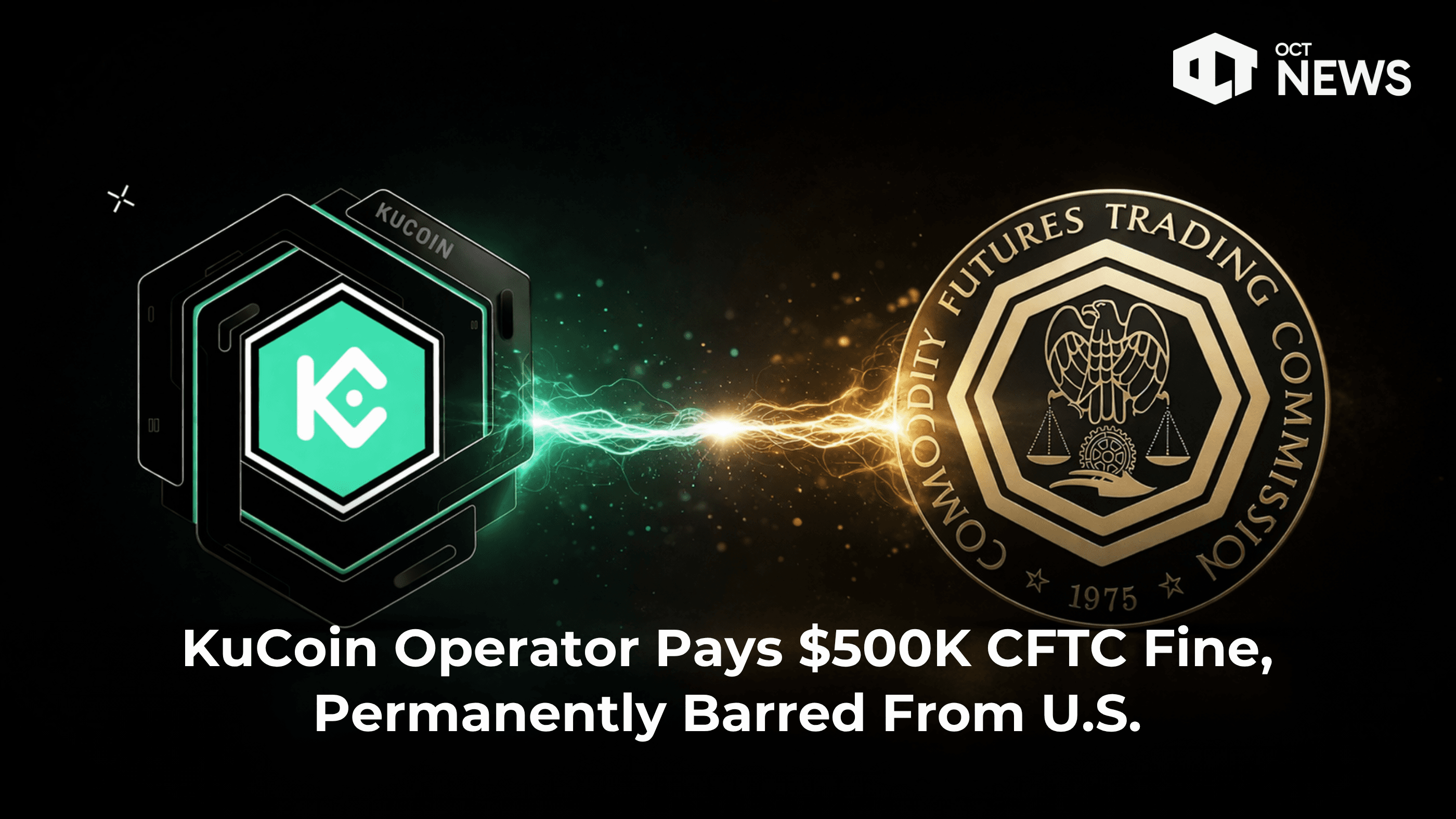
KuCoin's parent company, Peken Global Limited, to pay $500,000 in CFTC penalty for operating an unregistered offshore commodities exchange.

Author: Sahil Thakur
Steady attention without excessive speculation.
1st April 2026 – KuCoin’s parent company, Peken Global Limited, has agreed to pay a $500,000 civil penalty. The charge: operating an unregistered offshore commodities exchange that served American users for years.
High Signal Summary For A Quick Glance

TheCryptoBasic
@thecryptobasic

KuCoin will pay $500,000 to the CFTC to resolve a civil case over providing unregistered trading access to U.S. users. KuCoin is now barred from serving U.S. customers unless it completes proper registration. https://t.co/PbdnWYcaUq

01:32 PM·Mar 31, 2026

Cointelegraph
@Cointelegraph
🇺🇸 LATEST: KuCoin to pay $500K to the CFTC over unregistered exchange claims. The firm is now barred from serving US users unless it registers. https://t.co/xv2odkGQWd
09:40 AM·Mar 31, 2026

🚨BDN NEWS WIRE🚨
@BCDNewsBot
KUCOIN OPERATOR SETTLES CFTC ALLEGATIONS FOR $500,000 WITHOUT ADMITTING OR DENYING; COURT BARS SERVING U.S. USERS WITHOUT REGISTRATION
12:04 AM·Mar 31, 2026
The Commodity Futures Trading Commission announced on Monday that Peken Global entered into a consent order. As a result, the agency’s claims against KuCoin are now fully resolved. The company settled without admitting or denying the allegations.
Because KuCoin cooperated with the investigation, the CFTC did not require the company to return profits. The waiver covers the period from July 2019 to around June 2023. That decision reflected the regulator’s recognition of the firm’s willingness to work with enforcement staff.
The $500,000 civil penalty is relatively modest on its own. Yet it arrives on top of a much larger criminal case from the Department of Justice.
In January 2025, Peken Global pleaded guilty to operating an unlicensed money transmitting business. That case produced a $112.9 million criminal fine and $184.5 million in forfeiture. The combined DOJ penalties totaled roughly $297.4 million.
According to the DOJ, KuCoin served about 1.5 million registered users in the United States. The exchange earned at least $184.5 million in fees from those accounts. Employees openly promoted that the platform had no know-your-customer program. KuCoin only adopted KYC procedures in August 2023.
The CFTC’s $500,000 penalty explicitly accounts for the earlier DOJ punishment. In practice, this KuCoin CFTC settlement brings the total enforcement cost close to $298 million.
Key milestones in the case between KuCoin and the CFTC
The CFTC alleged that KuCoin allowed U.S. users to trade commodity derivatives and leveraged retail commodity products during this period without proper compliance controls.
The CFTC sued KuCoin-related entities in the Southern District of New York, alleging illegal operation of a digital asset derivatives platform and multiple registration and compliance failures.
On the same day, federal prosecutors brought a separate criminal case involving KuCoin-related entities, adding pressure alongside the civil enforcement action.
Peken Global, identified as a KuCoin operating entity, pleaded guilty to operating an unlicensed money transmitting business and agreed to major financial penalties while KuCoin agreed to exit the U.S. market for at least two years.
A federal court entered a consent order against Peken Global, permanently enjoining future violations, restricting U.S. access unless properly registered, and imposing a $500,000 civil monetary penalty.
The court dismissed all claims against the other KuCoin-related entities and dismissed several remaining counts against Peken Global, fully resolving the CFTC matter.
The consent order goes beyond financial penalties. It permanently enjoins Peken Global from future violations of the Commodity Exchange Act.
In plain terms, KuCoin cannot serve American users. The exchange must register as a foreign board of trade or futures commission merchant before resuming any U.S. operations.
The CFTC originally filed its civil complaint in March 2024. The agency alleged that KuCoin solicited orders for commodity futures, swaps, and leveraged transactions. It did so without the registrations required under U.S. law.
The commission also said KuCoin lacked procedures to verify user identities. That failure meant the exchange could not confirm whether its customers were U.S.-based, a key regulatory requirement for offshore platforms.
The DOJ settlement carried consequences beyond fines. KuCoin founders Chun Gan and Ke Tang agreed to step down from all management and operational roles at the exchange.
Both were named in the original DOJ indictment. Their departure was a condition of the guilty plea. The move signaled that U.S. prosecutors wanted structural changes at KuCoin, not just financial penalties.
The DOJ also revealed that KuCoin had facilitated billions of dollars in suspicious transactions. These included proceeds from darknet markets, ransomware schemes, and fraud operations. The exchange’s lack of KYC controls made it an attractive venue for bad actors looking to move funds without oversight.
KuCoin’s compliance troubles span multiple continents. Earlier in March 2026, Dubai’s Virtual Assets Regulatory Authority ordered KuCoin-linked entities to halt all virtual asset activities in the emirate.
VARA said KuCoin operated in Dubai without the necessary approvals. The regulator also accused the exchange of misrepresenting its licensing status to local users. The agency named four entities, including Peken Global and MEK Global Limited, as operating in breach of Dubai law.
In Europe, KuCoin secured a MiCAR license in Austria in November 2025. That license covered crypto services across 29 European Economic Area countries. Yet the Austrian Financial Market Authority later imposed restrictions on KuCoin EU Exchange GmbH. The reason: the company lost key staff responsible for anti-money laundering compliance.
Taken together, these actions show a pattern. KuCoin faces coordinated regulatory pressure across the U.S., Middle East, and Europe simultaneously.
The settlement closes the last major U.S. enforcement action against KuCoin. With both the DOJ and CFTC cases resolved, the exchange has no remaining federal proceedings in the country.
For American crypto users, the outcome is straightforward. KuCoin is off-limits unless the exchange obtains proper U.S. registrations. The company has shown no indication that it plans to seek those approvals.
The case also reinforces a broader trend in crypto enforcement. U.S. regulators are systematically targeting offshore exchanges that served American customers without licenses. Binance settled for $4.3 billion in 2023. KuCoin’s combined penalties now approach $298 million.
Other offshore platforms that operated without U.S. registration face similar risks. The CFTC and DOJ have shown a willingness to pursue multi-year investigations and extract both criminal and civil penalties. Exchanges that ignore U.S. rules can expect enforcement eventually.
KuCoin still operates in markets across Asia and other regions. The exchange’s ability to maintain those operations depends on resolving its open regulatory issues in Dubai and Austria. For now, this KuCoin CFTC settlement closes the U.S. chapter, and the message to offshore platforms serving American users is unmistakable.
Our Crypto Talk is committed to unbiased, transparent, and true reporting to the best of our knowledge. This news article aims to provide accurate information in a timely manner. However, we advise the readers to verify facts independently and consult a professional before making any decisions based on the content since our sources could be wrong too. Check our Terms and conditions for more info.