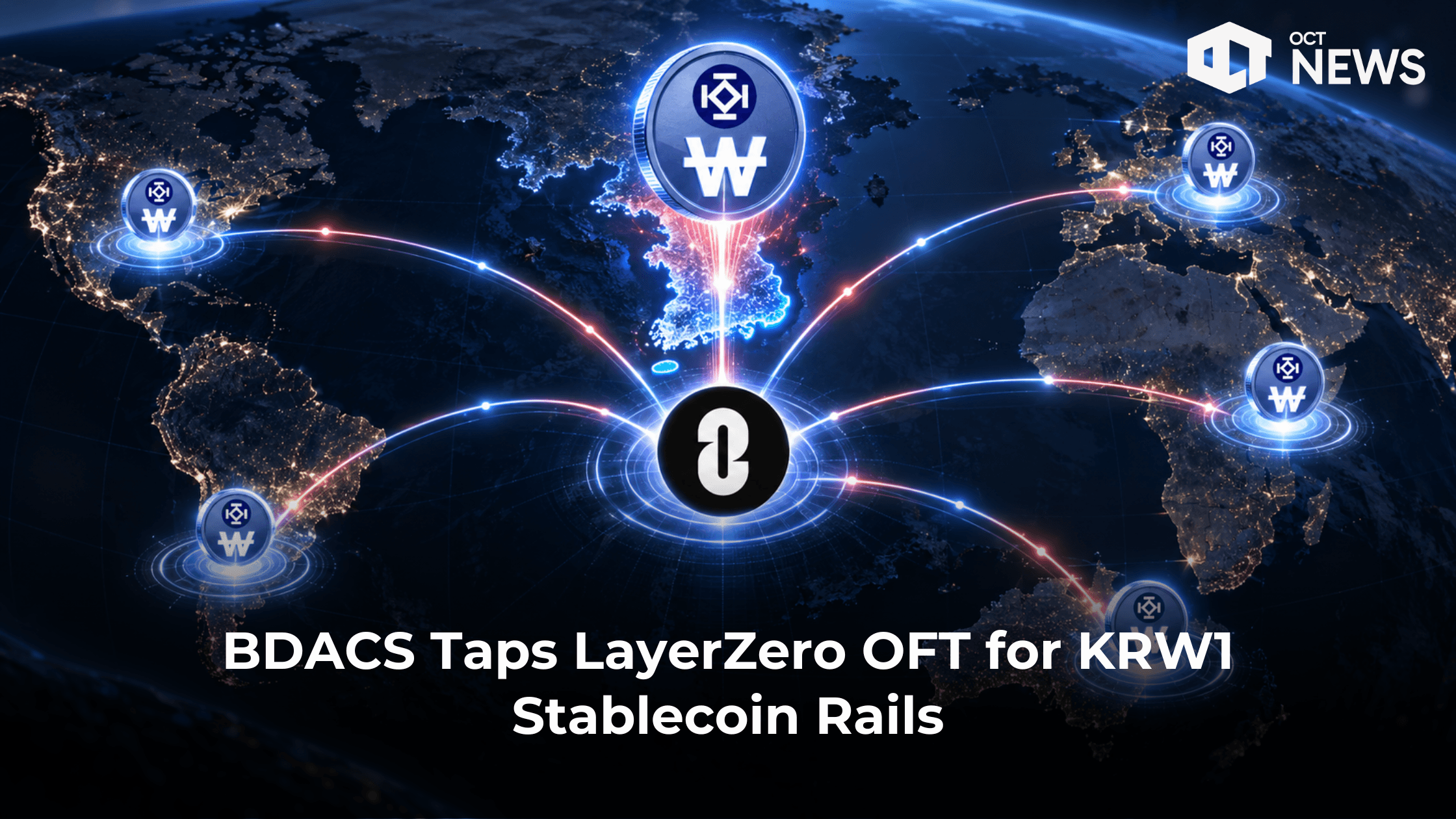
KRW1 stablecoin adopts LayerZero’s OFT standard for native cross-chain transfers as South Korea’s digital asset rules remain unsettled.

Author: Kritika Gupta
8th September 2026 – South Korean custodian BDACS has selected LayerZero’s OFT standard to carry its KRW1 stablecoin across blockchains, the two firms said this week.
High Signal Summary For A Quick Glance

Hypernest
@Hypernestdao

@LayerZero_Core @BDACSKorea the useful design is one KRW1 across chains, not a wrapped copy on each network. compliance stays with the issuer in Korea
@BDACSKorea has selected LayerZero's OFT standard to take KRW1, the first on-shore Korean won-backed stablecoin, cross-chain. KRW1 is now the first Korean won-backed stablecoin natively transferrable across major DeFi ecosystems https://t.co/LM4LDD8axF https://t.co/sSErebmg31
10:12 AM·Sep 8, 2026

Anjli
@AnjliAmin
@LayerZero_Core @BDACSKorea Chain count is the least interesting thing about a won stablecoin. Korea manages won convertibility tightly. A token that moves anywhere is only worth par if someone offshore will redeem it at 3am on a Sunday. That commitment is the product, not the bridge.
@BDACSKorea has selected LayerZero's OFT standard to take KRW1, the first on-shore Korean won-backed stablecoin, cross-chain. KRW1 is now the first Korean won-backed stablecoin natively transferrable across major DeFi ecosystems https://t.co/LM4LDD8axF https://t.co/sSErebmg31
07:40 AM·Sep 8, 2026

Laura Harper 🔸 Crypto
@LauraHarpercoll
@LayerZero_Core @BDACSKorea Omnichain rails are solved Getting KRW1 accepted outside Korean regulatory jurisdiction is the part that doesn't have a LayerZero solution
@BDACSKorea has selected LayerZero's OFT standard to take KRW1, the first on-shore Korean won-backed stablecoin, cross-chain. KRW1 is now the first Korean won-backed stablecoin natively transferrable across major DeFi ecosystems https://t.co/LM4LDD8axF https://t.co/sSErebmg31
06:02 AM·Sep 8, 2026
Steady attention without excessive speculation.
BDACS issues KRW1, a token backed one-to-one by the Korean won. Until now, moving it between chains meant minting wrapped copies. LayerZero’s Omnichain Fungible Token standard replaces that approach with a single, shared supply.
The two companies framed this as a selection, not a finished deployment. According to LayerZero’s blog, KRW1 will now be debited on a source chain and credited on a destination chain. In practice, that means one balance travels instead of many wrapped clones.
The language matters here. BDACS “has selected” OFT, and transfers “will now” settle this way. So far, no OFT adapter address, Stargate route, or deployment transaction has appeared. As a result, treat 8 September as the announcement date, not a verified mainnet go-live.
BDACS CEO Harry Ryoo tied the choice to reach. “The value of a Korean won stablecoin lies in its global scalability,” he said in the announcement. He added that OFT gives KRW1 “a technical foundation to expand beyond Korea into global markets.”
LayerZero’s post calls KRW1 “the first on-shore Korean won-backed stablecoin” to go cross-chain. That “on-shore” qualifier is doing heavy lifting. A rival token already crossed this bridge first.
Back on 30 October 2025, LayerZero itself published that KRWQ, from IQ and Frax, was the first multi-chain Korean won stablecoin on OFT. KRWQ launched on Base and is not offered to South Korean residents. So KRW1 can claim a domestic first, yet not the broader one.
The cleaner reading is narrow. KRW1 is the first on-shore, Korean-custodian-issued, Woori-reserved won token to adopt OFT. It is not the first won-pegged asset on public chains overall.
Key milestones in KRW1’s path toward omnichain adoption
The proposed Digital Asset Basic Act remains under discussion as the Bank of Korea and FSC debate who should be permitted to issue won-backed stablecoins.
BDACS introduces KRW1 on Avalanche with Woori Bank, using a 1:1 Korean won reserve model. The initial product is not available for public circulation.
BDACS announces deployments or trials involving Ethereum, Avalanche, Arc, Polygon, BNB Chain, Plume and Aptos.
The proposed integration would allow one unified KRW1 supply to move between supported chains without relying on wrapped copies.
BDACS must deploy and verify the relevant contracts, publish official addresses and activate KRW1 transfer routes across supported chains.
Updated attestations, reserve composition, redemption terms and operational disclosures will help determine whether KRW1 gains institutional adoption.
KRW1 runs ahead of Korea’s own stablecoin law. The Digital Asset Basic Act, or DABA, still is not enacted. Meanwhile, two regulators disagree on who should even issue these tokens.
The Bank of Korea wants bank-led consortia, with at least 51% bank ownership. The Financial Services Commission prefers broader fintech eligibility. Until that fight settles, no Korean issuer holds a dedicated stablecoin license, BDACS included.
Instead, BDACS operates as a KoFIU-accepted VASP and custodian. RWA.xyz still tags KRW1 as “Non-Regulated.” In other words, on-shore does not yet mean licensed.
How KRW1 compares with other omnichain and Korean won stablecoin efforts
A normal token lives on one chain. To use it elsewhere, you usually lock it in a bridge and mint a wrapped copy. That splits liquidity and stacks extra smart-contract risk, which looks bad for a token that must stay pegged to bank reserves.
OFT works differently. When a user sends KRW1 from chain A to chain B, the contract debits the amount on A and credits it on B. Consequently, one logical supply spans every connected chain. LayerZero names Stargate as the app that executes those transfers.
The same standard already carries Tether’s USDT0, PayPal’s PYUSD, and Paxos’s USDG. LayerZero claims OFT handles 87% of cross-chain transfer volume across 170-plus chains. Still, those are LayerZero’s figures, not independently audited numbers.
For a fiat token, the appeal is control. BDACS keeps mint, redeem, and reserve accounting at home, yet the token can still settle on other chains. However, OFT alone does not create redemption rights abroad or make KRW1 a licensed product.
The scale is small, so context helps. According to RWA.xyz, KRW1 supply sits at 141,804,279 tokens, worth roughly $100,000 at one token per won.
The holder base is tiny too. The tracker shows just 32 holders and about $35,500 in monthly transfer volume. That reads as an institutional sandbox, not a circulating national currency.
The chain split is uneven. RWA.xyz lists Polygon near 70 million tokens, Aptos at 30 million, and Plume at 19.5 million. One row shows Avalanche at zero, which looks like a data inconsistency rather than a real balance.
Several pieces are still missing. BDACS has not published the live OFT contract addresses, so the exact chain cohort is unclear. Journalists should pull any address from krw1.kr directly rather than trust random explorer entries.
The reserve story also has two versions. Marketing points to Korean won at Woori Bank, while the whitepaper allows won and cash-equivalents at multiple banks. Ask which attestation is current before repeating either line.
Calling KRW1 “natively transferrable across major DeFi ecosystems” is a capability claim. Actual DeFi usage, at 32 holders, is close to zero for now. The rails may exist, yet the traffic does not.
The next signals are concrete. Watch for verified OFT adapters on Etherscan, a live Stargate route, and a fresh reserve attestation on the KRW1 transparency page. Each would move this from press release to proven product.
Korea’s July 2026 “Won Internationalization Roadmap” could help, since it proposes offshore won settlement into 2027. Even so, the harder problem is legal acceptance outside Korean jurisdiction, which no messaging protocol can solve. For the KRW1 stablecoin, the passport is printed, but the borders are not open yet.
This article is informational and not financial advice. Always verify contract addresses and reserve data from official sources before acting.
Our Crypto Talk is committed to unbiased, transparent, and true reporting to the best of our knowledge. This news article aims to provide accurate information in a timely manner. However, we advise the readers to verify facts independently and consult a professional before making any decisions based on the content since our sources could be wrong too. Check our Terms and conditions for more info.


LayerZero