
Author: Chirag Sharma
March 29, 2026 The Kaspa transactions growth story just hit a major inflection point. The network has now processed over 1.3 billion transactions, a milestone reached in late March 2026. What stands out is the speed of this growth. Kaspa crossed 1 billion transactions just days earlier, showing an acceleration phase rather than slow accumulation.
High Signal Summary For A Quick Glance

Zelcore
@zelcore_io

@BSCNews @kaspaunchained Not surprised. $KAS is the number one most swapped asset in Zelcore this week!
🚨BIG: KASPA HITS 1.3 BILLION CUMULATIVE TRANSACTIONS @kaspaunchained transactions have surged in recent weeks, recently breaking past the 1.3 billion transaction milestone. The L1's native $KAS coin has a market cap of more than $940 million at time of writing. https://t.co/j22ttk5CoF
06:11 PM·Mar 28, 2026

BitcoinELIFive
@BitcoinELI5
@BSCNews @kaspaunchained A big transaction count tells you the network is busy, not that the asset has durable monetary demand. Activity is easy to scale. Credible long-term use is the harder test.
🚨BIG: KASPA HITS 1.3 BILLION CUMULATIVE TRANSACTIONS @kaspaunchained transactions have surged in recent weeks, recently breaking past the 1.3 billion transaction milestone. The L1's native $KAS coin has a market cap of more than $940 million at time of writing. https://t.co/j22ttk5CoF
04:31 AM·Mar 28, 2026
This surge reflects real usage, not spam or inflated metrics. The network continues to sustain high throughput using its BlockDAG architecture, which allows multiple blocks to be processed in parallel instead of sequentially.
With a production rate of 10 blocks per second, Kaspa avoids the congestion issues seen on traditional blockchains. Its GHOSTDAG consensus ensures that speed does not come at the cost of security.
The recent spike in Kaspa transactions growth is closely tied to ecosystem expansion. The launch of Igra Network, an EVM-compatible Layer-2, on March 19, 2026 introduced smart contracts and DeFi capabilities to Kaspa. This immediately increased activity across the network. Users began interacting with memecoins, token swaps, and early DeFi protocols. Developers started building on a system that combines low fees with near-instant settlement.
Earlier upgrades like the Crescendo hard fork in 2025 had already improved throughput. The addition of Layer-2 functionality created a compounding effect. Now, Kaspa is not just a fast chain. It is becoming a usable ecosystem. This combination of L1 speed and L2 programmability is what drives sustained activity rather than short-lived spikes.
The Kaspa transactions growth trend stands out when compared to broader blockchain performance across the market. Many networks claim high throughput but struggle to maintain performance during real usage spikes.
Kaspa continues to handle large transaction volumes without performance degradation or fee spikes. Recent data shows it surpassing Bitcoin in daily transactions while maintaining decentralization. Its Proof-of-Work model remains secure and energy efficient despite higher throughput levels. BlockDAG architecture allows scaling without compromising network security or decentralization. This challenges traditional assumptions about blockchain design trade-offs.
The network is increasingly viewed as functional infrastructure rather than a speculative asset. This shift reflects growing confidence among users and developers building on Kaspa.
Comparison vs previous Kaspa updates and network growth phases
Comparison vs similar high-throughput competitors like Solana
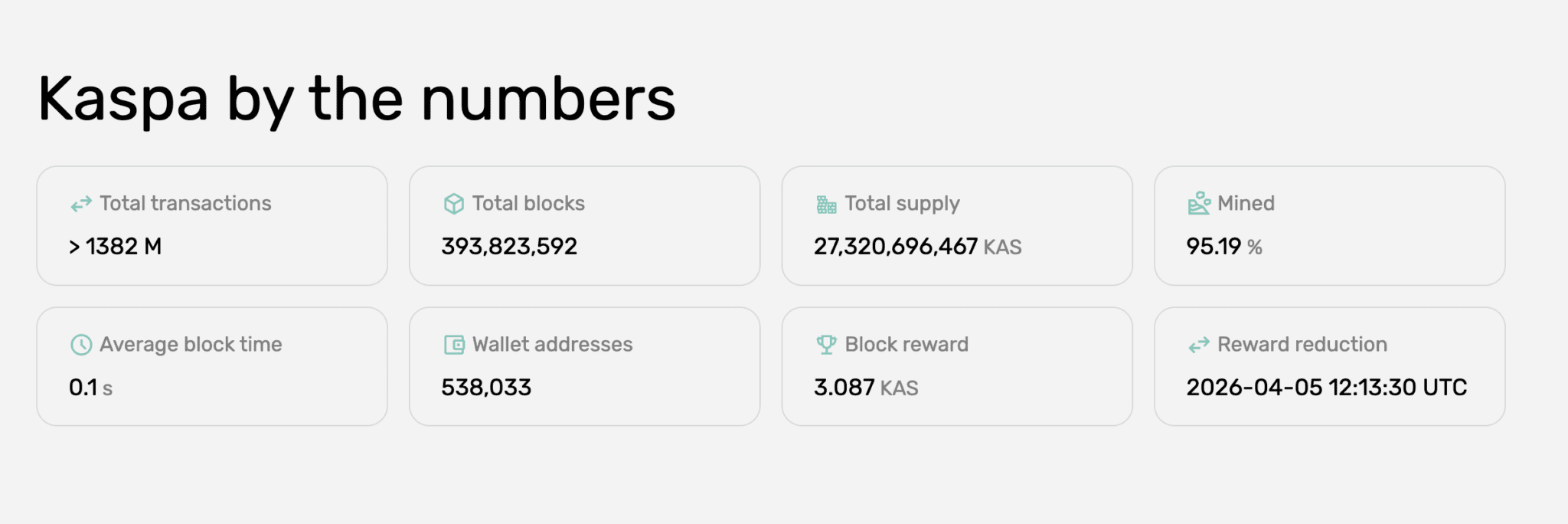
The trajectory of Kaspa transactions growth will depend on upcoming upgrades and ecosystem execution over the coming months. A Covenant-based hard fork is scheduled for May 5, 2026, introducing native assets and advanced programmability. A block reward reduction around April 5, 2026 will impact supply dynamics and miner incentives.
Future developments include DAGKnight consensus upgrades and increased block production rates targeting higher scalability. Planned zero-knowledge bridges will enhance privacy-focused Layer-2 scaling and interoperability. Key risks include execution challenges during upgrades and competition from other high-performance blockchain platforms.
Successful implementation of upgrades could strengthen Kaspa’s position as scalable infrastructure. Any delays or technical issues could temporarily slow momentum and shift market sentiment.
Our Crypto Talk is committed to unbiased, transparent, and true reporting to the best of our knowledge. This news article aims to provide accurate information in a timely manner. However, we advise the readers to verify facts independently and consult a professional before making any decisions based on the content since our sources could be wrong too. Check our Terms and conditions for more info.