Injective SEC transfer registration supports tokenized securities recordkeeping. Explore its role in RWA tokenization and regulatory limits.

Author: Kritika Gupta
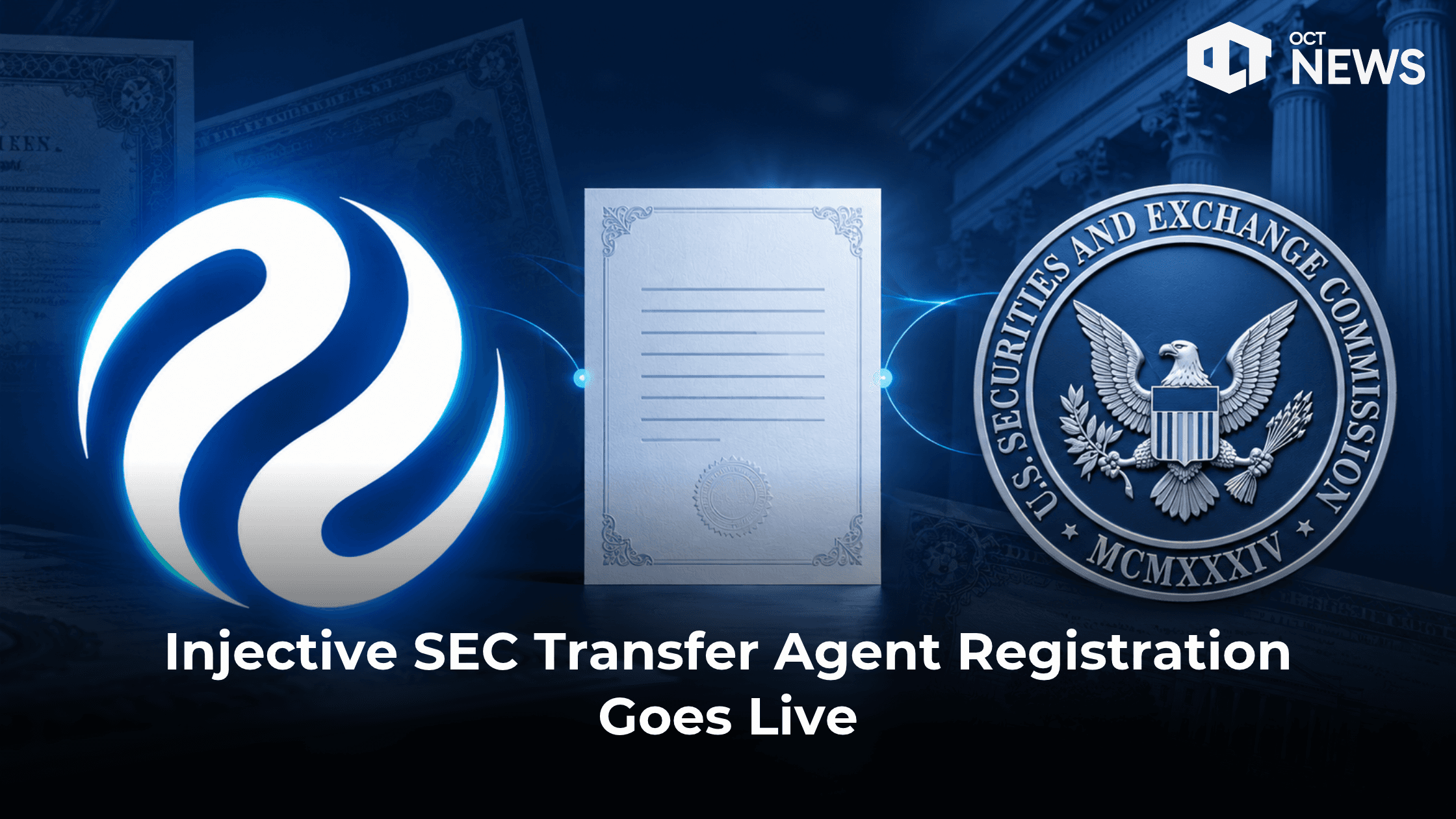
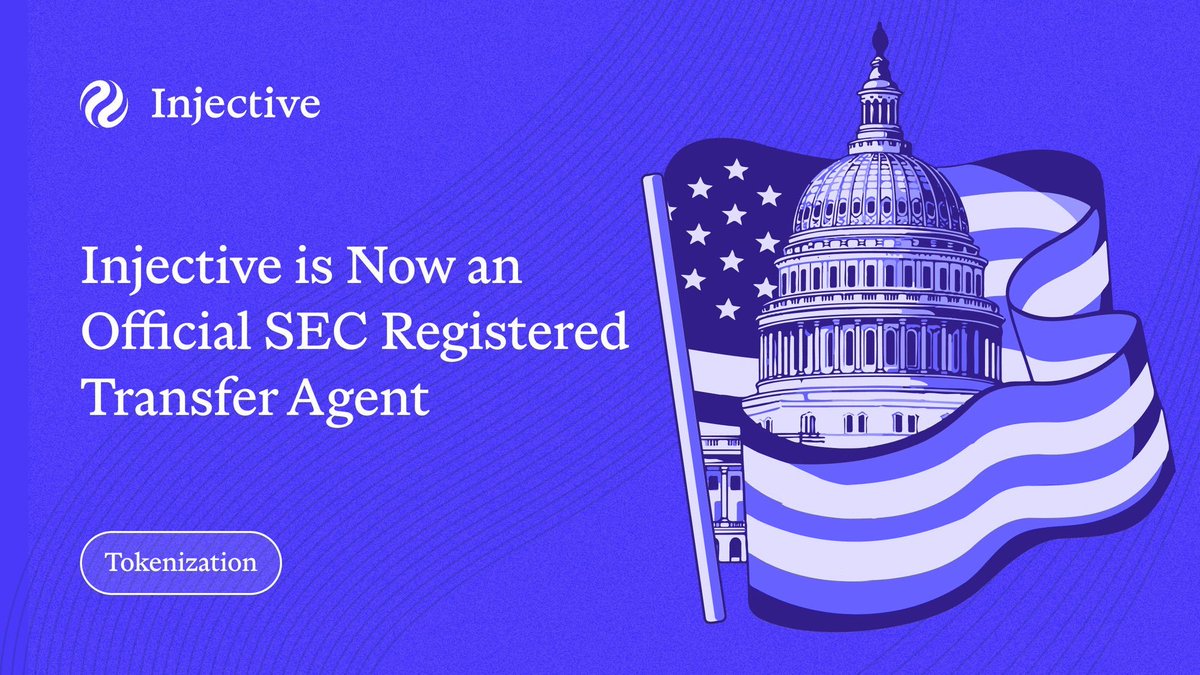
12th October 2026- Injective’s institutional arm is now an SEC-registered transfer agent. The company resurfaced the milestone alongside fresh real-world asset updates. The registrant is Injective Institutional Services, LLC, a wholly owned subsidiary of Injective Labs. It holds SEC file number 084-07096 after filing Form TA-1. CEO Eric Chen signed that form, and Injective declared the registration effective on August 19.
High Signal Summary For A Quick Glance

Lina 🌬
@DeeRealLina

Injective is taking another major step toward bringing traditional finance onchain. Becoming an SEC registered transfer agent adds an important layer to its RWA ambitions, giving @injective a stronger foundation for supporting tokenized assets in regulated markets. And the https://t.co/4DVkxpfO43
06:37 AM·Oct 12, 2026

PECULIAR
@PeculiarXD
Happy New Week, Ninjas! ☀️❤️ Good news! Injective is now officially an SEC-registered transfer agent! This makes Injective the first Layer 1 blockchain with this level of RWA infrastructure and regulatory readiness. From tokenized SpaceX and OpenAI shares to over $1B in https://t.co/kMea14FNJy

06:13 AM·Oct 12, 2026

MOHSIN
@0x_mohsin
Injective Is Building the Future of Tokenized Finance @injective just reached a major milestone by becoming an SEC registered transfer agent strengthening its position in the rapidly growing Real World Asset (RWA) sector But why does this matter? Traditional financial assets https://t.co/tFBCNqogLd

03:42 AM·Oct 12, 2026
High attention and emotional sentiment detected.
A transfer agent is the official recordkeeper for a security. It maintains the master securityholder file, the record of who owns what.
The agent also processes ownership transfers, issuance, and cancellation. In addition, it supports distributions, voting, and other corporate actions.
Importantly, this registration does not turn the Injective blockchain itself into a transfer agent. It also does not register INJ or any token as a security.
Instead, it lets the registered entity use distributed ledger technology as its official master securityholder file. That use still answers to every federal securities rule.
According to Injective, SEC staff guidance allows a transfer agent to keep that record on a blockchain. However, the agent must hold exclusive control and meet all recordkeeping and examination rules.
Traditional tokenization often creates a token that only mirrors an off-chain database. As a result, teams must reconcile the two records constantly.
A registered transfer agent can change that setup. Because the on-chain record can serve as the legal ownership record, settlement moves faster and fewer intermediaries sit in the middle.
Injective ties this to its own tooling. The chain already runs Injective Mint, which supports compliance-controlled issuance with holder limits, jurisdiction rules, freezes, and pauses.
Still, the status is plumbing rather than a shortcut. Each asset must meet full securities law before it rides on that record.
Key milestones in Injective’s RWA and institutional expansion
Injective advances its real-world asset strategy with programmable on-chain assets designed to broaden access to financial markets.
Injective’s ecosystem adds an on-chain treasury-related product associated with SharpLink Gaming, extending its institutional and real-world asset initiatives.
Injective Institutional Services files Form TA-1 with the SEC, initiating the formal transfer-agent registration process.
The registration becomes effective, marking a regulatory milestone for Injective’s ability to support securities recordkeeping and tokenized asset infrastructure.
The next milestone is confirmation of the first securities or tokenized assets serviced by Injective Institutional Services in its registered transfer-agent capacity.
Injective calls itself the first Layer 1 blockchain with an affiliated SEC transfer agent. That framing is the company’s own, not an SEC designation.
Other crypto firms reached this status earlier. Securitize registered years ago, and it already uses public blockchains as the master file for tokenized securities like BlackRock’s BUIDL fund.
Superstate Services registered around March 2025. The L2 project Plume followed in October 2025. So far, though, no earlier pure Layer 1 appears to hold its own registered transfer agent.
The timing also matters. In September 2026, the SEC proposed its first major transfer-agent overhaul since the 1980s, and the draft rules explicitly recognize blockchain records.
Injective vs. L1s and RWA players on regulatory status and tokenized-asset infrastructure
The registration anchors a wider institutional strategy. Injective has launched markets for tokenized equities, treasuries, and pre-IPO perpetuals, with exposure to firms like SpaceX and OpenAI.
Its iAssets framework also brings traditional exposure on-chain. So the transfer-agent status slots neatly into a stack built for capital markets.
On-chain records now include more than $1 billion in residential mortgage data. That volume came through Pineapple Financial, which tokenized about 2,079 records representing roughly $1.1 billion in referenced loan value.
These mortgage entries are on-chain counterparts to existing loan files. They are not new securities that transfer legal ownership.
Meanwhile, the Meridian mainnet upgrade added regulated token standards on Injective’s EVM. The company also added Gulf Labs as an institutional validator. It ran a trade-receivables pilot with POSCO International and LG CNS.
Markets reacted to the original news. INJ rose roughly 8% around the August 19 announcement, climbing from about $4.30. Its market cap sat near $450 million at the time.
By October 12, INJ traded near $7.80 to $8.10, with modest daily gains and higher volumes. Still, the recirculated tweet did not act as a major standalone catalyst.
Outlets covered the August news without much drama. The Block and Cointelegraph both reported the registration as a real but incremental infrastructure step.
The tokenization figures also deserve a reality check. RWA.xyz lists about $1.06 billion in represented value on Injective. DefiLlama, however, shows DeFi TVL near $13 to $14 million.
That gap reflects a real distinction. Represented or referenced value is not the same as capital locked inside DeFi protocols.
Chen has framed the transfer-agent status as a starting point. In an October 5 interview with The Block, he said more US licenses are on the way.
In a separate CNBC-TV18 interview, he called the registration a massive game changer for tokenized funds and private credit. He also linked it to the Meridian upgrade and institutional clearing.
For now, the status is infrastructure, not product approval. As a result, each tokenized asset still needs its own path to compliance.
Critics remain. One reply to the October 12 post dismissed it as a recycled, two-month-old headline. It even called the project scammers. So the reception is not universal.
Investors should treat the milestone as a regulatory building block, not a price signal. This article is not financial advice.
Our Crypto Talk is committed to unbiased, transparent, and true reporting to the best of our knowledge. This news article aims to provide accurate information in a timely manner. However, we advise the readers to verify facts independently and consult a professional before making any decisions based on the content since our sources could be wrong too. Check our Terms and conditions for more info.


Injective