Hyperliquid priority fees go live, introducing order and gossip priority while upgrading vaults and increasing HYPE token utility.

Author: Akshat Thakur
Steady attention without excessive speculation.
14th April 2026 – Hyperliquid rolled out priority fees on mainnet on April 13. Traders can now pay HYPE for faster execution on the network’s perpetual futures engine.
High Signal Summary For A Quick Glance

CallPutDev
@0DTE_Maniac

@Yaugourt Priority fees on Hyperliquid mainnet is a huge step for professional trading. Reducing the max rate from 20 to 8 bps shows they listen to feedback. Bullish for $HYPE ecosystem!
BREAKING: Priority fees are LIVE on Hyperliquid mainnet (alpha mode). Both gossip priority and order priority just went live. Not testnet. Mainnet. Key update from testnet: order priority max rate was reduced from 20 bps to 8 bps based on user feedback. More trader-friendly https://t.co/zhaglrxhAE
04:06 PM·Apr 13, 2026

Sarcastinator.hl
@Not_A_De_Gen
@Yaugourt this is a bigger structural update than it looks... priority fees make hypercore more explicit as a latency-priced execution venue, while the vault change makes it clear hyperliquid wants strategy infrastructure to move out of legacy vault wrappers and into tokenized
BREAKING: Priority fees are LIVE on Hyperliquid mainnet (alpha mode). Both gossip priority and order priority just went live. Not testnet. Mainnet. Key update from testnet: order priority max rate was reduced from 20 bps to 8 bps based on user feedback. More trader-friendly https://t.co/zhaglrxhAE
10:41 AM·Apr 13, 2026

Maven.HL
@MavenHL
@Yaugourt @Sakrexer Just use Hyperliquid 🤝
BREAKING: Priority fees are LIVE on Hyperliquid mainnet (alpha mode). Both gossip priority and order priority just went live. Not testnet. Mainnet. Key update from testnet: order priority max rate was reduced from 20 bps to 8 bps based on user feedback. More trader-friendly https://t.co/zhaglrxhAE
10:15 AM·Apr 13, 2026
Founder Jeff confirmed the launch in the project’s Discord. Builder and ecosystem participant Yaugourt posted screenshots on X the same morning. Both gossip priority and order priority went live in alpha mode, skipping testnet entirely.
The system introduces two separate mechanisms. Gossip priority lets users pay HYPE to accelerate market data propagation across the network’s gossip layer. Nodes that receive higher-priority data process it first.
Order priority is the bigger deal for active traders. Traders pay a percentage of notional value in HYPE to jump the execution queue inside HyperCore.
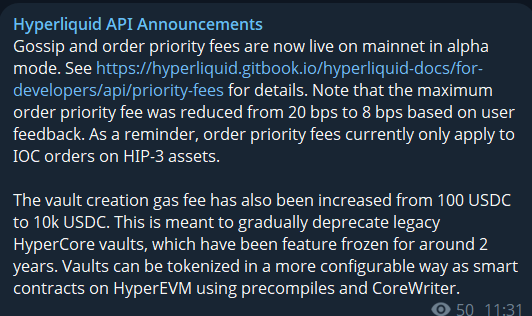
The priority parameter is expressed as p / 100,000,000. A value of 80,000 equals the current 8 basis-point maximum. The team initially tested a 20 basis-point ceiling on testnet but lowered it to 8 basis points after community feedback.
For now, order priority applies only to immediate-or-cancel (IOC) orders on HIP-3 assets. All cancels still receive priority over executable orders. Within the priority tier, higher payments rank ahead of lower ones on a linear scale.
Hyperliquid priority fees are deducted from undelegated staking balances. The protocol converts them at the spot mark price and burns them immediately. Only filled notional counts toward the fee calculation.
This creates deflationary pressure on HYPE that scales with trading activity. It sits alongside the existing 97% fee-redistribution model as a second native utility driver for the token.
The burn mechanic means that periods of high trading demand could translate into measurable supply reduction. That dynamic may attract attention from traders tracking token economics.
Before priority fees, professional traders and market makers on Hyperliquid faced an infrastructure arms race. Securing the best fills required ultra-low-latency connections and custom networking setups.
The new system prices that urgency directly in HYPE. Instead of racing for connectivity advantages, market makers can bid for execution priority while focusing on strategy. The 8 basis-point cap keeps costs predictable and trader-friendly rather than extractive.
This design reduces the incentive to spam the network with redundant orders. It also levels the playing field for participants who lack the resources to build custom low-latency infrastructure.
Alongside Hyperliquid priority fees, the team overhauled its vault system. The gas cost to create a new vault on HyperCore jumped from 100 USDC to 10,000 USDC, a 100x increase.
The team also signaled the gradual deprecation of legacy HyperCore vaults. New feature development on them is frozen for two years. Builders are directed toward tokenized vaults deployed as smart contracts on HyperEVM.
Legacy vaults, introduced in 2023, let users pool capital for automated strategies. They worked but were limited to basic configurations. They excluded HIP-3 and spot trading entirely.
New HyperEVM vaults use precompiles and CoreWriter to enable trustless read/write access to HyperCore state. Builders can implement ERC-4626-style accounting, authorize agents, and execute spot or HIP-3 trades on-chain.
The result is fully composable, tokenized positions. On-chain accounting, agent delegation, cross-protocol liquidity, and third-party integrations become possible for the first time on Hyperliquid.
The shift moves strategy infrastructure from a proprietary layer to a public, auditable EVM environment. It integrates natively with the exchange’s liquidity while remaining open to external developers.
The alpha label means the team is monitoring usage and may adjust parameters before declaring the feature production-ready. This approach is consistent with Hyperliquid’s track record of mainnet-first updates.
Hyperliquid operates as a purpose-built layer-1 for perpetual futures trading. It runs on HyperBFT consensus and delivers sub-millisecond execution through HyperCore. In February 2025, the network added HyperEVM, an Ethereum-compatible execution environment that shares state and liquidity with HyperCore.
HIP-3 assets represent the next layer of permissionless markets. Any entity staking 500,000 HYPE can deploy its own perpetual futures contracts directly on HyperCore. Priority fees now add an economic layer on top of that infrastructure.
HIP-3 markets are expected to see the first meaningful order-priority activity. The community is already discussing how the 8 basis-point cap affects maker economics compared to traditional venue latency advantages.
On the vault front, the two-year freeze gives builders a clear runway. They can migrate or rebuild on HyperEVM. Early adopters may port existing strategies first, then layer on new capabilities like on-chain rebalancing agents or tokenized yield products.
The higher vault-creation cost and tokenized model could concentrate activity on more sophisticated, auditable products. If the Hyperliquid priority fees burn meaningfully increases HYPE demand, it tightens the economic loop around the native token. The chain that built its reputation on speed is now pricing that speed explicitly.
This is not financial advice. Do your own research before making investment decisions.
Our Crypto Talk is committed to unbiased, transparent, and true reporting to the best of our knowledge. This news article aims to provide accurate information in a timely manner. However, we advise the readers to verify facts independently and consult a professional before making any decisions based on the content since our sources could be wrong too. Check our Terms and conditions for more info.


Hyperliquid