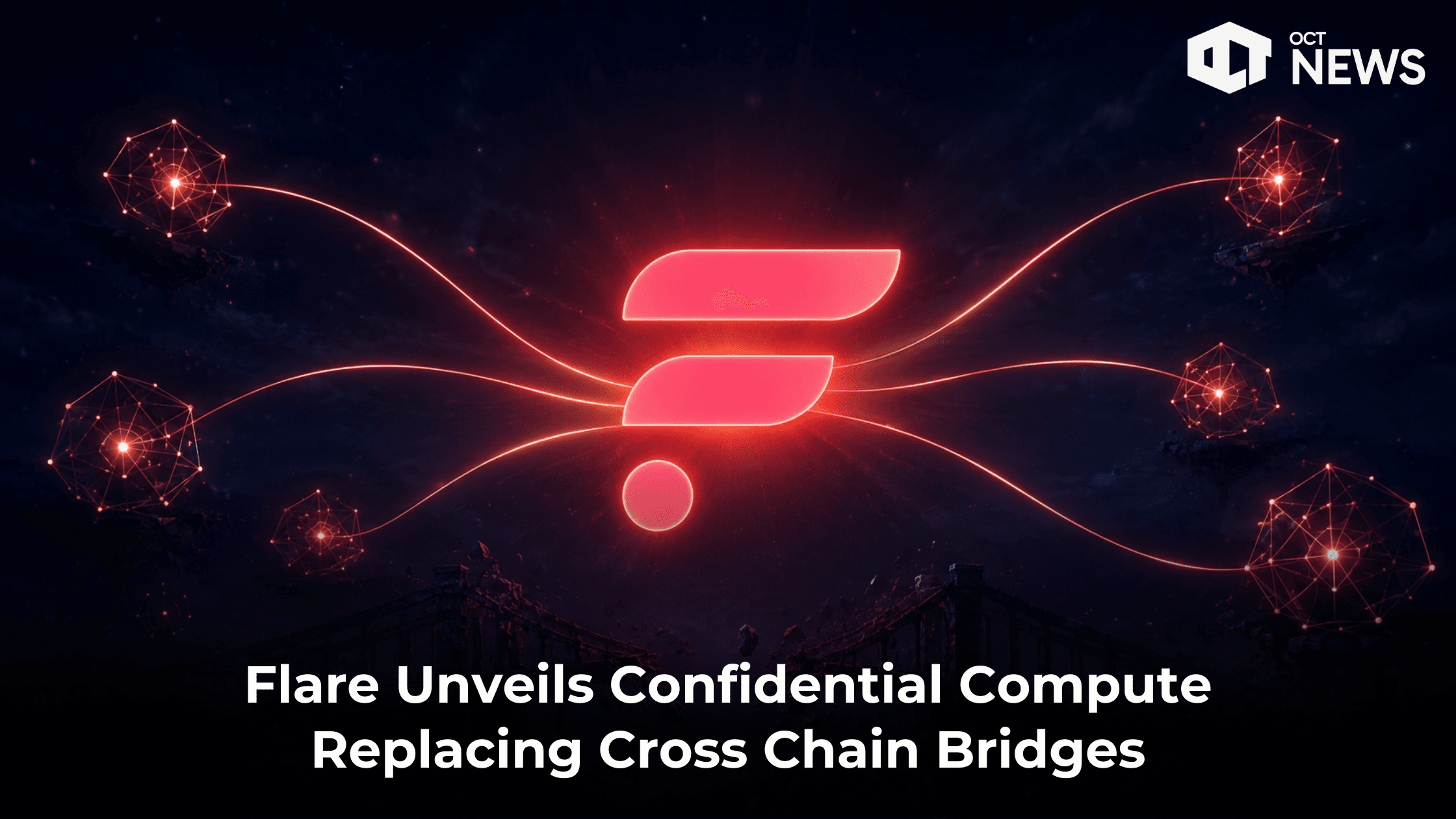
Flare Confidential Compute brings TEE-secured Protocol Managed Wallets to Songbird, aiming to enable cross-chain execution without bridges.

Author: Kritika Gupta
6th July 2026- Flare has pushed one of its most important infrastructure upgrades toward Songbird. The upgrade is called Flare Confidential Compute, and it introduces a new execution layer built around Trusted Execution Environments, or TEEs.
The bigger story is not just private computation. Flare wants to let protocols execute actions directly on external chains through Protocol Managed Wallets, starting with XRPL. That makes this a major step in Flare’s push beyond traditional bridges.
However, the system is not live on Flare mainnet yet. Governance proposal STP.13 opens on Songbird from July 6 to July 13, 2026. So, this remains a canary-network rollout, not a finished mainnet launch.
High Signal Summary For A Quick Glance

Weaver Labs
@Weaver_Labs

@FlareNetworks Interesting development. The infrastructure between ecosystems is becoming much more capable.
Flare Confidential Compute introduces a new layer for verifiable confidential computation. This enables secure cross-chain execution through Protocol Managed Wallets. Rather than relying on bridges, protocols can directly control and execute actions on other chains, secured by
06:13 AM·Jul 6, 2026

Vision33X ♘
@Vision33X
@FlareNetworks bridges have bought more hacker yachts than anything in crypto. cutting them out is the move
Flare Confidential Compute introduces a new layer for verifiable confidential computation. This enables secure cross-chain execution through Protocol Managed Wallets. Rather than relying on bridges, protocols can directly control and execute actions on other chains, secured by
01:35 AM·Jul 6, 2026
Steady attention without excessive speculation.
Flare Confidential Compute, or FCC, gives Flare a layer for verifiable confidential computation. It uses TEEs to run sensitive logic privately while still allowing the network to verify that the correct code executed.
This matters because cross-chain execution often needs privacy and verification at the same time. Private keys, signing logic, and execution rules must stay protected. At the same time, users need proof that the system followed the intended process.
Flare connects this confidential compute layer with its existing data stack, including FTSO and FDC. FTSO supports decentralized data feeds, while FDC verifies external chain events and data. Together, they give Flare a base for cross-chain coordination.
Protocol Managed Wallets, or PMWs, are the core feature inside FCC. A PMW is a wallet address on an external blockchain whose private keys are generated and held inside TEEs.
In the first version, Flare plans to start with XRPL. The PMW only executes transactions after it receives a valid weighted-majority signature from Flare data providers or validators.
In simple terms, Flare uses its own consensus to control a wallet on another chain. That wallet can then execute destination-chain actions without forcing users through a traditional bridge vault.
Traditional bridges usually ask users to lock assets in one place and receive a wrapped version somewhere else. This model creates large pools of locked value, which have historically attracted major exploits.
Flare takes a different route with PMWs. Instead of moving assets through a bridge first, the protocol can execute the required action directly on the destination chain.
That does not remove all trust from the system. However, it shifts the trust model away from bridge contracts, custodians, and wrapped-asset issuers. Flare replaces that model with Flare consensus plus TEE-based key protection.
Traditional Bridge vs. Flare Protocol Managed Wallet
The execution flow starts when a user or protocol sends an instruction on Flare. Then, Flare data providers relay that instruction through the network.
Next, a TEE-based quorum checks whether the instruction meets the required weighted-majority threshold. If it does, the PMW signs and executes the transaction on the external chain, such as XRPL.
After execution, FDC V2 can verify the external-chain result back to Flare. This creates a full loop from user intent to destination-chain action and then back to verification.
XRPL is the first planned external chain for Protocol Managed Wallets. This choice fits Flare’s long-standing connection with the XRP ecosystem and its focus on expanding utility for chains beyond standard EVM activity.
If the Songbird rollout works, XRPL could gain a new path into DeFi execution through Flare-controlled infrastructure. Protocols could trigger XRPL-side actions without relying on a normal bridge flow.
Still, Flare has not confirmed the full chain expansion roadmap. XRPL acts as the first test case, not the final scope of the system.
The next key step is the STP.13 governance vote on Songbird. The vote runs from July 6 to July 13, 2026.
Songbird serves as Flare’s canary network. That means Flare can test major upgrades in a live economic environment before considering mainnet deployment.
The bootstrap phase uses Google Confidential Compute, hosted by the Flare Foundation. Over time, Flare plans to diversify across multiple TEE vendors and operators. That step will matter because TEEs carry hardware and vendor trust assumptions.
Flare Confidential Compute is not mainly an MPC or zero-knowledge system. It is TEE-centric.
That means it relies on hardware-protected environments to keep keys and logic confidential. The system then uses attestation to prove that the right code ran inside the protected environment.
This design can make private signing and external-chain execution more practical. However, it also introduces risks around hardware trust, vendor dependence, side-channel attacks, and long-term operator decentralization.
The bull case is straightforward. Crypto needs safer cross-chain execution, and traditional bridges remain one of the weakest parts of the industry.
If Flare proves that PMWs work securely, it can position itself as more than a data-focused EVM chain. It can become an execution layer for cross-chain applications.
That could strengthen Flare’s role in XRPL DeFi, external-chain automation, confidential compute, and protocol-controlled wallet infrastructure. It also fits the broader Flare 2.0 vision that the team outlined in March 2025.
The main risk is that FCC has not reached full production yet. There is no confirmed Flare mainnet launch date, and Songbird deployment still depends on governance approval.
Flare also needs to show real performance data. Users and developers will want clarity on signing speed, throughput, latency, scalability, and reliability under actual network demand.
TEE trust is another major question. Google Confidential Compute supports the bootstrap phase, but long-term credibility depends on multi-vendor support and wider operator decentralization.
Finally, audits matter. Interim review may support the Songbird phase, but the market will want deeper security validation before treating PMWs as production-grade cross-chain infrastructure.
The market reaction looks modest so far. FLR has recently traded around the $0.007 range, while Flare TVL has stayed near the $123 million level based on recent data.
That muted reaction makes sense. FCC is still fresh, and the system has not launched on mainnet. Crypto markets often wait for working deployments before pricing infrastructure upgrades seriously.
However, the narrative could strengthen if Songbird deployment succeeds and XRPL execution shows real usage.
The first thing to watch is the STP.13 vote. If the vote passes, Flare can move FCC into a live Songbird environment.
After that, developers should track how PMWs perform with XRPL. The most important questions involve signing reliability, execution speed, FDC V2 verification, and security under real usage.
Then, the market should watch for audits, integrations, and chain expansion beyond XRPL. A working XRPL implementation would validate the first use case. Broader support would expand the narrative.
Our Crypto Talk is committed to unbiased, transparent, and true reporting to the best of our knowledge. This news article aims to provide accurate information in a timely manner. However, we advise the readers to verify facts independently and consult a professional before making any decisions based on the content since our sources could be wrong too. Check our Terms and conditions for more info.