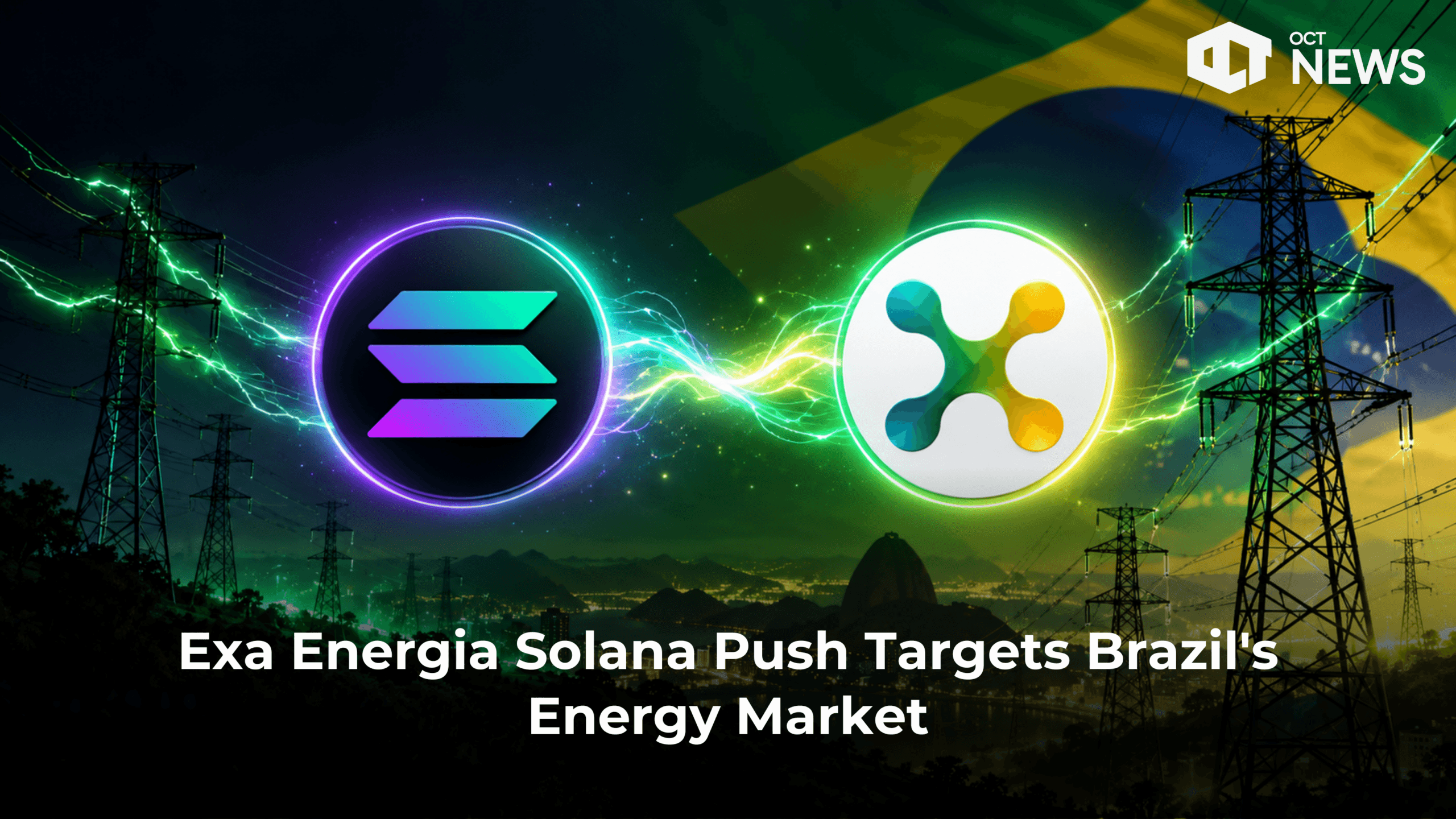
Exa Energia Solana aims to tokenize Brazil’s clean-energy supply, but its on-chain footprint remains unverified. Here’s what we know.

Author: Akshay
24th September 2026 – Solana’s official account put a small Brazilian energy startup in front of millions this week. On 24 September, @solana quote-posted a founder video for Exa Energia and said the company is “tokenizing supply” on Solana. The post drew about 24,000 views within hours.
High Signal Summary For A Quick Glance

Ubik Capital
@ubikcapital

@solana Bridging Brazil’s energy market with Solana shows how RWA tokenization can solve real-world liquidity and access issues. It's a significant milestone for the ecosystem that Ubik Capital has supported since testnet. ⚡
Brazil's $200B energy market produces more clean power than it can sell, yet businesses still overpay. Exa is tokenizing supply on Solana so generators and buyers can finally meet in one market. https://t.co/qqTBr7C4YH
06:04 AM·Sep 24, 2026

Kuka
@kukasolana
@solana Great founders with an amazing product!
Brazil's $200B energy market produces more clean power than it can sell, yet businesses still overpay. Exa is tokenizing supply on Solana so generators and buyers can finally meet in one market. https://t.co/qqTBr7C4YH
05:56 AM·Sep 24, 2026
High attention and emotional sentiment detected.
Exa Energia is a clean-energy marketplace that says it connects power generators with buyers, starting in Brazil. The Exa Energia Solana story spread fast across crypto X. Yet the loud framing and the on-chain reality do not fully line up.
The Solana post made a big claim. It said Brazil’s “$200B energy market produces more clean power than it can sell, yet businesses still overpay.” It then framed Exa as the fix that lets “generators and buyers finally meet in one market.”
That $200 billion figure comes from marketing copy, not a footnoted source. Independent estimates differ sharply. MarkWide Research pegs Brazil’s power market near $98.7 billion in 2026, roughly half the number Solana used.
The video itself came from Alliance, the crypto accelerator that backed the founders. Alliance posted it two days earlier with an apply-to-our-program call to action. So Solana was amplifying an accelerator’s promotional asset, not breaking independent news.
Here is the first thing a skeptic notices. Three sources describe Exa three different ways.
Solana says Exa is “tokenizing supply” on-chain. Alliance calls it a “distribution layer” that aggregates solar supply for resellers, and it never uses the word tokenize. Exa’s own website markets a simple WhatsApp-first energy bill, with no mention of Solana or tokens at all.
The company’s older posts add a fourth layer. In November 2025, Exa said generators would “receive EXA tokens upon production, digital, traceable, and instantly sellable.” The homepage, by contrast, sells a consumer product: one invoice, a discount plan, and PIX or card payment.
The startup also self-reports more than 5,000 users and over 10 partner generators. Those numbers are unverified and come straight from the homepage. So far, no third party has confirmed them.
The underlying pain point is genuine. Brazil really does generate more clean power than its grid can absorb. Carbon-free sources made up roughly 90% of the power mix in 2025, led by a boom in rooftop solar.
Small solar producers feed surplus power back to the grid. In return, they get distributed-generation credits under Brazil’s Lei 14.300. These credits are not cash. They expire after 60 months, and they are locked to a specific concession area and owner.
That trapped, illiquid credit is exactly what Exa says it wants to digitize. In theory, an on-chain claim could make those credits easier to match with buyers. In practice, tradable energy credits collide with concession rules and possibly securities law.
A separate but related problem adds urgency. Grid bottlenecks force operators to curtail large wind and solar plants. According to the Financial Times, curtailment losses topped 6 billion reais, about $1.1 billion, since 2024. That waste is why “Brazil can’t sell its clean power” resonates, even though it is a different issue from GD credits.
For a project pitched as Solana tokenization, the on-chain trail is empty. There is no published Solana program, no EXA token mint, and no Solscan activity tied to Exa Energia.
The project also does not appear on DefiLlama’s Solana real-world-asset dashboard. That page tracks names like Ondo, Maple, and Securitize. Solana’s RWA active value sits near $2.44 billion, up about 9.6% over the past 30 days, and Exa is nowhere on the list.
Until a mint or program address goes public, “tokenizing on Solana” stays a product claim rather than a verifiable fact. An editor cannot point to a single on-chain settlement today. That gap is the main reason to treat the Exa Energia Solana narrative with caution.
Exa vs. Live Energy & Commodity RWAs on Solana
The team behind Exa is real and locally rooted. Superteam Brasil lists two co-founders, Diogo and Luiz Scarlassari. It describes Diogo as a software engineer with a prior exit, and Luiz as an economist with private-equity experience.
Their momentum is a talent-pipeline story. Exa won first place at a Superteam BR and PineStake ideathon in September 2025, taking a modest $1,200 prize. Alliance then featured the founders this month.
Alliance advertises checks of roughly $400,000 to $500,000 for admitted startups. There is no public confirmation that Exa has closed that funding. As a result, the “backed by Alliance” label means selected for a program, not a signed round.
The next signals are concrete. Watch for a published token mint, a Solana program address, or a DefiLlama listing with real value locked. Any of those would move Exa from pitch to proof.
Also watch the regulators. A freely tradable energy token would need clarity from ANEEL on retail licensing and possibly from Brazil’s securities regulator. So far, no official body has commented on Exa.
For context, SOL traded near $114 on 24 September, with a market cap around $67 billion, and the tweet did not visibly move the price. Exa Energia targets a real gap in Brazil’s energy market, and Solana’s spotlight gives it a stage. Whether the on-chain product matches the marketing is the test that still lies ahead.
This article is analysis, not financial advice. Always do your own research before acting on any crypto project.
Our Crypto Talk is committed to unbiased, transparent, and true reporting to the best of our knowledge. This news article aims to provide accurate information in a timely manner. However, we advise the readers to verify facts independently and consult a professional before making any decisions based on the content since our sources could be wrong too. Check our Terms and conditions for more info.