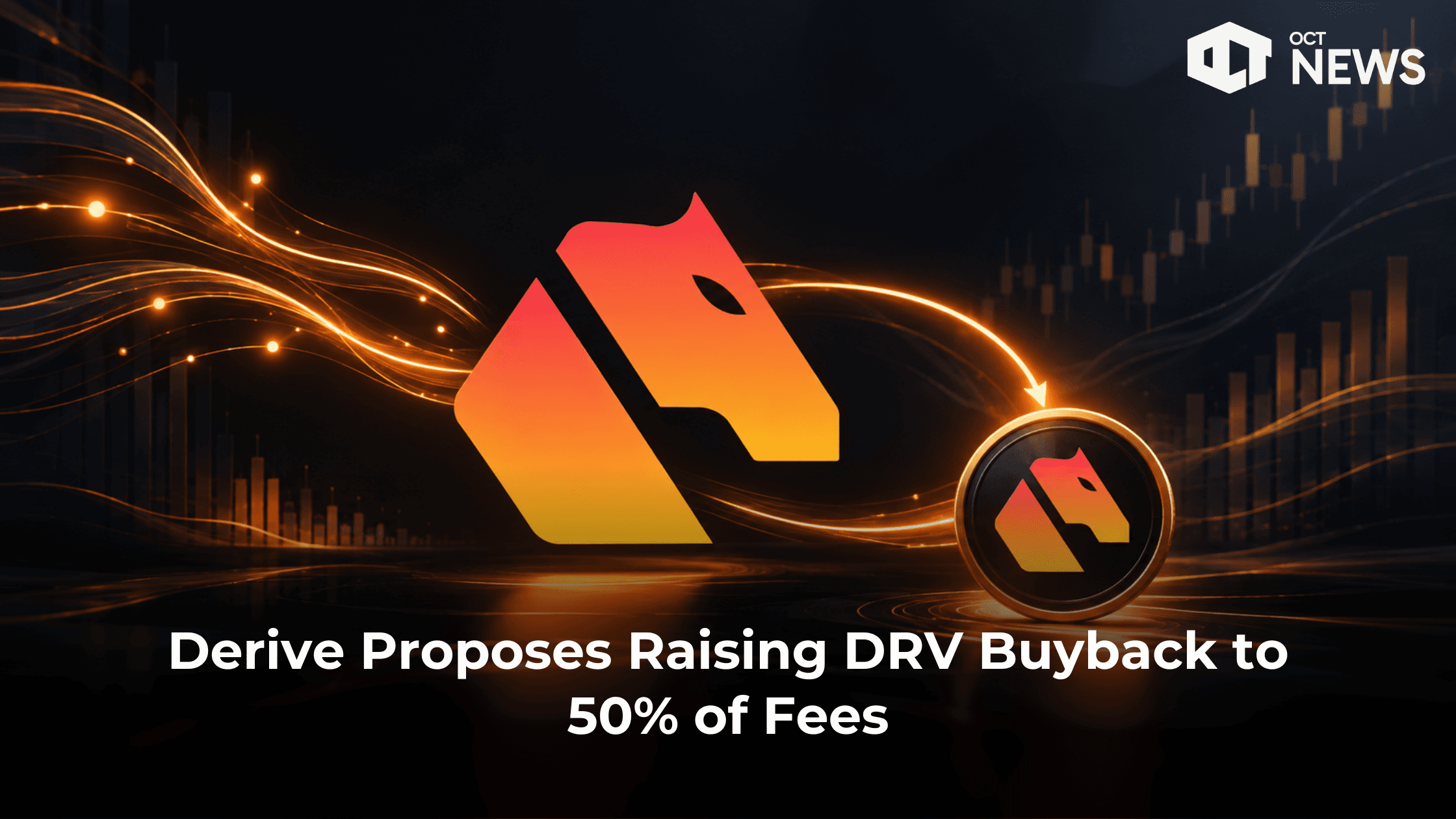
Derive’s DRV buyback proposal would raise the share of protocol fees used for buybacks from 35% to 50%. The proposal awaits a DAO vote.

Author: Kritika Gupta
24th September 2026 – Derive governance has a new proposal to raise the DRV buyback from 35% to 50% of applicable protocol fees, and the official account confirmed it hours ago.
High Signal Summary For A Quick Glance

tempest
@tempst0

DIP to move buybacks up to 50%, yea moon dat https://t.co/ibKGQ8o2vU
A new governance proposal to increase the allocation of protocol revenue to DRV buybacks to 50% is live on the Derive forum. Community members can review the proposed increase and share their views. Read the proposal and join the discussion: https://t.co/DGpUeuNkVp
03:09 PM·Sep 24, 2026

LT
@0xRugova
base:0x9d0e8f5b25384c7310cb8c6ae32c8fbeb645d083 is about to allocate 50% of its revenue towards buybacks, a needed step for the long-term run. https://t.co/GChPjjUXLV
A new governance proposal to increase the allocation of protocol revenue to DRV buybacks to 50% is live on the Derive forum. Community members can review the proposed increase and share their views. Read the proposal and join the discussion: https://t.co/DGpUeuNkVp
02:40 PM·Sep 24, 2026
High attention and emotional sentiment detected.
The protocol account @DeriveXYZ announced the DIP at 14:17 UTC on 24 September 2026. For now, it is a forum post, not a passed vote. Still, it extends a fee-linked story that has been building since the V3 plan.
The proposal changes one number. It lifts the share of applicable protocol fees spent on weekly buybacks from 35% to 50%.
Everything else stays put, according to the DIP text. The cadence, the execution process, and the eligible fee sources remain unchanged. Only the allocation moves.
Today’s 35% figure was set by an April 2026 DIP. That proposal also cut staking emissions to 100,000 DRV per week. It trimmed the unstake period to seven days too. Derive confirmed it passed on 23 April 2026.
There is one wrinkle. The proposal’s own forum text is slightly inconsistent on the remainder. A background table sends leftover fees to the insurance fund. The motivation section says remaining revenue also funds market-maker rebates.
A revenue-funded buyback is not a dividend. Instead, the venue takes a fixed percentage of trading, liquidation, and spread fees. It then converts that slice into open-market bids for DRV.
Historically, those bids run on the protocol’s own DRV-USDC spot market, TWAP-style. Because the buying is tied to usage, it creates a recurring spot bid that scales with fee income.
Raising the DRV buyback to 50% is a parameter change, not a new machine. The same fee pool feeds the program. About 43% more of it would hit the bid, since 50 divided by 35 is roughly 1.43.
The DIP frames the hike as a bigger base for a planned shift. Derive wants to move away from inflationary staking emissions. Instead, it would pay staking rewards from bought-back tokens.
The latest official print still ran at 35%. Weekly Buyback #85 bought 137,000 DRV at about $0.41 on 22 September 2026, per Derive’s post. Cumulative buybacks reached 27,782,461 DRV.
According to DefiLlama, the protocol booked $495,560 in revenue over 30 days. Apply 35% and that implies roughly $173,000 for buybacks. Apply 50% and it implies about $248,000. That is an incremental bid near $74,000 a month.
Those figures are illustrative, not official. The DIP does not fully define “applicable protocol fees.” So the real base could differ from DefiLlama’s revenue line.
Scale matters here. The DIP table lists 150,000 DRV in weekly emissions, or roughly 650,000 a month. Even 50% of current revenue may not retire more tokens than the protocol emits, unless fees climb or price falls.
Derive DRV buyback proposal snapshot
*Estimates use trailing 30-day protocol revenue as a proxy for applicable fees. The proposal has not confirmed this fee base, so the buyback amounts are illustrative.
The proposal pre-loads its own bear case. A higher percentage sends less fee flow to the insurance fund and to market-maker rebates.
A bigger share is also not automatically more dollars. If volume drops, the buyback shrinks with it. The base is real fees, not a fixed budget.
Two claims need care. The DIP does not say whether purchased DRV is burned, held in treasury, or saved for staking rewards. So “supply reduction” could be overstated if tokens simply sit in a wallet.
The vote path is also thin on detail. There is no Snapshot or Tally page yet. The DIP names no quorum, no voting window, and no passage threshold. It would take effect “upon implementation following passage.”
Watch two data traps as well. The official token page still calls buybacks “monthly,” while the weekly posts and DIPs treat them as weekly. Price and supply also diverge by source.
DRV has run hot, but not because of this DIP. The token is up roughly 90% over seven days on CoinGecko. That move predates the proposal and tracks the V3 narrative and a volume record near 19 September.
Spot data disagrees by source, so treat both with a footnote. CoinGecko lists DRV near $0.4531, a $452.9m market cap, and 999.66m in circulating supply. CoinMarketCap lists $0.4481, a $330.5m cap, and 737.52m circulating.
That supply gap is material, so no single figure should stand alone. The proposal is also too fresh to credit for the rally. This is analysis, not financial advice, and readers should do their own research.
For now, the next step is forum discussion, then the DAO’s existing governance process. A Snapshot or Tally vote would need to appear before anyone can call this live.
Traders should watch three things. First, whether a formal vote opens with a real quorum. Second, whether the next weekly print lands at 35% or 50%. Third, whether Derive clarifies the fate of the tokens it buys.
Until then, the DRV buyback stays at 35% in practice. The 50% figure is a proposal with momentum, not a settled parameter. The details will decide how much it actually matters.
Our Crypto Talk is committed to unbiased, transparent, and true reporting to the best of our knowledge. This news article aims to provide accurate information in a timely manner. However, we advise the readers to verify facts independently and consult a professional before making any decisions based on the content since our sources could be wrong too. Check our Terms and conditions for more info.