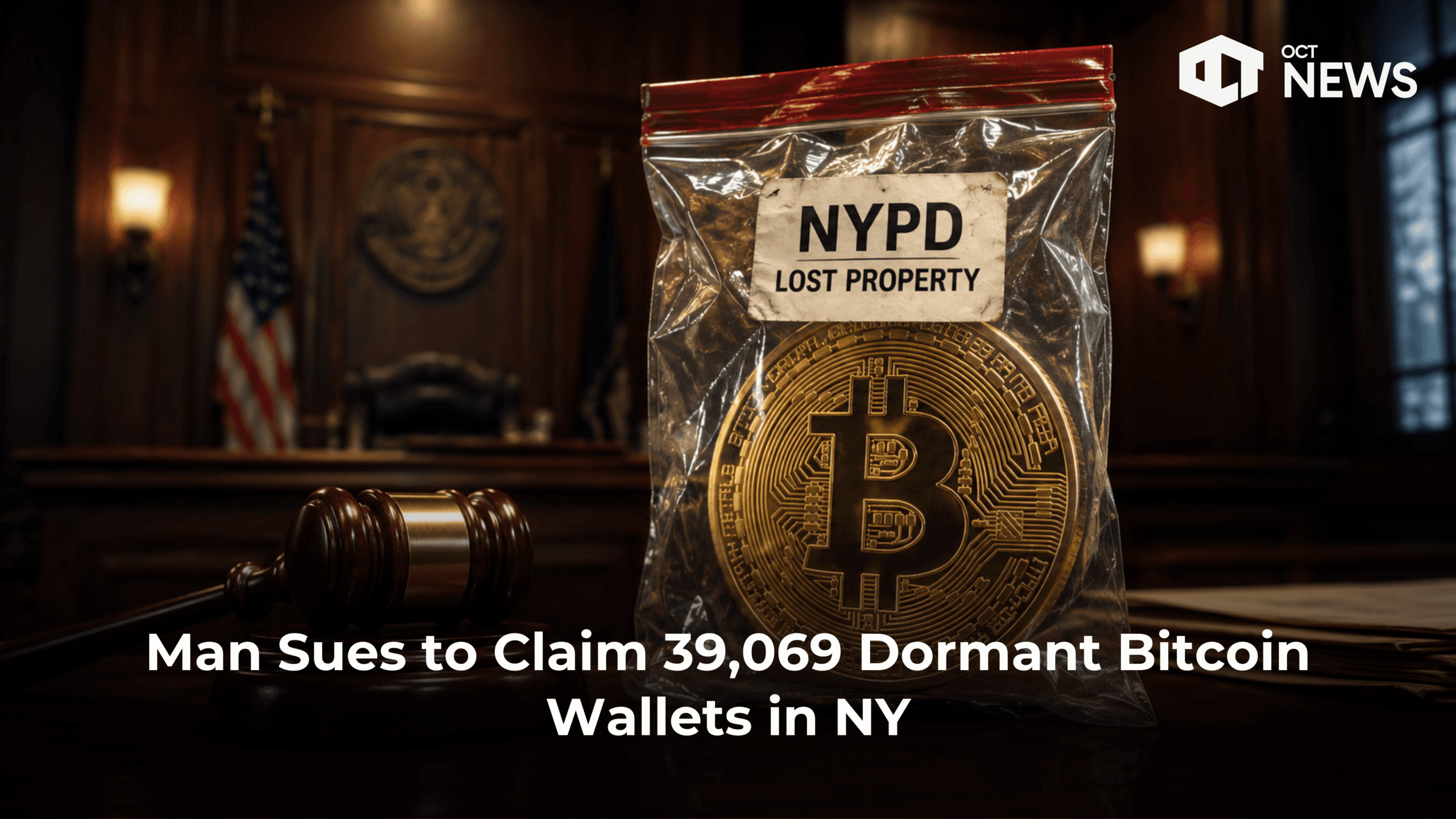
A pseudonymous New York resident filed a lawsuit claiming ownership of 39,069 dormant Bitcoin wallets worth an estimated $286B.

Author: Akshat Thakur
High attention and emotional sentiment detected.
27th May 2026 – A pseudonymous New York resident has filed a lawsuit claiming legal ownership of 39,069 dormant Bitcoin wallets. Media estimates put the combined holdings at roughly 3.8 million BTC, or about $286 billion at current prices.
High Signal Summary For A Quick Glance

redgreenblue
@redgreenbl35768

@DailyStackHQ "Some people suck" - Tom Segura
Someone built an algorithm to find inactive Bitcoin wallets, reported them to the NYPD as "lost property" - and is now suing to own them. 39,069 wallets. ~3.8M BTC. $286 billion. No private keys. Just a court order. The most audacious Bitcoin lawsuit in history. https://t.co/iK8KIx5OA8
04:43 PM·May 27, 2026

Stephen
@sworland11
@DailyStackHQ Let's say he wins. Unfortunately for him, the blockchain doesn't give a shit about a NY court order. No private keys means no ability to do anything even with a win in court. Regardless he won't win, but nice try wasting everyone's time.
Someone built an algorithm to find inactive Bitcoin wallets, reported them to the NYPD as "lost property" - and is now suing to own them. 39,069 wallets. ~3.8M BTC. $286 billion. No private keys. Just a court order. The most audacious Bitcoin lawsuit in history. https://t.co/iK8KIx5OA8
04:09 PM·May 27, 2026

Gran Hews Mat T Day
@BTCmaxe
@DailyStackHQ There's no way this will hold up
Someone built an algorithm to find inactive Bitcoin wallets, reported them to the NYPD as "lost property" - and is now suing to own them. 39,069 wallets. ~3.8M BTC. $286 billion. No private keys. Just a court order. The most audacious Bitcoin lawsuit in history. https://t.co/iK8KIx5OA8
01:17 PM·May 27, 2026
The plaintiff goes by “Noah Doe.” He filed the case on May 1, 2026 in New York Supreme Court (Index No. 153119/2026). Law firm Lewis & Lin LLC submitted the filing, which applies New York’s lost property law to Bitcoin for the first time.
According to the court filing, Noah Doe built a proprietary algorithm in Fall 2024. The program scanned the public blockchain for self-custodied addresses inactive for at least five years.
The algorithm initially flagged 42,001 wallets. Noah Doe then launched an outreach campaign to contact potential owners. That effort included OP_RETURN messages on the blockchain between June and July 2025.
He also issued a press release on August 7, 2025. It set a 90-day claim window ending October 10, 2025. Outreach removed 2,932 wallets from the list. In total, 424 wallets showed on-chain activity during this period. The remaining 39,069 addresses form the basis of the dormant Bitcoin wallets lawsuit.
The crypto community responded with overwhelming skepticism. Legal experts and industry figures say the case cannot succeed. Without the private keys, a court order cannot move Bitcoin.
The complaint relies on New York Personal Property Law Article 7-B. Specifically, it cites sections 252(1), 254, and 257. This “finders-keepers” statute covers tangible lost property. Under this law, title transfers to the finder after a police report and an unclaimed period.
Noah Doe submitted three USB drives to the NYPD 17th Precinct. The submissions occurred on December 26, 2024, April 7, 2025, and April 22, 2025. The NYPD issued receipts and later returned the drives.
The complaint states: “Pursuant to N.Y. Pers. Prop. Law section 257, title to the Abandoned Wallets vested in Noah Doe.” It lists three vesting dates: December 26, 2025, March 31, 2026, and April 14, 2026. Noah Doe later assigned interests to two Wyoming LLCs, ABC Company and XYZ Company.
The filing seeks a declaratory judgment under CPLR section 3001. It names the plaintiffs as legal owners. It does not request private keys, forced transfers, or damages.
Bitcoin runs on pure cryptographic custody. Spending BTC requires the matching private key. No court order can alter the protocol or compel miners to accept unsigned transactions.
Bitcoin lawyer Ian R. Cohen explained the problem in a detailed thread on X. The blockchain does not recognize court orders. A judge could declare Noah Doe the owner, but no node would process a transaction without a valid signature.
Former Ripple CTO David Schwartz publicly ridiculed the claim. Many in the crypto community compared it to photographing the Hope Diamond and then filing a police report.
The complaint itself acknowledges practical limits. It notes that expert recovery value is less than $10 per wallet “as is.”
The filing does not state a precise BTC total or dollar value. Media estimates, based on on-chain balance aggregation, suggest roughly 3.79 to 3.8 million BTC. At late May 2026 prices of $75,000 to $76,000 per BTC, that equals an estimated $286 billion.
For context, Chainalysis and River Financial estimate that 2.3 to 4 million BTC are permanently lost. The total mined supply sits at roughly 19.8 million BTC. As a result, this lawsuit targets a large share of all estimated lost Bitcoin.
Despite the headline number, the story produced no measurable BTC price reaction. Bitcoin traded in the $75,000 to $76,000 range with no volume spike, according to CoinGecko data.
No court has ever applied New York’s lost property law to cryptocurrency. Article 7-B covers tangible items that someone physically finds and reports to police. Applying it to blockchain addresses raises entirely new questions.
Prior attempts to claim dormant Bitcoin failed on different grounds. Craig Wright spent years trying to prove he created Bitcoin. Courts ultimately rejected his claims.
Still, some legal observers note that even a failed case could matter. A ruling on how property law applies to crypto would set a precedent. Future cases involving lost digital assets could rely on that decision.
The dominant sentiment across X, Reddit, and crypto outlets is a mix of disbelief and humor. “No keys, no coins” appeared across countless responses to the viral @DailyStackHQ thread that broke the story.
Bitcoin developers dismissed the case outright. Legal commentators acknowledged it as novel but predicted zero practical success. Early memes formed around “finders-keepers on the blockchain.”
So far, coverage remains limited to crypto outlets including CCN, NewsBTC, Crypto.news, and CoinEdition. As of May 27, 2026, no mainstream outlets like Bloomberg or Reuters have covered the case.
The dormant Bitcoin wallets lawsuit now sits in New York Supreme Court. Several unknowns remain. Noah Doe’s real identity stays hidden behind a pseudonym. Whether the NYPD formally accepted the claim beyond receipts is unclear.
At best, a favorable ruling could create a “cloud on title” for the listed addresses. That could complicate future transactions if an original owner resurfaces with their keys. At worst, the court dismisses the case early.
An early dismissal would itself set a precedent. It would establish that cryptocurrency does not qualify as “lost property” under Article 7-B. Either way, this case has already forced a conversation the crypto industry has long avoided.
This article is for informational purposes only and does not constitute financial advice. Always do your own research before making investment decisions.
Our Crypto Talk is committed to unbiased, transparent, and true reporting to the best of our knowledge. This news article aims to provide accurate information in a timely manner. However, we advise the readers to verify facts independently and consult a professional before making any decisions based on the content since our sources could be wrong too. Check our Terms and conditions for more info.



Bitcoin