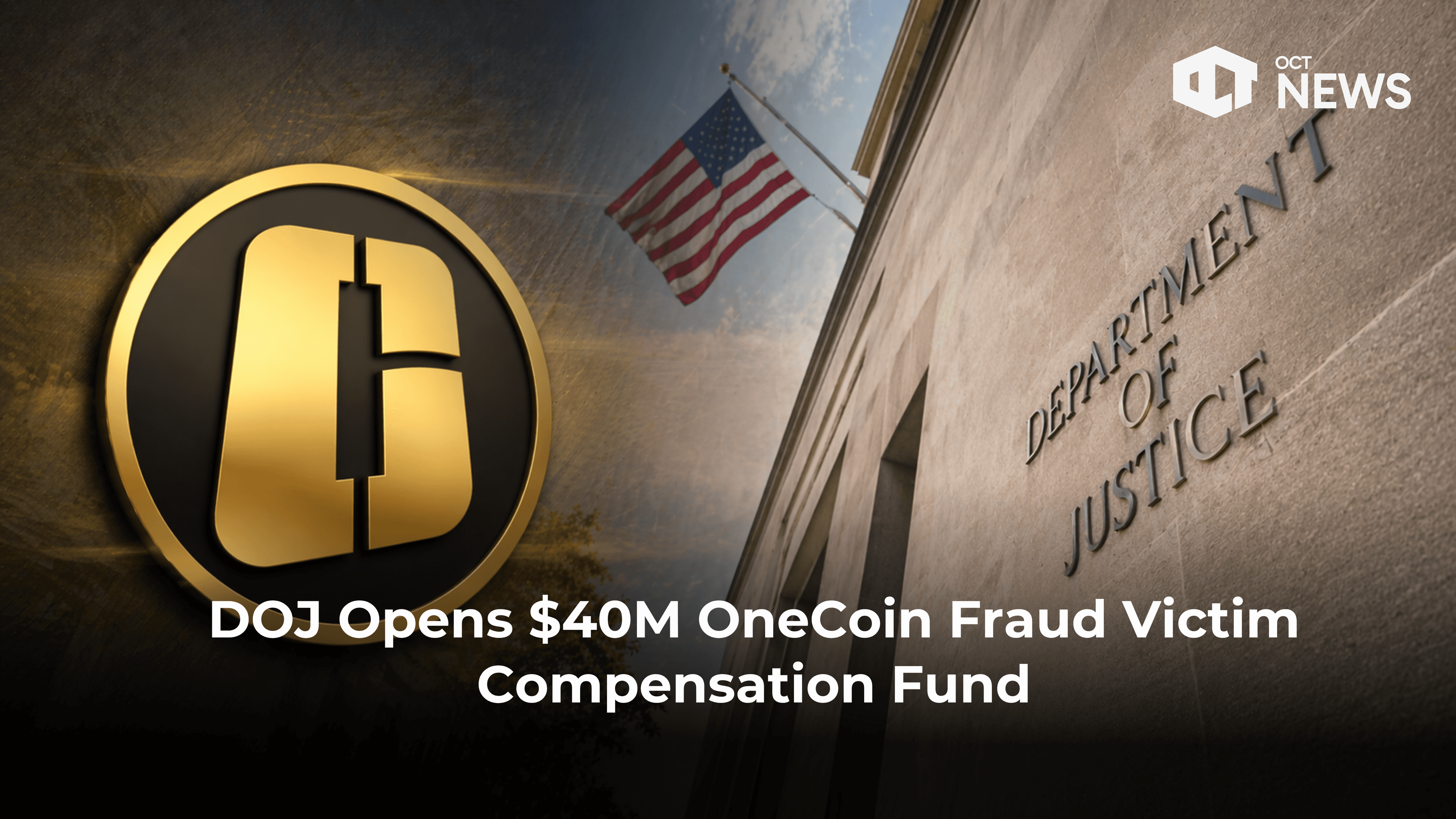
OneCoin victim compensation process opens as DOJ releases $40 million in recovered funds for distribution to eligible victims of the fraud.

Author: Akshat Thakur
Steady attention without excessive speculation.
15th April 2026- The U.S. Department of Justice launched a formal OneCoin fraud victim compensation process. More than $40 million in forfeited assets are now available for distribution to people who lost money in the scheme. The announcement came through an official DOJ press release that detailed the start of a remission process. This is the formal mechanism the DOJ uses to return seized proceeds directly to crime victims.
High Signal Summary For A Quick Glance

Coinvo
@Coinvo

AMAZING: 🇺🇸 DOJ has begun a compensation process for victims of the $4 billion OneCoin crypto fraud. Claims start by June 30, 2026. https://t.co/SNdsE1KwaO

10:10 AM·Apr 14, 2026

Coin Bureau
@coinbureau
🚨JUST IN: U.S. DOJ opens compensation process for victims of the $4B OneCoin crypto fraud, claims due by June 30, 2026. Over $40M currently available for compensation from seized assets, and claims are open to those who invested between 2014–2019 and suffered net losses. https://t.co/8O0jCdvvoj

09:35 AM·Apr 14, 2026

Decrypt
@DecryptMedia
DOJ Opens $40M Compensation Process for OneCoin Crypto Fraud Victims https://t.co/PF9SI9pk51
09:32 AM·Apr 14, 2026
Jay Clayton, the U.S. Attorney for the Southern District of New York, addressed the significance of the move. He stated, “Today’s announcement marks an important step toward returning funds to those harmed.”
OneCoin operated from 2014 through 2019. Prosecutors and investigators widely regard it as one of the largest cryptocurrency frauds ever recorded.
Organizers promoted the scheme through multi-level marketing events and celebrity endorsements. As a result, hundreds of thousands of people worldwide bought into what organizers marketed as a revolutionary blockchain cryptocurrency.
In reality, no functional blockchain existed. No independent ledger supported the system. Instead, the entire operation relied on a centralized database that credited users with fictional coins.
Internal records seized by prosecutors showed the company generated roughly $4 billion in revenue. Almost all of that came from new investor inflows rather than any legitimate product. According to estimates, more than 3 million people across over 100 countries fell victim to the scheme
Ruja Ignatova, the Bulgarian national who styled herself the “CryptoQueen,” served as the public face of the project. She disappeared in 2017 and remains on the FBI’s most-wanted list.
Her co-founder Karl Sebastian Greenwood pleaded guilty in U.S. federal court. He is currently serving a 20-year prison sentence for his role in the fraud.
Other associates also faced prosecution. In 2019, a federal jury convicted Mark Scott, a former lawyer, for laundering approximately $400 million in OneCoin proceeds. Similarly, Irina Dilkinska, OneCoin’s head of legal and compliance, pleaded guilty in 2023.
Key milestones in OneCoin Fraud and Victim Compensation
OneCoin debuts as a supposed cryptocurrency, promoted via MLM networks and events, despite lacking any real blockchain infrastructure.
The scheme spreads to 100+ countries, defrauding over 3 million victims and generating approximately $4B in revenue.
Ruja Ignatova vanishes and is later placed on the FBI’s most-wanted list, while co-founder Karl Greenwood is eventually convicted and imprisoned.
U.S. authorities pursue forfeiture actions, seizing funds linked to the scheme and building a compensation pool for victims.
DOJ launches remission process, making $40M+ available to victims, with Kroll appointed to manage claims and a June 30 deadline set.
CoinMarketCap shares details of the compensation process, directing affected users to the official claims portal and instructions.
Federal prosecutors in the Southern District of New York spent years pursuing criminal forfeiture actions against assets tied to the scheme. Those efforts produced the pool of funds now available.
Kroll Settlement Administration LLC handles the logistics. Victims who purchased OneCoin between 2014 and 2019 and can demonstrate a net loss are eligible to file.
To begin, petitioners must submit a form with supporting documentation. Bank records, transaction receipts, or other proof of investment and loss qualify as evidence. They can file online at onecoinremission.com or by mail.
The hard deadline is June 30, 2026. No attorney is required. In addition, Kroll has set up a dedicated phone line at 1-833-421-9748 and email support for petitioners.
Forfeited assets sit in a dedicated fund managed by the Criminal Division’s Money Laundering and Asset Recovery Section. After Kroll verifies eligible claims and calculates each victim’s net loss, the administrator will distribute the available pool on a pro-rata basis.
The $40 million figure, while substantial, represents roughly 1% of the estimated $4 billion in total losses. Because of this gap, many victims who lost life savings or retirement funds may receive only partial recovery.
If authorities seize additional assets in the future, the DOJ can supplement the fund. The ongoing hunt for Ignatova and further seizures could therefore grow the pool. For now, the current amount represents only what prosecutors have recovered and finalized.
This OneCoin fraud victim compensation round underscores how federal authorities handle large-scale crypto fraud after criminal cases conclude. Asset forfeiture serves as the primary tool for restitution, rather than leaving individuals to pursue civil lawsuits.
The SDNY, which also prosecuted the Bernie Madoff Ponzi scheme and the FTX case, has become the lead venue for major cryptocurrency fraud in the United States. Consequently, the OneCoin remission follows a template that could apply to future cases.
At the same time, the gap between the $40 million fund and the $4 billion in estimated losses illustrates a hard reality. When fraud proceeds move offshore or disappear, enforcement can only recover a fraction.
The claims portal at onecoinremission.com is now live. Victims have until June 30, 2026, to gather documentation and submit petitions.
Kroll will then review submissions, request additional information where needed, and prepare a distribution plan for court approval. Payments should follow that review period, though the exact timeline depends on the volume of claims.
This process closes one chapter of the OneCoin saga while leaving others open. The hunt for Ignatova continues, and any remaining hidden assets could lead to additional distribution rounds. For now, the mechanism for OneCoin fraud victim compensation is finally in motion.
Our Crypto Talk is committed to unbiased, transparent, and true reporting to the best of our knowledge. This news article aims to provide accurate information in a timely manner. However, we advise the readers to verify facts independently and consult a professional before making any decisions based on the content since our sources could be wrong too. Check our Terms and conditions for more info.