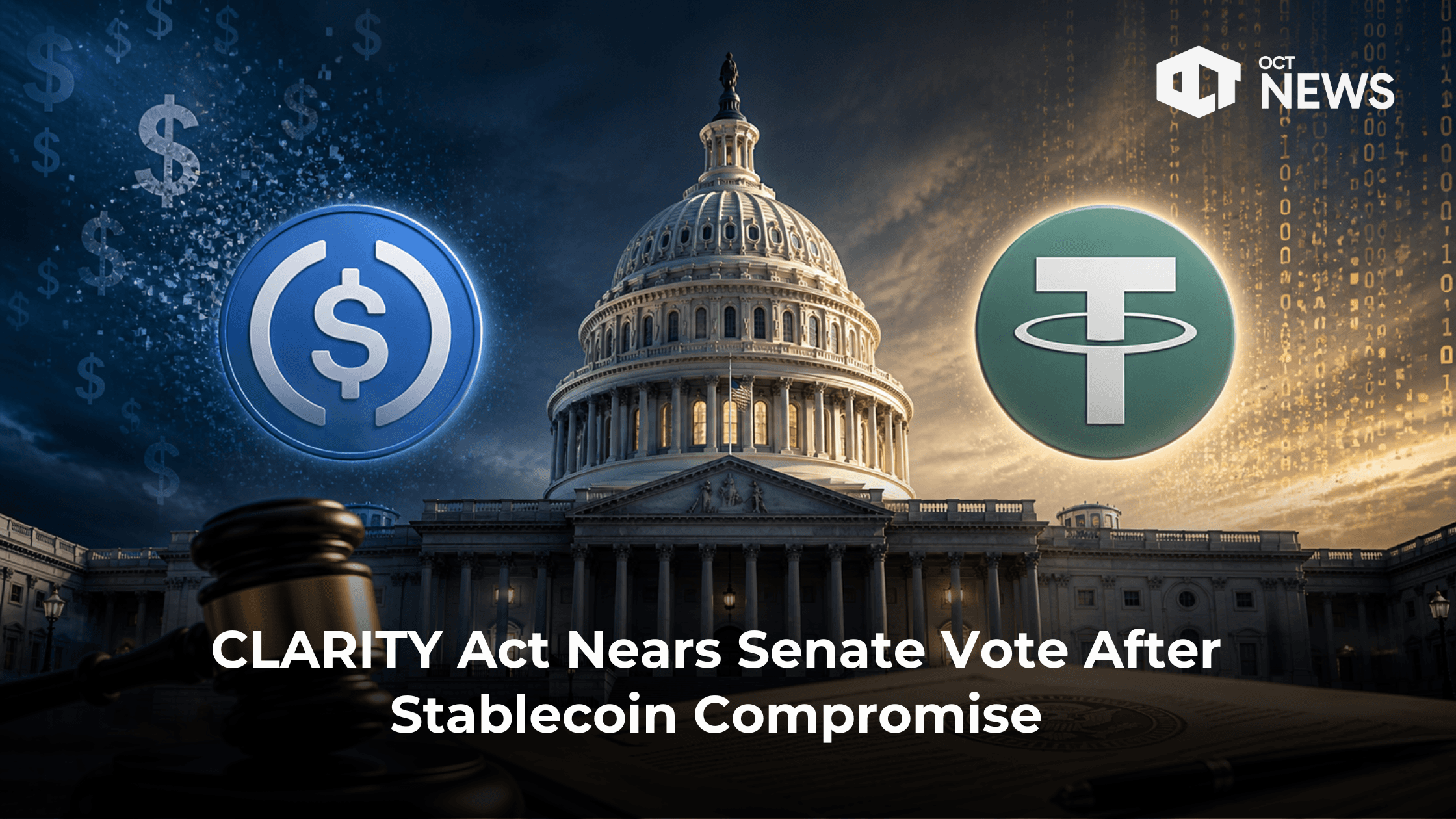
CLARITY Act nears Senate vote after stablecoin compromise, advancing U.S. crypto regulation framework and digital asset oversight.

Author: Arushi Garg
High attention and emotional sentiment detected.
5th May 2026 – The CLARITY Act is headed toward a full Senate vote within three weeks. Senators Thom Tillis and Angela Alsobrooks released a bipartisan compromise on May 1 that resolved the stablecoin yield dispute stalling the bill for eight months.
High Signal Summary For A Quick Glance

Michael Menelaou
@MMene02

@BullTheoryio Why not let the free hand of the market decide? It's not like banks are the symbol of financial safety. 2008 needed a $700B bailout. SVB collapsed in 36 hours. Silvergate, Signature, First Republic all failed in 2023. Let the people decide.
🚨 Congress could be just 3 weeks away from passing the Crypto Market Structure Bill. The CLARITY Act has been stuck in the Senate for months because of one specific fight, whether crypto companies should be allowed to pay yield on stablecoins. Banks were furious about this https://t.co/hGRtQbn1wc
10:24 AM·May 5, 2026

Braveman884
@braveman884
@BullTheoryio Week after week, until this law is passed, cryptocurrencies are a massive scam and a Ponzi scheme, also, the technology is useless, and nobody gives a damn about this nonsense. Uninstall all crypto centralized exchange apps and don’t vote for Trump. It’s that simple.
🚨 Congress could be just 3 weeks away from passing the Crypto Market Structure Bill. The CLARITY Act has been stuck in the Senate for months because of one specific fight, whether crypto companies should be allowed to pay yield on stablecoins. Banks were furious about this https://t.co/hGRtQbn1wc
10:23 AM·May 5, 2026

Banana Republic 🦧
@Monkeyiobe
@BullTheoryio Banks moving trillions daily but panic the moment the Monkey gets a better option 😂. The Gorilla never fights this hard unless something real is at stake 👀. That's your signal right there.
🚨 Congress could be just 3 weeks away from passing the Crypto Market Structure Bill. The CLARITY Act has been stuck in the Senate for months because of one specific fight, whether crypto companies should be allowed to pay yield on stablecoins. Banks were furious about this https://t.co/hGRtQbn1wc
10:08 AM·May 5, 2026
The compromise bans passive yield on stablecoins that functions as the “economic equivalent” of bank deposits. At the same time, it allows activity-based rewards tied to real platform usage. These include trading fees, payments, and staking.
Industry groups are now pushing for a Senate Banking Committee markup the week of May 11. According to Punchbowl News, Senator Tim Scott signaled the bill is “in the red zone.”
The Digital Asset Market Clarity Act creates a federal framework for crypto regulation in the United States. It assigns CFTC oversight for digital commodities like Bitcoin and Ethereum. Securities fall under SEC jurisdiction.
The bill also includes DeFi safe harbors and staking protections. It establishes a tokenization framework for real-world assets. Both provisions address longstanding gray areas that kept institutional capital on the sidelines.
The House passed the bill in July 2025 with strong bipartisan support at 294-134. Since September 2025, it sat in the Senate Banking Committee. One dispute held everything up: whether crypto firms can pay yield on stablecoins.
That single issue consumed eight months of negotiations. Banks feared deposit flight. Crypto firms argued yield products drive adoption. Neither side budged until the Tillis-Alsobrooks text landed.
Banks lobbied hard against stablecoin yield. They argued that paying interest on stablecoins competes directly with bank deposits. If customers move savings into higher-yielding stablecoins, banks lose cheap funding.
The compromise draws a clear line. Crypto firms cannot offer yield that is “the functional or economic equivalent to banks’ offerings.” Passive yield, similar to a savings account, is banned.
Activity-based rewards remain legal. These include trading fee rebates, payment processing rewards, and staking participation incentives. The distinction protects deposits while preserving crypto innovation.
Coinbase CEO Brian Armstrong called it “a durable compromise that protects innovation while addressing bank concerns.” Banking trade groups responded cautiously on May 4. They stated the language “falls short of a full prohibition.”
Markets responded quickly to the compromise. According to CoinDesk, Polymarket odds for “CLARITY Act passes in 2026” jumped from roughly 46% to 55-64%. That shift happened within 24 hours of the text release.
Coinbase ($COIN) and Circle stock both rose sharply between May 2 and May 4. Stablecoin-related tokens including MKR, ENA, and FXS posted gains during the same window.
Stablecoin TVL in yield-bearing products remains a key metric. Ethena’s USDe, MakerDAO’s sDAI, and Mountain Protocol all saw increased deposits as traders positioned for regulatory clarity.
The current timeline points to a Senate Banking Committee markup during the week of May 11. If that proceeds on schedule, a full CLARITY Act Senate vote could happen by late May. That would put it before the Memorial Day recess.
Multiple sources confirm this timeline. CoinDesk, Barron’s, and Reuters all reported the compromise as the breakthrough clearing the final hurdle. Punchbowl News cited committee sources expecting action within days.
Several unknowns remain. The exact markup date is not confirmed. Amendments could alter the final text. The Senate calendar is crowded, and some members want more time to review the compromise language.
Timeline: The CLARITY Act’s path from introduction to expected Senate vote
The CLARITY Act is introduced in the House to establish federal rules for crypto market structure.
The bill passes the House with strong bipartisan support in a 294–134 vote.
The CLARITY Act is referred to the Senate Banking Committee for further review.
The bill is delayed amid disagreement over whether crypto firms can offer yield on stablecoins.
Senators Tillis and Alsobrooks release a compromise text on stablecoin yield, breaking the months-long deadlock.
The Senate Banking Committee targets a markup of the revised CLARITY Act.
A full Senate vote on the CLARITY Act could take place within the next three weeks.
The American Bankers Association issued a joint statement on May 4 with other banking groups. They said the proposed language “falls short” and warned Congress “must get this right.”
Their concern centers on defining “activity-based” rewards. If the line between passive yield and activity rewards proves blurry, banks worry crypto firms could offer deposit-like products under a different name.
For now, this opposition has not derailed the timeline. Amendments during markup could still tighten the language further. The final text may look different from the current compromise.
How the CLARITY Act compromise separates crypto yield models from traditional bank interest
The crypto industry is watching the week of May 11 closely. A successful markup moves the CLARITY Act Senate vote to the full chamber. If it passes, the bill goes to the President’s desk.
Signing would give the U.S. its first comprehensive crypto market structure law. That means regulatory clarity for exchanges, DeFi protocols, staking services, and tokenized assets. It could also unlock institutional capital that has waited for clear rules.
Community sentiment on social media is strongly bullish. Retail investors are celebrating the “3 weeks away” narrative. Analysts remain measured, focusing on the May 11 markup as the next real catalyst.
The bill’s passage would also set a global precedent. Other jurisdictions including the EU and UK have moved faster on crypto rules. A U.S. framework could reshape how global projects structure their operations and token distributions.
This is not financial advice. Legislative timelines can shift. The final text may differ from the current compromise.
Our Crypto Talk is committed to unbiased, transparent, and true reporting to the best of our knowledge. This news article aims to provide accurate information in a timely manner. However, we advise the readers to verify facts independently and consult a professional before making any decisions based on the content since our sources could be wrong too. Check our Terms and conditions for more info.