Circle unveils quantum-resistant roadmap for Arc blockchain with opt-in post-quantum signatures at mainnet launch.

Author: Akshat Thakur
Steady attention without excessive speculation.
6th April 2026 –Circle has outlined a quantum-resistant roadmap for its Arc Layer 1 blockchain. The plan introduces opt-in post-quantum signatures at mainnet launch. It also covers the full infrastructure stack from wallets to validators.
High Signal Summary For A Quick Glance

Cryptopolitan
@CPOfficialtx

🚨QUANTUM COMPUTERS COULD BREAK BITCOIN Circle just warned that quantum machines could compromise blockchain security within the decade They're rolling out full defense for Arc blockchain - but is it enough? Crypto apocalypse we're not talking about 🧵 https://t.co/w17GQ0DIDs

08:35 AM·Apr 6, 2026

Coin Bureau
@coinbureau
🚨 CIRCLE UNVEILS QUANTUM-RESISTANT BLOCKCHAIN ROADMAP Circle revealed a quantum-resistant roadmap for its Arc L1, warning that quantum computers could break today’s encryption by 2030 or sooner. The plan introduces a phased upgrade path, starting with quantum-safe wallets and https://t.co/mwH9jRKrKw

06:45 AM·Apr 6, 2026

Wu Blockchain
@WuBlockchain
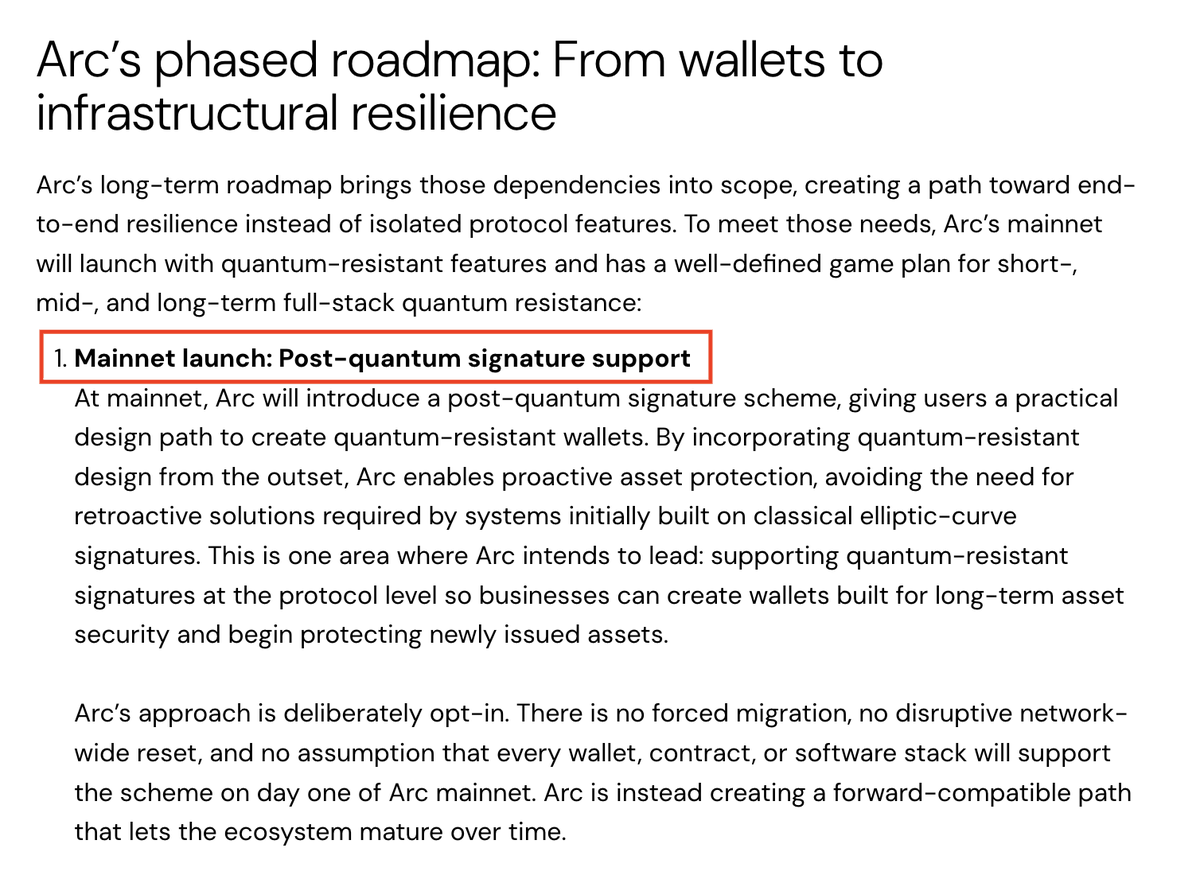
Circle announced the quantum-resistant roadmap for its L1 blockchain Arc, adopting a phased approach to full-stack quantum resistance across wallets, private state, validators, and infrastructure. The mainnet will introduce post-quantum signatures with an opt-in model. Circle https://t.co/dDCudfOWbm
03:28 AM·Apr 6, 2026
The announcement came on April 2, 2026. Circle warned that quantum computing could threaten public-key cryptography as early as 2030. The company also flagged the “harvest now, decrypt later” risk. In that scenario, adversaries collect encrypted data today and wait for quantum hardware to mature.
Most blockchains rely on the elliptic curve digital signature algorithm (ECDSA) to secure transactions. That includes Bitcoin, Ethereum, and nearly every major network.
ECDSA is vulnerable to Shor’s algorithm. A sufficiently powerful quantum computer could use it to forge signatures. It could also extract private keys from public keys exposed on-chain.
Current quantum hardware operates with roughly 1,000 to 1,500 qubits. Breaking ECDSA would require millions of error-corrected qubits. Still, recent advances in hardware and algorithm optimization have shortened those timelines. Circle’s roadmap treats this as a near-term priority.
NIST finalized its first post-quantum cryptographic standards in August 2024. Those standards include ML-DSA (Dilithium) and SLH-DSA (SPHINCS+). Circle has not disclosed which algorithms Arc will adopt. The focus is on schemes with extensive standardization review.
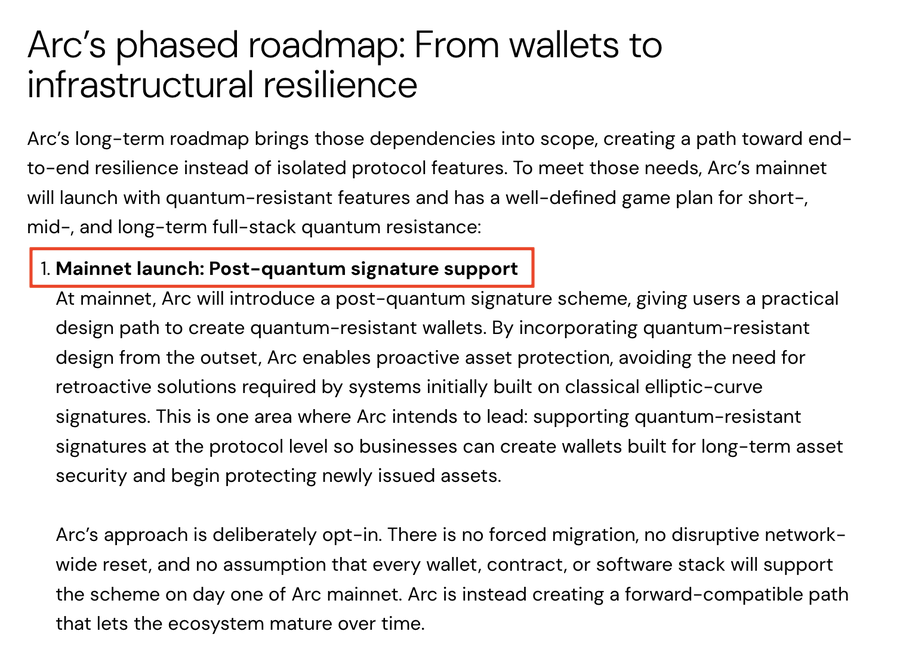
Arc’s design follows a phased, layered approach. At mainnet, the chain will support post-quantum signatures on an opt-in basis. Users and applications can migrate to quantum-safe algorithms. Meanwhile, existing ECDSA signatures remain supported.
The roadmap extends protection across the full stack. Wallets will incorporate post-quantum key generation and signing. Private state mechanisms will use quantum-resistant encryption. Validators will upgrade their consensus signatures too.
Infrastructure layers will also implement quantum-safe communication protocols. Circle emphasized that the system maintains compatibility with existing tools. Reserves and transaction data remain auditable on-chain.
The opt-in model lets early adopters upgrade at their own pace. It avoids forcing the broader ecosystem to switch immediately. This approach balances security with usability during the transition period.
Circle built its reputation through USDC. It is one of the largest dollar-pegged stablecoins, with a market cap typically above $30 billion. The company launched Arc in 2025 as a high-performance L1 for regulated applications.
Arc features native stablecoin support and payments infrastructure. It also includes the Arc Cross-Chain Transfer Protocol (CCTP). From the start, the chain targeted enterprise users who need compliance and scalability alongside Ethereum tooling.
The quantum-resistant roadmap fits that enterprise positioning. Institutions evaluating blockchain adoption need long-term cryptographic assurance. Custody providers, payment networks, and regulated entities want a chain designed to stay secure as threats evolve. Circle Arc’s quantum-resistant approach addresses that demand directly.
Most Layer 1 blockchains have not published concrete quantum-resistance plans. Ethereum’s research community has discussed post-quantum account abstraction. Vitalik Buterin has written about the topic, but no timeline exists for implementation.
Bitcoin developers have explored quantum-resistant BIP proposals. Progress on that front remains slow. The Quantum Resistant Ledger (QRL) project focuses on quantum safety. It operates as a niche chain rather than a major ecosystem.
Arc’s announcement could pressure larger networks to accelerate their own roadmaps. Regulatory bodies and standards organizations may also increase focus on post-quantum guidelines for digital assets.
One concern Circle highlighted is the “harvest now, decrypt later” strategy. Adversaries can record public keys and transaction data from blockchains today. That data sits on public ledgers and is accessible to anyone.
Once quantum computers reach sufficient power, those stored public keys become vulnerable. An attacker could derive private keys and forge signatures retroactively. This makes the threat relevant today, not just in the future.
For financial institutions, that timeline creates urgency. Data stored on-chain now could be targeted years from now. Early migration to quantum-safe signatures reduces that exposure window.
One key challenge is signature size. Post-quantum signatures from Dilithium produce outputs around 2.4 KB. ECDSA signatures are roughly 64 bytes. That 37x increase affects block size, bandwidth, and storage costs.
Verification speed is another consideration. Lattice-based schemes are generally fast to verify. Hash-based schemes like SPHINCS+ offer strong security margins but produce even larger signatures. The choice of algorithm involves balancing security, performance, and chain scalability.
Circle has not revealed its final selection. The company said it prioritizes schemes that have undergone extensive review. NIST-standardized algorithms remain the leading candidates.
Circle plans to publish detailed technical specifications in the coming months. Mainnet launch will include opt-in post-quantum signature support. Full-stack upgrades will roll out in subsequent phases.
Developers interested in early integration will get access to documentation and testnet environments. Wallet providers, custodians, and DeFi protocols will also need to assess migration paths for existing users.
Other L1 and L2 teams may accelerate their own quantum-resistance plans in response. The broader crypto ecosystem will likely watch Arc’s implementation closely.
Circle Arc now stands as one of the first major L1 chains to treat quantum security as a core design principle. The rest of the industry faces a clear choice. Act now or risk playing catch-up once quantum threats materialize.
Our Crypto Talk is committed to unbiased, transparent, and true reporting to the best of our knowledge. This news article aims to provide accurate information in a timely manner. However, we advise the readers to verify facts independently and consult a professional before making any decisions based on the content since our sources could be wrong too. Check our Terms and conditions for more info.


Securitize Stocks Launches Tokenized Equities on Solana
Stellar Settles First Institutional Repo Using Tokenized Treasury Collateral
Uniswap Aggregator Hooks Go Live & Route Fees to UNI Burn
Drift Protocol Exploit Sends $122M to Tornado Cash
Securitize Stocks Launches Tokenized Equities on Solana
Stellar Settles First Institutional Repo Using Tokenized Treasury Collateral
Uniswap Aggregator Hooks Go Live & Route Fees to UNI Burn
Drift Protocol Exploit Sends $122M to Tornado Cash