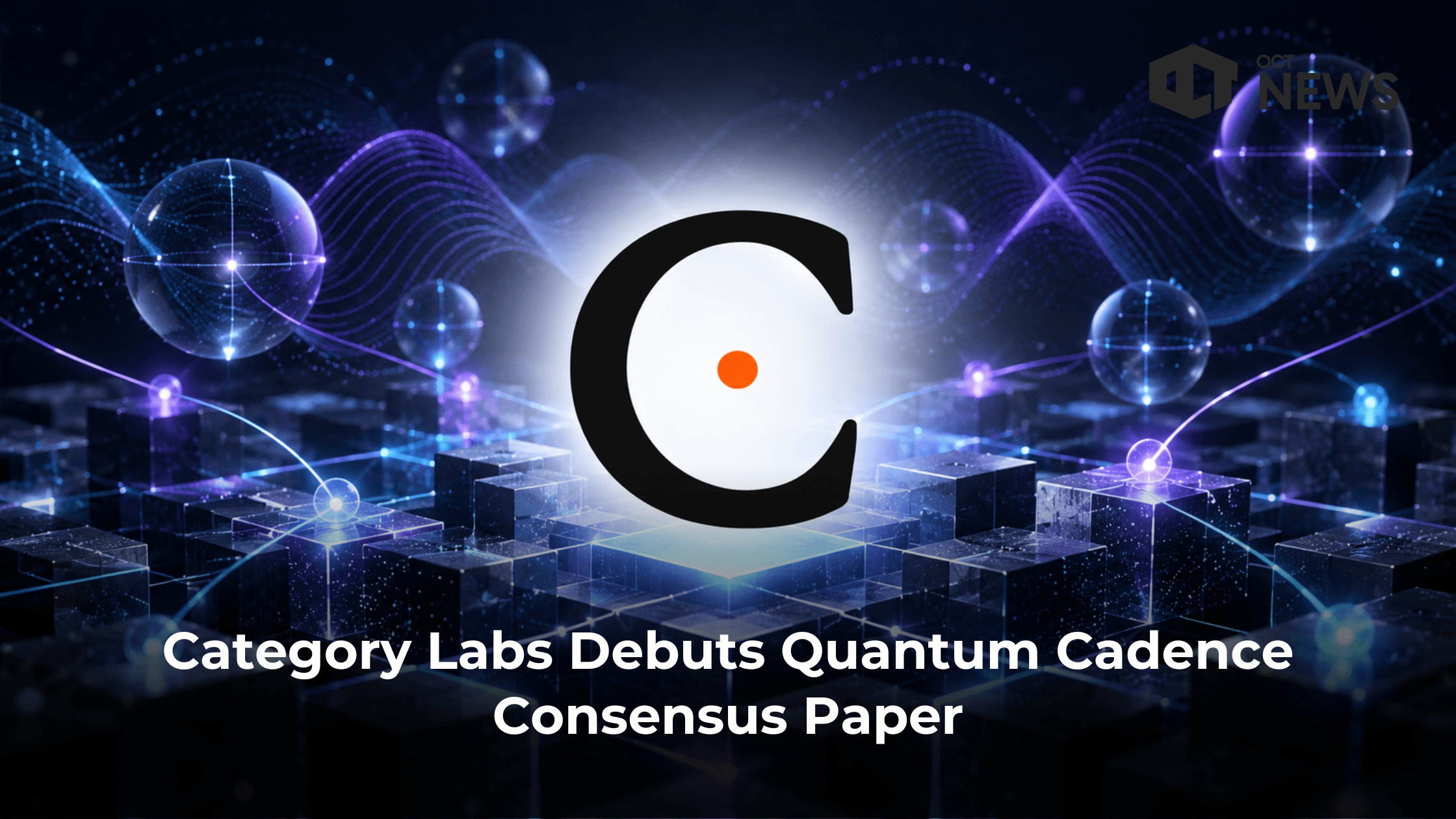
Quantum Cadence Monad research introduces a post-quantum consensus design that removes signature dependence from safety and liveness.

Author: Kritika Gupta
27th October 2026– Category Labs released Quantum Cadence this week, a post-quantum redesign of its Cadence consensus protocol. The firm announced the work in a tweet that linked a research paper, an interactive explainer, and an early prototype.
High Signal Summary For A Quick Glance

Daniel Von Fange
@danielvf

This is serious voodo. Problem: Post-quantum signatures are performance incompatible with high-performance distributed blockchain consensus. Solution: Get rid of almost all signatures from the consensus protocol (!!) Now PQ safe scales even better than the old way. https://t.co/HWPMbb6ivo
Quantum Cadence is out. Turns out to be post-quantum secure does not really cost us any meaningful fast-path performance, despite post-quantum signatures being much bigger. In fact, Quantum Cadence scales better with the number of proposers. https://t.co/oxrg9Oxzqu
02:47 PM·Oct 27, 2026

danny
@opendanny
Quantum computers will break current consensus mechanisms. Quantum Cadence is a quantum-safe version of @category_xyz's future consensus protocol. This means high-performance chains can remain both fast and secure. The upgrade is already running on an internal test network. https://t.co/hkG46ttxyl
Today we are releasing Quantum Cadence, a post-quantum version of Cadence, our consensus protocol with multiple concurrent proposers. Quantum Cadence uses no quorum certificates, and its safety and liveness do not depend on signatures. Most modern consensus protocols, Cadence https://t.co/c4NlEq1vNB
02:31 PM·Oct 27, 2026

CryptoPsycho.nad
@ICallCrypto
@category_xyz Post-quantum consensus that doesn't lean on signatures is a big step. Great to see Monad's builders thinking about the next decade. Is this headed for mainnet, or research only for now? 👀💪
Today we are releasing Quantum Cadence, a post-quantum version of Cadence, our consensus protocol with multiple concurrent proposers. Quantum Cadence uses no quorum certificates, and its safety and liveness do not depend on signatures. Most modern consensus protocols, Cadence https://t.co/c4NlEq1vNB
02:25 PM·Oct 27, 2026

port
@port_dev
Blockchains of today rely on digital signatures to agree on which txs are valid. The problem with that is that quantum computers could break those signatures. There are several possible solutions to this problem. Quantum Cadence takes a different approach here: design consensus https://t.co/KEaTn4liaP
Today we are releasing Quantum Cadence, a post-quantum version of Cadence, our consensus protocol with multiple concurrent proposers. Quantum Cadence uses no quorum certificates, and its safety and liveness do not depend on signatures. Most modern consensus protocols, Cadence https://t.co/c4NlEq1vNB
02:25 PM·Oct 27, 2026
High attention and emotional sentiment detected.
Quantum Cadence makes two bold claims. It uses no quorum certificates, and according to the team, its safety and liveness do not depend on signatures. Those are strong statements, so they will draw close review from cryptographers.
Quantum Cadence keeps the core design of Cadence, the multiple-concurrent-proposer protocol Category Labs introduced in July. Instead of one leader per block, several validators propose content for the same slot.
The redesign swaps the per-slot consensus for a new fast path called Quantum Chorus. It runs one round of dissemination and two voting rounds, which matches Cadence’s good-case latency.
When the fast path stalls, the protocol falls back to Coda. Coda is a signature-free Byzantine agreement built for multiple proposers. So the system keeps moving even under adverse network conditions, while Cadence still targets a block interval near 100 milliseconds.
Most fast consensus protocols lean on quorum certificates. A quorum certificate is a compact proof that a supermajority signed the same value, and designs like HotStuff and Tendermint broadcast them to prove a quorum voted.
Quantum Cadence drops that step. Instead, each validator tallies the individual messages it personally receives. When it sees a quorum of consistent votes, it moves forward on its own.
Because the quorum intersection property still holds under the usual n = 3f+1 assumption, two honest validators cannot finalize conflicting values. As a result, safety rests on authenticated channels and collision-resistant hashing rather than any signature scheme. The team adds post-quantum signatures only for accountability, so honest parties can later prove that a validator misbehaved.
Shor’s algorithm lets a large quantum computer break classical signatures, including the BLS aggregation that packs many votes into one quorum certificate. If that aggregation breaks, certificate-based protocols lose the proof their safety depends on.
NIST has already finalized post-quantum signature standards such as ML-DSA, also known as FIPS 204. Yet these schemes produce large signatures, so flooding the network with post-quantum certificates becomes impractical for a high-throughput chain.
Quantum Cadence sidesteps both problems at once. Since safety and liveness never rely on signatures, the core protocol holds even if an attacker forges them. The design still uses post-quantum signatures, but only for the narrower job of accountability.
The new protocol draws directly on Forget-IT, a signature-free precursor co-authored by Category Labs researchers Jovan Komatovic and Sourav Das. Forget-IT reached optimal three-round good-case latency in the information-theoretic setting, and Coda extends those techniques.
To test the design, the team ran simulations with 200 validators modeled on Monad’s validator geography as of 1 October. The results show latency comparable to Cadence and better bandwidth scaling as the number of proposers grows.
That tradeoff matters for an MCP protocol. When proposer counts are small and signatures are large, bandwidth can run higher than classical BLS designs. As proposers scale up, however, the signature-light approach pulls ahead.
The release is early-stage. Category Labs published the 35-page paper on arXiv on 23 October, so it has not passed peer review. There is also no public code, no public testnet, and no audit.
The prototype runs on an internal test network. The team describes it as an AI-assisted port of an existing Cadence prototype, built in a few hours. So treat the performance claims as simulated rather than proven on live hardware.
No independent cryptographer has publicly challenged the signature-free safety claim yet. Still, that silence reflects how new the paper is, not an endorsement. Experts need time to work through 35 pages of formal lemmas.
Standard BFT consensus vs. Quantum Cadence
Category Labs frames the work as part of Monad’s broader post-quantum roadmap, which already flagged ongoing Cadence work in September. A Monad protocol engineer called the paper “a very important part” of that roadmap.
So far, the market has barely reacted. MON traded near $0.0215 on 27 October, for a market cap of roughly $233 million to $256 million. No clear price move tracks back to this release.
For now, Quantum Cadence stands as a research milestone rather than a shipped feature. Watch for peer review, an open-source release, or a public testnet as the next real signals. None of this is financial advice.
Our Crypto Talk is committed to unbiased, transparent, and true reporting to the best of our knowledge. This news article aims to provide accurate information in a timely manner. However, we advise the readers to verify facts independently and consult a professional before making any decisions based on the content since our sources could be wrong too. Check our Terms and conditions for more info.