Learn how Brickken Agentic simplifies tokenization on Base with AI agents, MCP, x402 payments, and compliant on-chain token issuance.

Author: Akshay
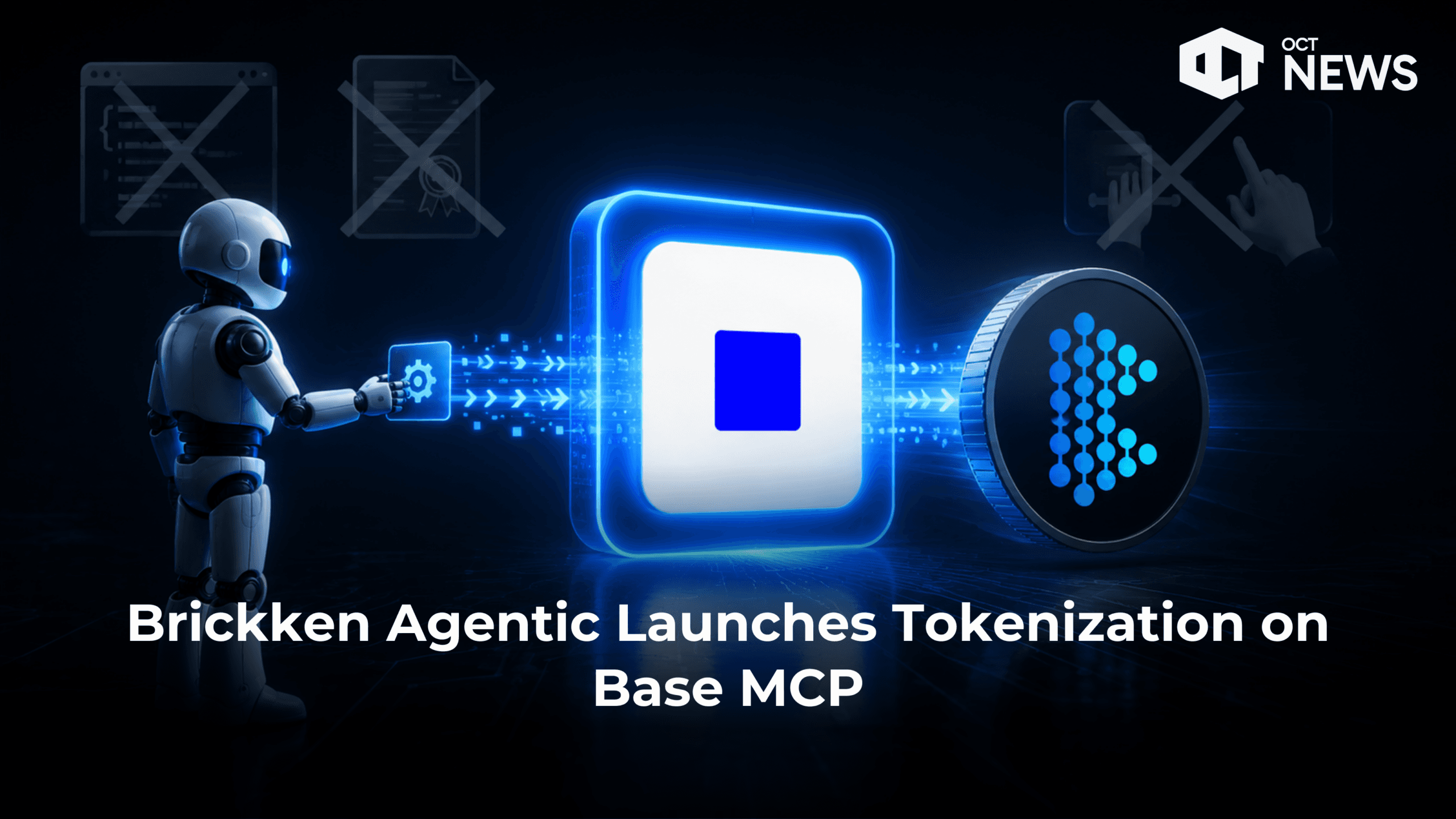
26th June 2026 – Brickken Agentic is now live, and it lets any compatible AI agent issue a compliant token on its own. Brickken launched the tool on June 23, 2026, as a Model Context Protocol server on Base. Through one endpoint, an agent can register, pay, and mint a token without a human in the loop.
High Signal Summary For A Quick Glance

KingJ
@JkingJDE

@Brickken @base This is a big step forward. Automating the entire tokenization workflow makes building faster and much more scalable....
The full tokenization lifecycle, now run by an AI agent. @Brickken Agentic is live on @base MCP. Point an agent at one endpoint and it runs the whole flow: register the on-chain identity, pay via x402, issue a compliant token. No SDK wrangling. No human-only steps. What used https://t.co/6m9MaAFYdo
10:26 AM·Jun 26, 2026

Bliss
@Pearl_Blesovek
@Brickken @base AI-powered tokenization is a huge leap forward
The full tokenization lifecycle, now run by an AI agent. @Brickken Agentic is live on @base MCP. Point an agent at one endpoint and it runs the whole flow: register the on-chain identity, pay via x402, issue a compliant token. No SDK wrangling. No human-only steps. What used https://t.co/6m9MaAFYdo
10:09 AM·Jun 26, 2026

BeautyPlus
@hrh__christi
@Brickken @base Love seeing $BKN pushing the boundaries of automation and on-chain infrastructure.
The full tokenization lifecycle, now run by an AI agent. @Brickken Agentic is live on @base MCP. Point an agent at one endpoint and it runs the whole flow: register the on-chain identity, pay via x402, issue a compliant token. No SDK wrangling. No human-only steps. What used https://t.co/6m9MaAFYdo
10:04 AM·Jun 26, 2026
High attention and emotional sentiment detected.
The pitch is direct. Brickken wants autonomous agents to handle tokenization end to end, not just parts of it. So the company exposed its full issuance stack as MCP tools that any agent can call.
The service runs as a hosted server at the endpoint mcp.brickken.com/mcp. Agents connect to it and then discover a set of tokenization tools. Next, they call those tools to do real on-chain work.
The core flow has three steps. First, the agent registers an on-chain identity. Then it pays for the action through Coinbase’s x402 protocol. Finally, it issues a compliant token on Base.
According to the official announcement, no SDK integration is required. The agent also needs no human approval for the core flow. Exposed tools include agent_register and agent_create_token, plus mint, burn, and transfer actions.
The design stitches together three separate standards. Each one solves a different problem for an autonomous agent. Together, they cover identity, payment, and issuance.
First comes MCP, the open standard from Anthropic. It lets an AI agent discover and call tools over a simple connection. So any MCP-compatible agent can find Brickken’s tokenization tools without custom code.
Next comes x402, an open payment protocol from Coinbase. It uses the old HTTP 402 “Payment Required” status code. The agent gets a 402 response, then pays instantly in stablecoins such as USDC on Base. As a result, the agent needs no account and no pre-approval.
Identity is the third piece. Here Brickken uses ERC-8004, a standard for trustless agents. It mints an ERC-721 token that represents the agent’s portable identity. That record also holds metadata, so other systems can discover the agent and link reputation to it.
Relative positioning between traditional tokenization workflows and Brickken’s AI-driven agentic tokenization flow
Brickken did not just hand agents a mint button. Instead, it built the compliance logic into the token itself. So the agent operates inside the rules, not around them.
The issued tokens carry permissioned transfer logic, KYC and AML hooks, and transfer restrictions. For example, a token can enforce whitelisting at the contract level. That approach matters because most autonomous issuance would otherwise raise hard legal questions.
Brickken frames this as operating inside regulatory guardrails. Still, the industry is only starting to test whether permissioned logic holds up when an agent presses the button.
This launch did not appear from nowhere. Brickken has spent months building toward agent-driven markets. The June release is the latest step in that plan.
On June 2, 2026, Brickken and Taiko announced a partnership for agentic RWA workflows. That deal introduced RAMS, a compliance delegation standard for AI agents on regulated assets. Then, on June 16, the company unveiled BKN 2.0 and positioned its token as a layer for “Agentic Capital Markets.”
Ludovico Rossi, Brickken’s CRO and co-founder, described the broader thesis at the time of the Taiko deal. “Tokenized real-world assets and autonomous agents are converging faster than most infrastructure was built to handle,” he said. He argued that issuers now need rails where agentic workflows are a first-class consideration.
The track record behind the pitch is real. Brickken launched in Barcelona in 2020. By mid-2026, it reported more than $500M in tokenized value across 30+ countries. It also serves 150+ clients and supports chains such as Ethereum, BSC, Polygon, and Base.
The market response stayed muted, at least so far. BKN traded near $0.067 on June 26, according to CoinMarketCap snapshots. Its market cap sat around $5M, and daily volume hovered between $70K and $120K.
On-chain activity tells a similar story. DefiLlama tracks Brickken’s protocol TVL near $42M, with about $5.14M on Base. So far, no clear price spike or volume surge has tied directly to the June 23 launch.
None of this is investment advice. BKN trades thinly, and prices can move fast in either direction. Readers should treat any token figure here as a snapshot, not a forecast.
The headline claim is bold, yet several gaps remain. For one, public block explorers show no indexed example of an agent completing the full register, pay, and issue flow. The launch is only days old, so that absence is not surprising.
Coverage is thin too. As of June 26, no tier-1 outlet such as CoinDesk, The Block, or Bloomberg had reported on Brickken Agentic. Base’s own documentation does list the integration, which adds some third-party confirmation.
Other questions stay open. Brickken has not detailed agent fees, the jurisdictions for autonomous issuance, or how many agents now use the tool. The hard legal issues also remain, including liability and KYC duties when an agent issues a securities-like asset.
The next test is usage. Brickken has shipped the rails, so the open question is whether real agents now mint real assets through them. Verifiable on-chain examples would settle much of the current doubt.
For now, Brickken Agentic is among the first live tools letting an AI agent issue a compliant token alone. Watch the Base explorers and the developer docs for the first proven end-to-end run.
Our Crypto Talk is committed to unbiased, transparent, and true reporting to the best of our knowledge. This news article aims to provide accurate information in a timely manner. However, we advise the readers to verify facts independently and consult a professional before making any decisions based on the content since our sources could be wrong too. Check our Terms and conditions for more info.


Securitize Stocks Launches Tokenized Equities on Solana
Stellar Settles First Institutional Repo Using Tokenized Treasury Collateral
Uniswap Aggregator Hooks Go Live & Route Fees to UNI Burn
Drift Protocol Exploit Sends $122M to Tornado Cash
Securitize Stocks Launches Tokenized Equities on Solana
Stellar Settles First Institutional Repo Using Tokenized Treasury Collateral
Uniswap Aggregator Hooks Go Live & Route Fees to UNI Burn
Drift Protocol Exploit Sends $122M to Tornado Cash

Brickken