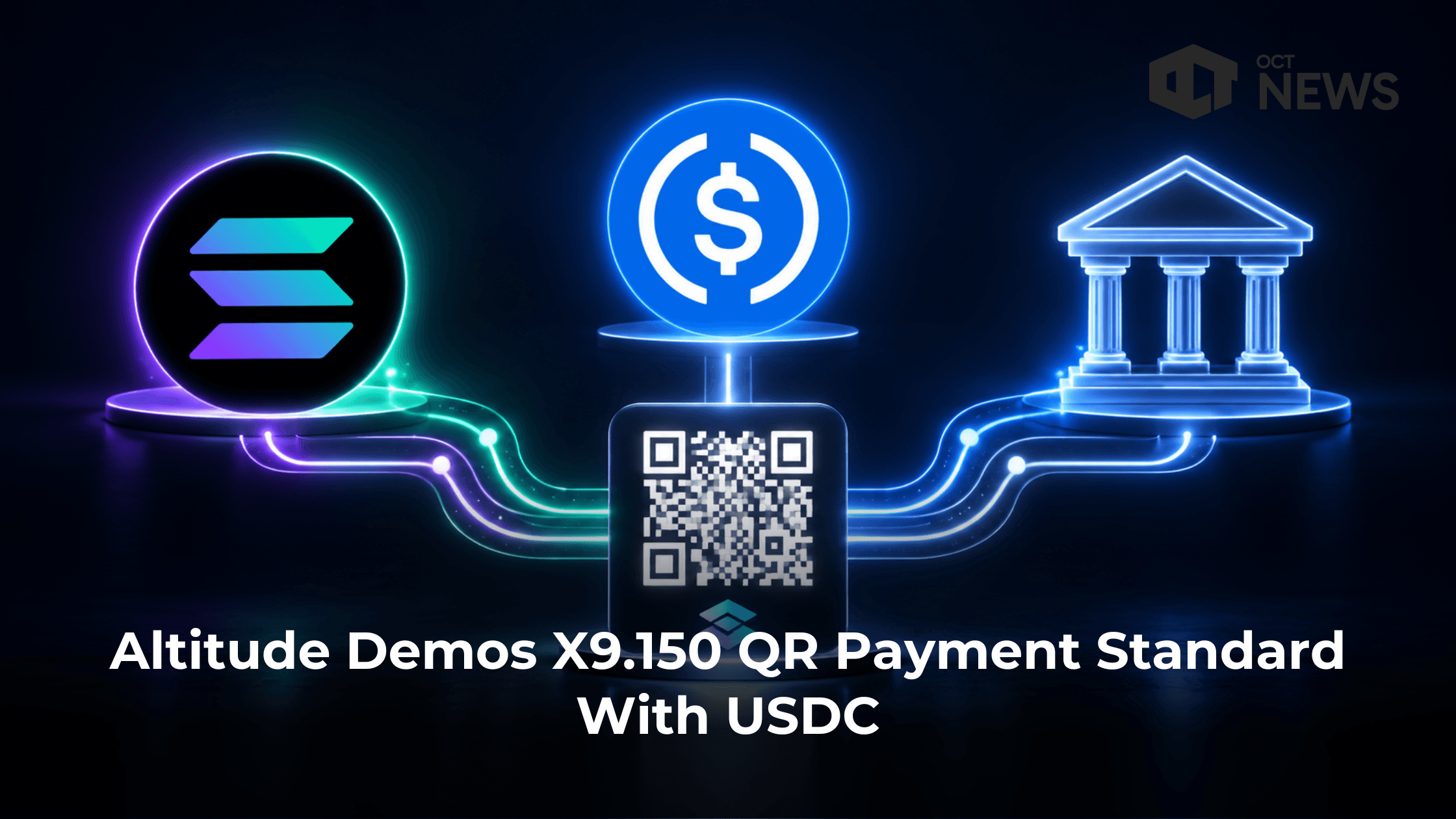
Altitude demos the X9.150 QR payment standard with USDC settlement on Solana, showing how one QR can support crypto and bank payment rails.

Author: Kritika Gupta
19th October 2026- Altitude, working with Matera, demonstrated a proof-of-concept Bill Pay workflow at Money20/20 USA. The demo ran on the new X9.150 QR payment standard. It turned a business invoice into a verified payment that settled in USDC on Solana.
High Signal Summary For A Quick Glance

0xwolverine
@0xwolverines

@solana @altitude same QR settling in USDC on Solana or over FedNow/RTP is the interesting bit. the merchant stops caring which rail the payer picks. and signed payment requests could kill a lot of fake-invoice fraud if banks actually adopt X9.150
At Money20/20, @altitude is demoing Bill Pay with X9.150, the new US standard for payment QR codes. A business uploads an invoice, Altitude verifies the signed payment request, and it settles in USDC on Solana. The same code can also be paid over FedNow or RTP. https://t.co/NedP441Roe
04:56 PM·Oct 19, 2026

XFM | Onchain Research
@xfmgg
@solana @altitude I’d like to see the rejection flow too: a correctly signed invoice that the business chooses not to pay. The signature can establish origin and detect edits; it doesn’t replace the invoice approval decision.
At Money20/20, @altitude is demoing Bill Pay with X9.150, the new US standard for payment QR codes. A business uploads an invoice, Altitude verifies the signed payment request, and it settles in USDC on Solana. The same code can also be paid over FedNow or RTP. https://t.co/NedP441Roe
04:50 PM·Oct 19, 2026

ᴿᴱᴹᴹʸˢᴾᴵᶜᴱ
@RemmySp1ce
@solana @altitude This is where payments get interesting: one QR code connecting stablecoins with existing payment rails could make bill pay much more flexible. The big test will be adoption, security, and how seamlessly it works for everyday businesses.
At Money20/20, @altitude is demoing Bill Pay with X9.150, the new US standard for payment QR codes. A business uploads an invoice, Altitude verifies the signed payment request, and it settles in USDC on Solana. The same code can also be paid over FedNow or RTP. https://t.co/NedP441Roe
04:35 PM·Oct 19, 2026
Steady attention without excessive speculation.
The workflow starts with an invoice PDF, not a phone at a checkout counter. A payer uploads the file, and Altitude reads an embedded QR code to pull and verify the payment request. Once the payer approves, the money moves and the invoice updates to paid.
The demo ran at Money20/20 USA, held October 18 to 21 in Las Vegas. Altitude and Matera walked through a full invoice-to-settlement flow on stage.
First, an invoicing app generates an invoice PDF that carries an X9.150 QR code. Then the payer uploads that PDF into Altitude Bill Pay. The app reads the QR and retrieves a digitally signed payment request from the invoicing software.
Next, Altitude verifies where the request came from and whether anyone altered it. The invoice and recipient details then pre-fill for the payer to review. After the payer authorizes the payment, it settles in USDC on Solana.
Finally, a payment notification returns to the invoicing app, so the invoice status flips to paid. Carlos Netto, co-founder and CEO North America at Matera, framed why bills fit this model.
“When people hear ‘payment QR,’ they picture a phone at a checkout counter. Nobody scans anything here, the invoice arrives as a file and the payables system reads it,” Netto said. He added that invoices and one-off bills are an enormous share of what businesses and households actually pay.
The X9.150 QR payment standard is a published national standard, not a draft. The Accredited Standards Committee X9, an ANSI-accredited body, issued ANSI X9.150-2026 on July 14, 2026.
The standard defines the structure, content, and security rules for merchant-presented payment QR codes in the United States. It also sets a Payment Payload Data Model and a Payment Notification format. Because those formats are shared, different providers can read the same QR.
Security sits at the center of the design. A signed payment request is a structured message that the originating app signs. It carries the amount, recipient, and invoice details. The receiving system then checks that signature against the X9 Financial PKI.
That check confirms the request came from the claimed source and reached the payer unchanged. Still, a valid signature does not prove the underlying invoice is legitimate, so the business must authorize the payment.
The demo settled in USDC on Solana, and that choice leans on real volume. Solana carried about $15.55 billion in stablecoin market cap as of October 19, according to data from DefiLlama.
USDC makes up roughly $6.8 billion of that total, or about 43.7% of Solana stablecoins. The chain also recorded around 557 million stablecoin transfers in September 2026, leading major networks.
Altitude comes out of Squads, and its accounts run on Squads smart accounts on Solana. The company launched Altitude Bill Pay in February 2026, and it already supports both USDC and fiat rails. In May 2026, Squads raised $18 million in a round led by Solana Ventures.
Same QR Code, Two Settlement Paths
Demo distinction: Altitude demonstrated USDC settlement on Solana. X9.150 supports FedNow and RTP as alternative rails, but the demo did not establish their availability in this workflow.
The settlement shown was USDC, but the standard itself stays rail-agnostic. The same X9.150 QR can route over FedNow, RTP, ACH credits, or a stablecoin, depending on what the provider supports.
So the invoicing side does not need a separate integration for each network. Instead, the payer’s system or the payment provider picks the rail. That design lowers integration cost and cuts fragmentation across U.S. instant payments.
Sarah Hoisington chairs the X9.150 Work Group and serves as GM North America at Matera. She described the goal when the standard launched. She said the standard creates a foundation for faster business payments and simple consumer payments. Banks, meanwhile, keep the freedom to choose their own networks.
The Federal Reserve also welcomed the effort. Amy Burr of Federal Reserve Financial Services praised the clarity. “Clear, consistent standards like X9.150 make it easier for everyone to trust the payment experience,” she said.
From US instant-payment rails to Solana invoice settlement
The Clearing House launches RTP, establishing a US instant-payment rail.
The Federal Reserve launches FedNow, expanding US instant-payment infrastructure.
X9 announces work on a secure, interoperable QR payment standard.
The standard supports a common QR payment format across bank rails and stablecoin payment methods.
Tools such as Altitude Bill Pay bring Solana-based stablecoin payments into business workflows.
At Money20/20 USA, the proof of concept verifies X9.150 payment requests and settles invoices in USDC on Solana.
Further pilots and wider availability remain next steps, with no confirmed launch dates for this workflow.
For now, this is a demonstration, not a live product. Altitude and Matera both framed the Bill Pay flow as a proof of concept. Broader availability has not arrived yet.
No public Solscan links or transaction signatures for the demo have been released either. So the settlement claim rests on the companies’ account rather than on-chain records anyone can inspect today.
Several questions also stay open. The companies have not named a go-live date. They also have not named the banks that would support the FedNow or RTP side of an X9.150 QR.
Stepan Simkin, CEO of Squads and Altitude, kept the framing simple on X. He said the team worked with Matera and Solana to bring X9.150 into business payments. The demo then settled in USDC on Solana.
The demo matters because it places a stablecoin rail inside a U.S. financial-industry standard, next to FedNow and RTP. That framing treats USDC settlement as one option among several, not an outsider.
Adoption will still depend on invoicing apps, banks, and payment providers wiring up the X9.150 QR payment standard at scale. Readers can track Altitude and Matera for a general-availability date, and watch whether live settlements follow the Money20/20 demo.
Our Crypto Talk is committed to unbiased, transparent, and true reporting to the best of our knowledge. This news article aims to provide accurate information in a timely manner. However, we advise the readers to verify facts independently and consult a professional before making any decisions based on the content since our sources could be wrong too. Check our Terms and conditions for more info.



Solana