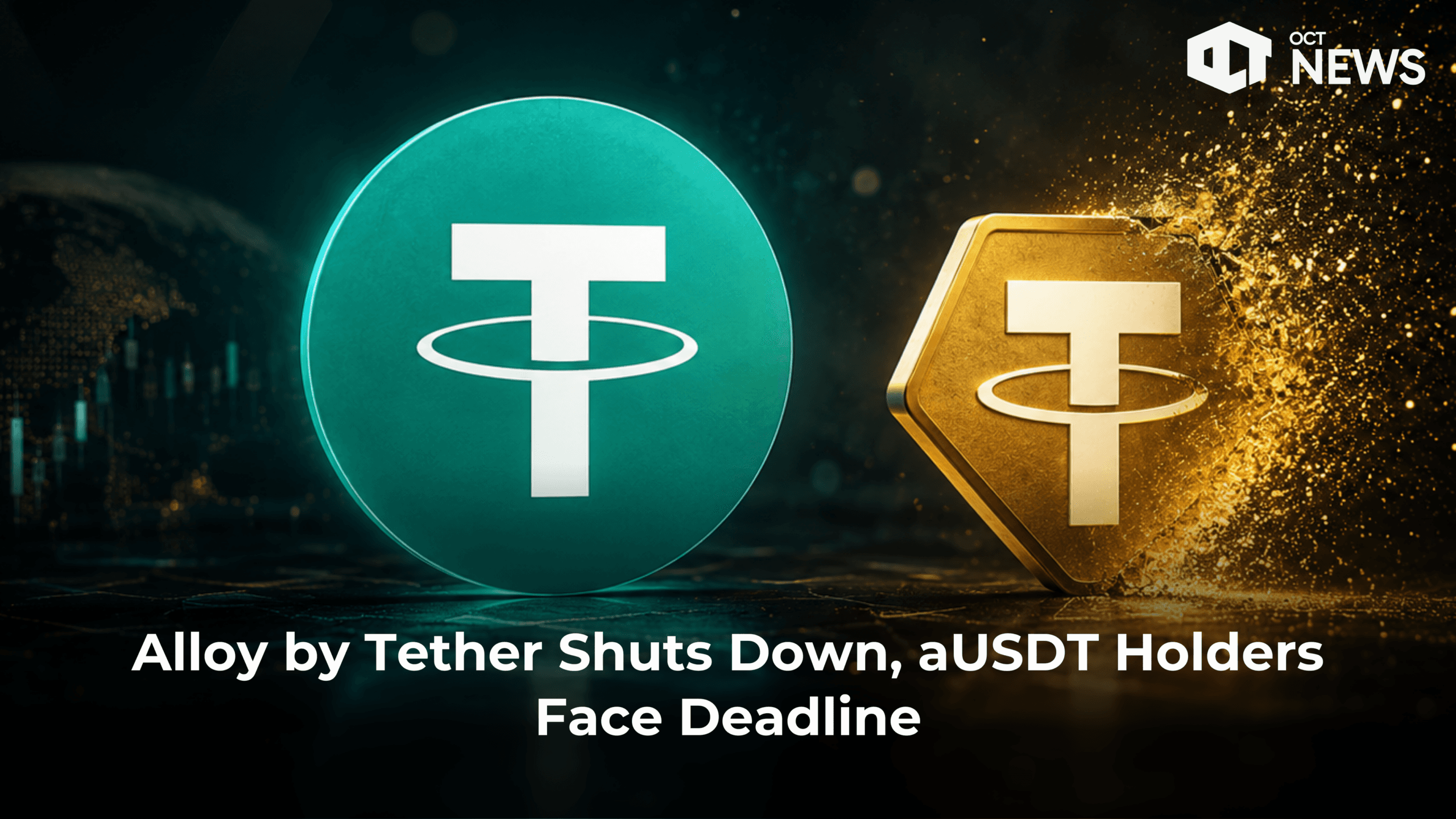
Tether will shut down Alloy by Tether and aUSD₮ after weak adoption, giving holders until September 17, 2026, to redeem XAU₮ collateral.

Author: Akshat Thakur
High attention and emotional sentiment detected.
18th June 2026 – Tether announced on June 17, 2026 that it will wind down Alloy by Tether and discontinue support for aUSD₮, its gold-backed synthetic dollar. The company will retire the platform in phases. New minting stopped the same day.
High Signal Summary For A Quick Glance

J.V ⚔️
@Judivandes

@MerlijnTrader Why don t they do that with btc ? Tether is born with bitcoin not gold
TETHER IS CUTTING PRODUCTS TO GO ALL-IN ON GOLD It just wound down aUSDT, its experimental gold-backed dollar. Market cap: a tiny $1.2 million. It barely got used. Tether Gold already owns 45% of the entire tokenized gold market. $3 BILLION in physical gold, on-chain. https://t.co/ST8voOZLuO
05:27 PM·Jun 18, 2026

@Marciaferrary
@Marciaferrary1
@MerlijnTrader Child know gold never die, them just catching up
TETHER IS CUTTING PRODUCTS TO GO ALL-IN ON GOLD It just wound down aUSDT, its experimental gold-backed dollar. Market cap: a tiny $1.2 million. It barely got used. Tether Gold already owns 45% of the entire tokenized gold market. $3 BILLION in physical gold, on-chain. https://t.co/ST8voOZLuO
03:16 PM·Jun 18, 2026

Jodran
@JodranMjodran
@0xCabana @tether Demand is the ultimate product validator
So, @tether killed off aUSDT. Not because gold-backed assets disappeared, but because demand concentrated elsewhere. XAUT sits at billions in market ca, aUSDT never really got traction. In crypto, adoption tends to beat architecture. How many products are solving for users? https://t.co/ize7uYTbS4
11:33 AM·Jun 18, 2026
Holders now face a hard deadline. They can return aUSD₮ and withdraw their Tether Gold collateral until September 17, 2026. After that date, the platform will no longer let them recover those funds.
The statement came from Tether AbT*, through the entities Moon Gold El Salvador and Moon Gold NA. According to the official announcement, the decision followed a review of user activity, market demand, and company priorities.
Tether said it wants to focus on products with stronger demand and deeper liquidity. It specifically named XAU₮ and its other core assets. As a result, Alloy and aUSD₮ no longer fit that roadmap.
Tether did not disclose exact circulation figures or collateral totals in the notice. Instead, it pointed users to the Alloy Terms of Use for redemption details.
The wind-down is phased, so existing users keep some time. Until September 17, 2026, they can still return aUSD₮ and unlock their XAU₮ collateral. The three-month window opened the day Tether published the notice.
The risk is clear for anyone who waits. After the deadline, customers who have not returned aUSD₮ can no longer recover their XAU₮ through the platform. So holders should act well before the cutoff.
On-chain data shows the affected pool is small. Roughly 76 wallets hold aUSD₮, according to Etherscan. Together they account for about 1.2 million tokens. These are block-explorer snapshots, not official Tether figures.
The process is straightforward for current holders. First, connect the wallet that holds aUSD₮ to the Alloy platform. Then return the tokens to release the locked XAU₮ collateral.
Tether points to its Terms of Use for the exact mechanics. Users who keep aUSD₮ on a centralized venue should move it to a self-custody wallet first. After that, they can complete the return well before September 17.
Timing matters more than usual here. Because the window closes on a fixed date, late redemptions carry real risk. So holders should not wait until the final week.
Alloy by Tether launched on June 17, 2024, exactly two years before the shutdown. Paolo Ardoino, Tether’s CEO, framed it then as “a class of digital assets backed by gold and tethered to a reference fiat currency.”
Adoption stayed thin from the start. The aUSD₮ market cap peaked near $1.2 million, backed by roughly 14.73 kg of gold. By comparison, XAU₮ carries a market cap above $2.6 billion.
Trading volume also remained minimal, often under $10,000 a day. The token held its peg near $1.00, with no notable depeg around the news. In short, demand never matched the ambition.
Timeline of Alloy by Tether and aUSDT
Tether officially launches Alloy by Tether along with its first synthetic dollar product, aUSDT. The token is designed as an overcollateralized synthetic USD backed by XAUT, Tether’s gold-backed token, and operates on Ethereum.
Industry reporting highlights that aUSDT has seen very limited usage during its first month of operation, with only a small amount of supply minted and little visible market traction.
Throughout its two-year lifespan, aUSDT records minimal adoption relative to major stablecoins and synthetic-dollar competitors. Minting activity, holder growth, and trading volume remain subdued.
Tether publishes an official notice confirming that Alloy by Tether will be discontinued due to low user activity and insufficient market demand. New aUSDT minting is disabled immediately.
The discontinuation announcement spreads across crypto media outlets and social platforms, drawing attention to the end of one of Tether’s lesser-used products.
Users must redeem their aUSDT and withdraw the underlying XAUT collateral before this date. The redemption window officially closes at the end of the wind-down process.
Following the redemption deadline, Alloy by Tether ceases operations and aUSDT becomes unsupported. Users who failed to redeem during the wind-down period can no longer recover collateral through the platform.
aUSD₮ was an overcollateralized synthetic dollar, not a fiat-backed stablecoin. Users deposited XAU₮, where each token represents one troy ounce of physical gold, into smart contracts on Ethereum.
They could then mint aUSD₮ against that collateral. Because the gold backing exceeded the token’s dollar target, the design aimed to hold the peg through overcollateralization. Redemption simply reversed the process.
To exit, a user returns aUSD₮ to the platform and unlocks the underlying XAU₮. That mechanism still works today. However, it closes for unredeemed positions after September 17.
The announcement landed as straightforward news. On X, the dominant tone was neutral, and users mostly urged holders to redeem in time. There was no panic and no broad FUD.
XAU₮ kept tracking physical gold, trading in the $4,200 to $4,300 range around June 17 and 18. That move reflected macro and gold conditions, not the Alloy news. aUSD₮ itself barely moved.
Posts from accounts like CryptoJack drew the most engagement, framing the story as a redemption alert. CoinMarketCap then amplified it further. Most commenters read it as a low-demand experiment reaching its end.
Tether built aUSD₮ as an experiment, not a flagship. It sat beside USDT, the world’s largest stablecoin, and XAU₮, the firm’s tokenized gold product. The pitch combined dollar stability with gold’s long-term value.
That blend sounded useful on paper. In practice, though, most users wanted either a plain dollar stablecoin or direct gold exposure, not a hybrid of both. So aUSD₮ stayed niche while its two siblings grew.
The launch also arrived during a busy stretch for Tether. The company was expanding USDT across new chains and pushing XAU₮ as a gold play. Against those priorities, a small synthetic dollar was always a side project.
The move fits a broader consolidation. Tether is steering resources toward USDT and XAU₮, where liquidity and demand run deepest. Whether it builds a direct replacement for aUSD₮ remains unclear.
For now, the priority is simple for affected users. Return aUSD₮, withdraw the gold, and do it before the September deadline. Secondary outlets including Crypto Briefing and Coinpedia have echoed that same warning.
The Alloy by Tether episode shows that even the largest stablecoin issuer will retire an experiment that does not scale. This article is informational and not financial advice.
Our Crypto Talk is committed to unbiased, transparent, and true reporting to the best of our knowledge. This news article aims to provide accurate information in a timely manner. However, we advise the readers to verify facts independently and consult a professional before making any decisions based on the content since our sources could be wrong too. Check our Terms and conditions for more info.