Deep Dive
The Great Exchange Shakeout
State of Centralized Exchanges, July 2026


State of Centralized Exchanges, July 2026
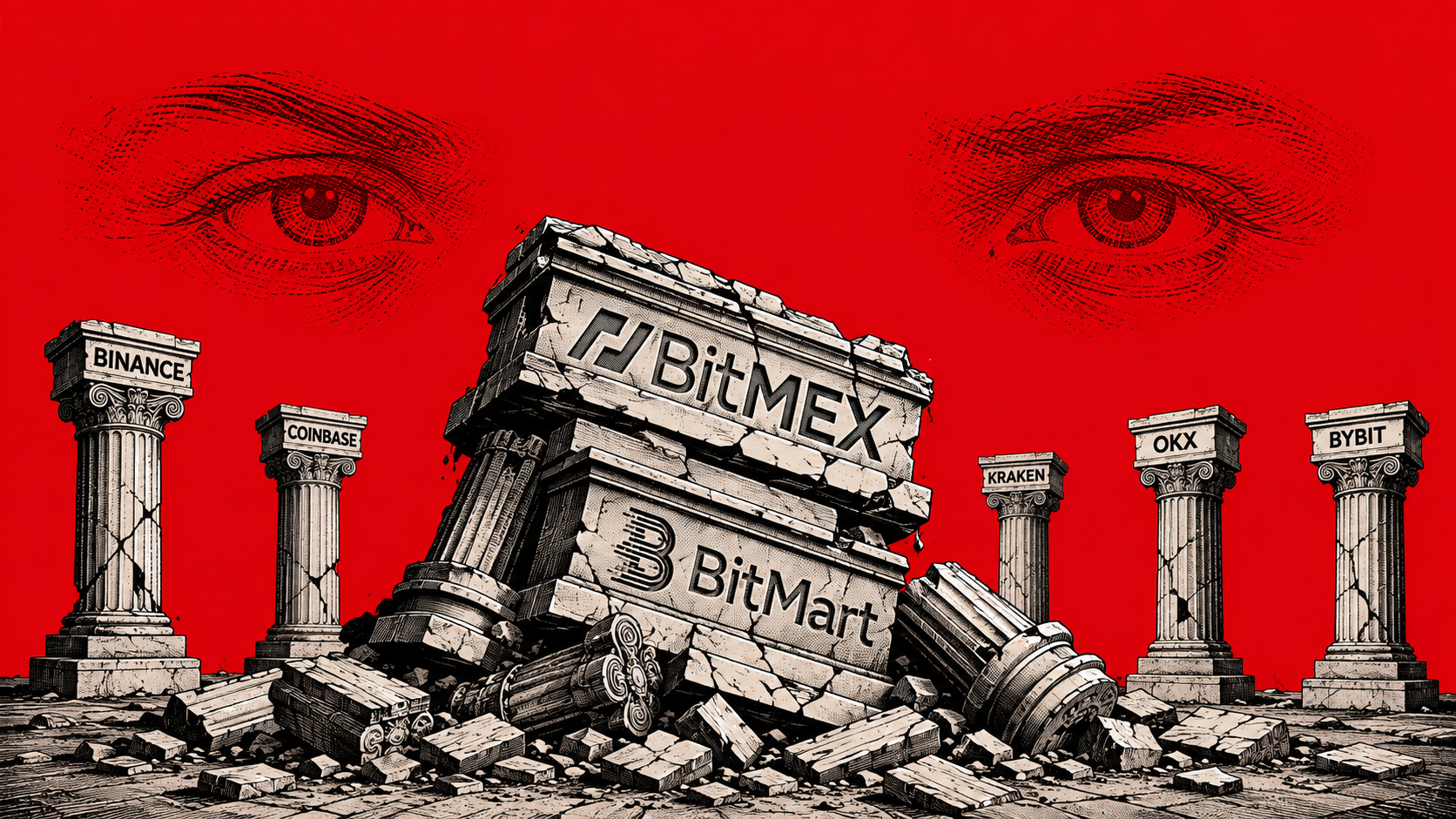
Two exchanges closed in the same week in July 2026. Most people treated this as crypto news. It is actually a structural story about where the entire CEX market is heading.
BitMart announced its wind-down on July 26, 2026. BitMEX announced its permanent shutdown three days earlier, on July 23. Both were once meaningful players. BitMEX invented the perpetual futures contract that now defines crypto derivatives trading globally. BitMart was a top-20 exchange at its peak. Now both are gone. And they are not the only ones.
AscendEX terminated operations effective July 1, 2026, citing MiCA non-compliance, a failed liquidity transaction, and operational pressures. Knaken, a Dutch platform, went dark in early June 2026, locking out approximately 30,000 users. Bit.com completed a phased wind-down by March 2026. Huione closed after a FinCEN money-laundering designation. The cluster of closures in 2025 and 2026 is not a coincidence.
Three forces are squeezing the middle tier simultaneously. First, MiCA's licensing requirements in Europe created compliance costs that smaller exchanges cannot absorb. Second, liquidity and volume concentrated into the top five exchanges after FTX collapsed trust in everything below tier one. Third, Hyperliquid and other DEXs started offering a better perps trading experience at lower cost, pulling the user base that mid-tier CEXs depended on for volume.
The economics are brutal for any exchange outside the top five. Market makers withdraw liquidity from low-volume platforms because the economics do not work. Thin order books drive away sophisticated traders. Fewer traders mean even less volume. Less volume means compliance costs represent a higher percentage of revenue. And rising compliance costs mean you either pay to survive or close. Most are choosing to close.
This is not a story about bad actors or failed projects. BitMEX was technically solvent when it announced closure. Its assets exceeded its liabilities. The platform simply ran out of reason to exist. When your daily trading volume drops to $400,000, you cannot cover the compliance costs of running a regulated derivatives exchange. The math does not work anymore, and the founders knew it.
The volume did not disappear. It consolidated. Binance, OKX, Bybit, Coinbase, and Kraken now hold more of the market than at any point in crypto history. The middle did not lose. The middle was eliminated.
BitMart's wind-down announcement on July 26, 2026 was handled professionally on paper. What happened internally in the 48 hours before the announcement is a different story.
The official announcement cited a careful evaluation of operating conditions, market environment, and future strategic direction. New user registrations and deposits suspended at 01:30 UTC on July 26. Futures accounts moved to reduce-only mode immediately. All spot and futures trading ends at 01:00 UTC on August 26, 2026. Full platform operations cease at 15:59 UTC on January 31, 2027. Withdrawals remain available with possible additional KYC and source-of-funds compliance checks. The timeline is generous by crypto standards. Six months to close properly.
The backstory is less tidy. Global CEO Nenter Chow stated publicly that he was terminated on July 24, two days before the announcement. He said he had no role in the decision, was not consulted, and learned of the wind-down the same way the public did: from the announcement. A CEO fired two days before his company announces its closure is not a normal governance situation. The market priced that uncertainty instantly.
BMX, BitMart's native token, dropped approximately 58 to 60% in the 24 hours following the announcement. That is the market's verdict on whether anyone believed the orderly wind-down framing. Token holders understood that a closing exchange has no reason to support its own token price and every incentive for insiders to exit as quickly as possible.
For users, the practical checklist is clear. Close all positions before 01:00 UTC August 26 and submit withdrawals before 05:00 UTC the same day. Any remaining futures positions may be batch-settled at mark or index price, which may not be favorable. Users who miss the primary withdrawal window still have access until January 2027 but face possible extra compliance friction including source-of-funds documentation and Travel Rule requirements.
BitMart had a prior security history that context-sets the current exit. A 2021 hot wallet hack resulted in approximately $196 million in losses. The platform survived that incident but the trust damage combined with sustained volume decline in a market that rewarded the biggest players made the economics of continuing untenable. The closure is orderly. The underlying story is one more data point in the consolidation of retail trading volume away from mid-tier platforms.
BitMEX invented the perpetual futures contract. The entire derivatives market that Binance, Bybit, and Hyperliquid are built on runs on an instrument that BitMEX created. And on the day it announced its closure, it was doing $400,000 in daily volume.
BitMEX announced permanent shutdown on July 23, 2026, effective 04:00 UTC September 23, 2026. Eleven years of operation. New account registrations stopped immediately. Risk limits apply from August 26, after which no new positions can be opened. Any positions still open at closure will be force- closed. Assets remaining post-closure incur the greater of $50 or 1% per year, charged monthly, with the rate subject to increase. The message to users was clear: get out now.
The decline of BitMEX is a case study in how legal risk destroys a business more effectively than any competitor can. Co-founders including Arthur Hayes pleaded guilty to Bank Secrecy Act and AML violations. The company itself pleaded guilty in 2024 and paid an additional $100 million fine in January 2025. The founders were subsequently pardoned by President Trump in 2025. But by then, the institutional and retail users who had migrated to Binance, Bybit, and OKX during the legal proceedings had no reason to return.
The attempt to find a buyer tells the real story. BitMEX had been seeking a buyer since February 2025 via Broadhaven Capital Partners. Thirteen months of a formal sale process with no disclosed result. When nobody will buy your exchange, even after it has been on the market for over a year, the board faces a choice between burning cash maintaining operations or closing cleanly. The board chose clean.
BMEX, BitMEX's native token, dropped approximately 91% following the announcement. The market's response to a token whose only value proposition was exchange fee discounts and ecosystem participation on a platform that is closing is rational. The token had already been declining for years. The announcement simply made official what the market had been pricing slowly for a long time.
BitMEX's own Proof of Reserves page confirmed assets exceeded liabilities at closure. This was a solvent exchange that chose to close, not a platform that failed its users financially. But solvency without volume is not a viable business. $400,000 in daily trading volume on a derivatives exchange cannot cover the compliance, technology, and operational costs of running a regulated platform in 2026. The economics were terminal before the announcement was made.


BitMart and BitMEX had announcements. Hundreds of smaller exchanges simply disappeared. MiCA's July 1, 2026 hard deadline was the single largest coordinated regulatory event in crypto exchange history, and most retail traders barely noticed it.
The EU's Markets in Crypto-Assets regulation reached its final enforcement deadline for all crypto-asset service providers on July 1, 2026. Any VASP operating in the EEA without a CASP license had to stop accepting new clients, limit activity to wind-down services only, and facilitate orderly user exits. The number of platforms that could not meet that requirement was staggering. Of more than 1,200 pre-MiCA VASPs operating in Europe, only 210 to 244 obtained full CASP authorization. The rest failed.
AscendEX is the highest-profile casualty. Operations terminated effective July 1, 2026, citing MiCA non-compliance, a failed liquidity transaction, and operational and financial pressures. Users faced withdrawal issues and were given no full recovery guarantee. Knaken, a Dutch platform with roughly 30,000 users, went dark in early June 2026 without warning. Zondacrypto and others reported similar MiCA-driven restrictions. Binance itself withdrew its Greek CASP application and restricted EU services in certain markets.
The economics of MiCA compliance are straightforward at the large exchange level and impossible at the small exchange level. Compliance requires capital segregation, governance structures, regular audits, AML infrastructure, custody standards, and licensing fees across multiple jurisdictions. For an exchange doing $50 million in monthly volume, these costs represent an unworkable percentage of revenue. For Binance or OKX, they are overhead.
The GENIUS Act signed in the US in July 2025 adds another layer. Primarily targeting stablecoin issuers with 1:1 reserve requirements and federal or state licensing, its secondary effects on exchanges listing payment stablecoins add compliance complexity. Final rules were delayed beyond the one-year mark, with full effect expected around January 2027. The regulatory environment is not getting simpler for any exchange, at any tier.
The brutal irony of MiCA is that it was designed to protect retail investors. In practice, its immediate effect was to lock tens of thousands of European crypto users out of platforms they had trusted, freeze accounts with no clear recovery timeline, and transfer volume to a handful of exchanges large enough to navigate the licensing process. The regulation did not make the market safer for most users. It made it smaller and more concentrated at the top.
When a mid-tier exchange closes, its users do not stop trading. They go somewhere else. And in 2025 and 2026, almost all of them went to the same five places.
Binance holds approximately $109 billion in reserves as of July 2026. OKX holds $27 billion. Kraken $22 billion. Bitfinex $20 billion. Bybit $13 billion. These are not just large numbers in absolute terms. They represent a concentration of the global crypto trading stack into a handful of platforms that dwarfs anything the industry has seen before. For context, BitMEX was doing $400,000 in daily volume when it closed. Binance does that every few seconds.
Binance's spot market share sits at approximately 24% in recent Q2 2026 data, down from higher peaks but still dominant. Its BTC perpetual share sits around 42% and its overall derivatives share around 29%. Bybit, OKX, Coinbase, and Kraken follow at meaningful but substantially smaller shares. Gate showed a notable +1.55 percentage point spot share gain in June 2026. But the story is not which exchange gained. The story is what happened to everyone below the top five.
Total global CEX spot volume hit $18.6 to $19.2 trillion in 2025, up roughly 9% year on year. CEX derivatives volume hit $61.7 to $85.7 trillion, up 28 to 29%. The raw numbers are growing. But the distribution of that growth has become extremely narrow. More total volume flowing through fewer exchanges means mid-tier platforms experienced declines even as the overall market expanded.
Post-FTX, the logic of concentration became self-reinforcing. Retail traders wanted exchanges with transparent reserves, regulatory clarity, and proof that they would not wake up to a locked account. Binance, Coinbase, OKX, Bybit, and Kraken could demonstrate those things. Most mid-tier exchanges could not. So volume moved up the stack. And as volume moved, liquidity followed. And as liquidity followed, the gap between the top tier and everyone else became unbridgeable.
The M&A data confirms what the volume data implies. 2025 saw roughly 265 deals across the crypto exchange and infrastructure space totaling approximately $8.6 billion. Kraken acquired NinjaTrader and Small Exchange. Coinbase acquired Deribit. Mirae Asset acquired Korbit in South Korea. The survivors are not just surviving. They are buying the assets of the platforms that cannot survive, absorbing their technology, licenses, and user bases.





Hyperliquid is not competing with Binance. It is not trying to take $109 billion in reserves or 24% of global spot share. It is doing something more surgical: it is taking the perpetuals users that mid-tier CEXs depended on for volume. And it is winning.
The DEX perps market hit $6.4 to $7.9 trillion in total volume in 2025. DEX perpetuals as a share of CEX perpetuals peaked at 13 to 22% in late 2025 and has held at 10 to 20% into 2026. Spot DEX to CEX ratios have risen to 13 to 15% from low single digits historically. These numbers sound modest. But they do not represent volume taken from Binance. They represent volume taken from Bybit, OKX, and the dozen exchanges below them that used to serve the active perps trader.
Hyperliquid controls 50 to 70% of all DEX perpetuals volume. Its monthly trading volume runs in the range of $165 to $250 billion. Its open interest sits in the billions. Its active user count reaches into the hundreds of thousands. To put that in perspective: BitMEX was doing $400,000 in daily volume before closing. Hyperliquid does that in seconds.
The reason Hyperliquid has scaled so fast is product quality. It runs an on-chain order book with low latency that rivals centralized exchange execution. Fees are competitive. The permissionless HIP-3 market framework allows anyone to launch derivative markets for new assets without waiting for exchange listing committees. RWA perpetuals covering gold, oil, and equity indices launched in October 2025. Hyperliquid is not just a crypto perps exchange. It is becoming a general-purpose derivatives venue.
Uniswap and PancakeSwap lead the spot DEX space. Jupiter, Raydium, Aerodrome, and Orca contribute meaningful Solana and Base ecosystem volume. dYdX continues to operate but has fallen behind Hyperliquid significantly in perps market share. The spot DEX landscape is more fragmented than perps, where Hyperliquid has established a dominant position.
The critical point for understanding CEX closures: the volume moving to DEXs did not come from Binance. It came from the exchanges that were already struggling. When a sophisticated perps trader moves to Hyperliquid, they are leaving Bybit or a mid-tier CEX, not Binance. The top of the CEX market is largely insulated from DEX competition. The middle is not.
| Top-Tier CEX Binance Futures, Bybit | Hyperliquid (DEX) On-chain order book | Mid-Tier CEX The closing category | |
|---|---|---|---|
| Daily volume (perps) | Binance $10B+ daily | $5-8B monthly avg daily | $400K-$50M (collapsing) |
| Custody model | Custodial (platform holds funds) | Non-custodial (your keys) | Custodial (platform holds funds) |
| Counterparty risk | High but SAFU fund + PoR | Smart contract risk only | High, often no PoR |
| Regulatory status | VASP/licensed in key jurisdictions | Unregulated (feature not bug) | Often unlicensed or closing |
| Deposit insurance | Binance SAFU. Coinbase insured. | None. Code is law. | None typically |
| Liquidation quality | Deep books, low slippage | On-chain, transparent | Thin books, high slippage |
| New asset access | Listing committee required | Permissionless via HIP-3 | Low bar, often low quality |
| Future outlook | Consolidating, growing | Taking market share from mid-tier | Closing |
DEX is not threatening Binance. It is threatening the exchange that was already losing. When a sophisticated perps trader moves to Hyperliquid, they are leaving Bybit or a mid-tier CEX. The top of the CEX stack is largely safe. The middle is not.
The market cap on a small exchange is not the price you get when you try to sell. That gap between displayed price and actual exit price is one of the most underappreciated risks in crypto, and it hits hardest when an exchange is failing.
Top-tier exchanges like Binance and OKX show BTC order books with tens to hundreds of millions of dollars within 1% of mid price. Mid-tier exchanges show a fraction of that depth. The practical consequence: a $50,000 sell order on a large exchange moves the price by fractions of a percent. The same order on a thinly traded platform can move it by 5 to 10%. You are paying a hidden tax on every significant trade you execute on a low-liquidity venue.
Wash trading makes this worse by obscuring the true liquidity picture. Historical estimates suggest 50 to 70% of reported volume on some smaller unregulated exchanges is wash traded. Recent DOJ enforcement actions and academic studies confirm this is ongoing. An exchange reporting $500 million in daily volume but actually processing $100 million in real trades has a book that is four times thinner than the headline number suggests. You do not discover this until you try to execute a meaningful position.
Market makers are the proximate cause of liquidity collapse at closing exchanges. When an exchange announces closure or falls onto a watchlist, market makers pull their quotes immediately. They have no economic incentive to provide liquidity on a platform that is winding down. The moment market makers leave, bid-ask spreads widen dramatically, depth collapses, and the displayed price becomes meaningless for any trade above micro-size. This is why token prices on closing exchanges can look stable until the moment they do not.
Token projects listed primarily on low-liquidity or closing exchanges face an especially brutal outcome. Their token price discovery becomes impossible. Potential buyers cannot acquire meaningful positions without destroying the price. Existing holders cannot exit without the same problem in reverse. The project is forced to either pursue a top-tier listing or migrate to a DEX liquidity pool, both of which require resources and relationships that were the reason they were on a mid- tier exchange to begin with.
February 21, 2025 was the largest crypto exchange hack in history. $1.46 billion gone in one transaction from Bybit's cold wallet. What happened next tells you more about the exchange landscape than the hack itself does.
The Bybit hack was not a hot wallet compromise or a private key leak. It was a compromised Safe(Wallet) UI signing flow attributed to the Lazarus Group from North Korea. Approximately 401,000 ETH and staked variants were drained from Bybit's cold wallet in a single transaction. Bybit kept withdrawals open throughout, secured bridge liquidity, and restored its ETH reserves within approximately 72 hours.
The market share reaction is the more important data point. Bybit's spot and derivatives share dropped to approximately 4% immediately following the hack. By later 2025 it had recovered to 7 to 8%. That recovery tells you that a well-capitalized, operationally competent exchange can survive even a $1.46 billion theft if it responds correctly. What it cannot survive is a $1.46 billion theft with no liquidity buffer, no operational continuity plan, and no transparent communication. That version ends like FTX.
H1 2026 saw approximately $1.3 billion in total crypto hacks across more than 200 incidents. Credentials and phishing remain the most common attack vectors. CoinDCX lost $44 million in 2025. DeFi protocols KelpDAO and Drift collectively lost over $575 million in H1 2026. The hack environment has not improved. It has intensified. The exchanges and protocols without large reserve buffers and operational security maturity are the ones that do not survive incidents.
Proof of Reserves has become the post-FTX baseline. Bitget holds the longest continuous monthly PoR record at 42 months. OKX publishes monthly with ZK proofs. Binance publishes quarterly with ZK-open-sourced methodology and maintains a SAFU emergency fund. MEXC and CoinEx publish regular attestations above 100% reserves. Coinbase relies on audited statements as a public company. The platforms that do not publish PoR are the ones you should not hold meaningful assets on.
User trust data reflects the cumulative effect of every exchange failure since 2022. Surveys show 65% of crypto holders trust exchanges less than they did four years ago. Majority preference has shifted toward self-custody as the aspiration, even if most users still keep assets on exchanges for convenience. The Bybit hack accelerated short-term outflows. The recovery of Bybit's share shows that operational competence and reserves matter more than hack history. But the underlying trend toward distrust of custodial holding is structural and it is not reversing.

| # | MV | Asset | Price | 24h % | 7d % | Volume | Cap |
|---|---|---|---|---|---|---|---|
| 01 | +% | +% | $109B reserves | SAFU fund maintained | |||
| 02 | +% | +% | $27B reserves | Best-in-class transparency | |||
| 03 | +% | +% | $22B reserves | Oldest licensed US exchange | |||
| 04 | +% | +% | $20B reserves | Long operational track record | |||
| 05 | +% | +% | $13B reserves | Recovered from $1.46B hack | |||
| 06 | +42% | +% | Verify current | Longest continuous monthly PoR | |||
| 07 | +% | +% | Closed | Solvent at closure - $400K daily vol | |||
| 08 | +% | +% | Winding down | CEO fired 2 days before announcement |
The story of the CEX market in 2026 is not all closures. The top tier is not just surviving. It is expanding its moat faster than at any previous point in crypto history.
Coinbase is the clearest example of the regulatory moat in action. As the only publicly listed major US crypto exchange, it publishes audited financial statements rather than voluntary PoR attestations. The Deribit acquisition gives it a dominant position in crypto options. Its US bank charter application positions it for the post-GENIUS Act regulatory environment. Coinbase is not trying to compete with Binance on volume. It is trying to be the last regulated exchange standing in the US institutional market. That is a different and arguably more durable strategy.
Kraken's acquisition strategy shows what a well-capitalized mid-tier exchange looks like when it survives. NinjaTrader and Small Exchange give it futures and derivatives capabilities targeted at the TradFi crossover market. Kraken is not trying to out-Binance Binance. It is building the regulated institutional on-ramp for the next wave of traditional finance participants entering crypto.
Among genuinely mid-tier exchanges, the survivors share specific characteristics. Strong local licensing in specific jurisdictions. Niche product focus on specific asset pairs or fiat corridors that larger exchanges do not prioritize. Cost discipline that keeps the compliance overhead manageable relative to revenue. And reserve transparency that gives users a reason to stay when a competing platform closes nearby.
The M&A cycle is accelerating. 265 deals worth $8.6 billion in 2025 is not a burst of optimism. It is consolidation. The exchanges with capital are buying the licenses, technology, and user bases of the exchanges without capital. The regulatory frameworks that are closing smaller platforms are simultaneously making the acquired assets of those platforms more valuable to the acquirers. This is how financial markets consolidate. It is exactly what happened in traditional brokerage after the 1990s discount broker wave.
Most retail traders have never had an exchange close on them. The two types of closure, orderly and chaotic, produce very different outcomes. Knowing which type you are in determines how fast you need to move.
The orderly closure (BitMart and BitMEX are current examples) gives you a timeline. Positions close by a specific date. Trading ends by a specific date. Withdrawals remain available, often for months. You face additional KYC friction, source-of-funds requests, and Travel Rule compliance checks. These can slow withdrawals and in some cases freeze accounts temporarily. The practical rule: submit withdrawals as early as possible, complete any requested compliance documentation immediately, and do not wait until the deadline.
The chaotic closure (AscendEX, Knaken, and most historical exchange failures) gives you nothing. The platform goes dark. Accounts are locked. Withdrawal requests queue with no processing. Customer support either disappears or is overwhelmed. In the Knaken case, 30,000 users discovered simultaneously that their funds were inaccessible with no clear timeline for resolution. In chaotic closures, partial recovery is common. Full recovery is not guaranteed. Recovery timelines can stretch into years.
Projects listed primarily on closing exchanges face their own crisis. Liquidity disappears as market makers pull quotes. Price discovery becomes impossible. Holders cannot exit at any rational price. The project team must scramble to list on another venue, whether a top-tier CEX, a mid-tier survivor, or a DEX liquidity pool. Each option requires resources, relationships, and time that the crisis does not provide. Token prices on closing exchange listings typically fall 30 to 80% before any rescue listing can be announced.
The best practices developed from every closure since FTX are consistent. Keep only active trading balances on any exchange. Use a hardware wallet for anything you are not actively trading. Verify that your exchange publishes regular PoR attestations. Check that it holds a license in at least one major jurisdiction. Diversify across two or three reputable platforms rather than concentrating on one. Complete KYC early so you are not racing through it under deadline pressure. Set up withdrawal address whitelisting wherever the exchange supports it. None of these protect against everything. All of them reduce your risk.
The shakeout happening right now is not the end of the CEX market. It is a compression event that will leave a smaller, more concentrated, and arguably more resilient set of survivors. Here is what happens next.
More mid-tier closures are coming. The combination of MiCA compliance deadlines, GENIUS Act secondary effects on exchanges listing stablecoins, volume concentration at the top, and Hyperliquid's continued expansion in perpetuals creates a sustained hostile environment for any exchange outside the top ten. The exact names are unpredictable. The direction is not.
Consolidation through acquisition will accelerate. The 265 deals and $8.6 billion in 2025 M&A activity was an early signal. Exchanges with capital (Coinbase, Kraken, Binance-adjacent entities) will continue acquiring regulated licenses, derivatives capabilities, and regional user bases from platforms that cannot survive independently. The regulatory compliance infrastructure that kills small exchanges makes their acquired assets more valuable to the survivors.
Hyperliquid and DEX perps will continue taking perpetuals volume from the mid-tier CEX category specifically. This does not threaten Binance futures in the near term. Binance's $109 billion in reserves, its liquidity network, and its regulatory relationships provide a moat that on-chain venues have not yet approached. But every exchange between rank 5 and rank 20 in global perps volume faces a DEX competitor that now offers a comparable or better product experience.
For retail traders, the practical conclusion is straightforward. The top five exchanges have never been more concentrated or better capitalized. Using them for active trading is rational. Holding meaningful assets on any exchange as long-term storage is not. Hardware wallet for anything you are not actively trading. PoR verification before any meaningful deposit. Withdrawal address whitelisting as standard practice. These are not advanced techniques. They are the baseline for anyone who has been paying attention since 2022.



