For Projects: How Exchange Delistings Destroy Web3 Projects Overnight?
In 2026, Binance delisted Loopring. Kraken cut 28 tokens in five months. Harvest Finance lost two exchanges in the same week. The message is clear: having a working product no longer protects you. This report breaks down every major delisting from 2019 through May 2026 – the price crashes, the legal battles, the projects that died, and the one privacy coin that refused to.
CS
Chirag
Chief Content Officer
Key Findings
01The average 24 hour price drop after a major exchange delisting sits between 30% and 60% — tokens like LINA and TROY losing 59–65% in a single day.
02Between January and mid-May 2026, Binance ran three batch delistings (19 tokens) and Kraken removed 28 — including real DeFi protocols like Loopring, Beefy Finance, and Harvest Finance.
03Listings pump 22–35%. Delistings dump 30–65%. The downside is always larger, and a 50% loss requires a 100% gain just to break even.
04Projects that survive delistings share three traits: real utility, distributed liquidity, and a community that does not need exchange validation to stay active.
05Having a working product no longer protects you. The 2026 wave shows exchanges now cut projects that fail to sustain volume thresholds, regardless of on-chain activity or tech quality.
TOKENS DELISTED
120+
Q1 2024 alone
AVG 24H DROP
–42%
On delisting announcement
KRAKEN 2026
28
Delistings to mid-May
LISTING PUMP
+28%
Avg 24h gain on Binance listing
§ 01
The Listing Trap Nobody Talks About
Getting listed is not the finish line. It is the start of a ticking clock.
You spent months grinding. Your project finally got listed on Binance. The community celebrated. Influencers tweeted about you. Volume spiked. For a brief moment, everything felt real.
The crypto industry treats exchange listings like trophies. Projects spend anywhere from $500,000 to $5 million just to secure a listing on a top exchange. Some pay even more through market maker deals, liquidity commitments, and under-the-table arrangements that never make it into the public record.
But the relationship is not a partnership. It is a lease. You are renting credibility from the exchange. And when your rent check bounces, you get evicted. No negotiation. No second chances. Just a blog post, a 24-hour panic, and a token price in free fall.
In Q1 2024 alone, over 120 tokens were delisted globally from centralized exchanges. Between January and mid-May 2026, Binance executed three separate batch delistings removing 19 tokens. Kraken delisted 28 tokens across two batches. The cleanup machine runs on autopilot now.
The irony is painful. The same listing that gave a project credibility becomes the weapon used against it. When Binance delists you, the market does not see routine cleanup. They see a death sentence. This article breaks down what actually happens, case by case, number by number, all the way through May 2026.
You are not a partner. You are a tenant. And when your rent bounces, you get evicted.
— OCT Research, May 2026
TOKENS DELISTED GLOBALLY
120+
In Q1 2024 alone·Rising every quarter since
§ 02
The Immediate Damage: What the Data Shows
The pattern is brutal, consistent, and spans years across different exchanges and market conditions.
The average 24-hour price drop after a major exchange delisting sits between 30% and 60%. Tokens like LINA (Linear Finance) lost 65% in a single day after Binance announced removal in early 2025. TROY crashed 59%. Even Monero dropped 37% in just 12 hours.
The pattern continued into 2026. When Binance announced its April 1 batch, Loopring (LRC) dropped 31% within 24 hours. Radiant Capital (RDNT) fell 28%. These were not unknown microcaps. Loopring was a legitimate Layer 2 project. Radiant held over $100 million in TVL at its peak.
The damage goes beyond price. Trading volume collapses because the exchange was often responsible for the majority of that token's liquidity. Open interest evaporates overnight. Market makers pull their bids. Retail holders panic sell into a market with zero buyers on the other side.
In a normal crash, the whole market drops together. Liquidity still exists. Buyers return. In a delisting, only your token drops. And the exit door gets smaller every single hour.
Binance typically gives holders a three-month withdrawal window after delisting. After that deadline, remaining balances may be converted to stablecoins — but this is explicitly not guaranteed. Miss the window, and your tokens become inaccessible on that platform permanently.
24-Hour Price Drop on Delisting Announcement
Fig. 2.1 — Selected delistings from Binance and Coinbase, 2019–2026.
LINA (Binance 2025)
65.00% CHANGE
XRP (Coinbase 2021)
60.00% CHANGE
TROY (Binance 2025)
59.00% CHANGE
XMR (Binance 2024)
37.00% CHANGE
FARM (Binance 2026)
34.00% CHANGE
LRC (Binance 2026)
31.00% CHANGE
WAVES (Binance 2024)
30.00% CHANGE
RDNT (Binance 2026)
28.00% CHANGE
OMG (Binance 2024)
27.00% CHANGE
BSV (Binance 2019)
12.00% CHANGE
§ 03
The Asymmetry: Listing Pump vs Delisting Dump
Crypto loves to celebrate listings. But the market forgets that the downside of a delisting is almost always worse than the upside.
A Binance listing often triggers a 20–35% pump within 24 hours. In 2026, Morpho (MORPHO) debuted on Binance and pumped around 22%. Pi Network (PI) surged 35% when it landed on Kraken in March 2026, its first major Tier 1 exchange listing.
But look at the other side. Loopring lost 31% on delisting day. Harvest Finance dropped 34%. The pattern has not changed one bit in three years.
The asymmetry is real. You gain 30% on the way up. You lose 50% on the way down. And a 50% loss requires a 100% gain just to break even.
Consider the math. A project raises $10 million. It spends $2 million on a Binance listing, including market making commitments. The token pumps 30% on listing day. Six months later, volume fades and Binance adds a monitoring tag. Three months after that comes the delisting. Token drops 50%. That $2 million investment just returned deeply negative value for the entire ecosystem.
Listing Pump vs Delisting Dump: The Asymmetry
Fig. 3.1 — 24-hour price change on listing vs delisting announcements, Binance and Kraken 2024–2026.
PI Network — Listed Kraken 2026
35.00% PRICE CHANGE (24H)
AXL — Listed Binance 2024
32.00% PRICE CHANGE (24H)
WIF — Listed Binance 2024
28.00% PRICE CHANGE (24H)
MORPHO — Listed Binance 2026
22.00% PRICE CHANGE (24H)
FARM — Delisted Binance 2026
-34.00% PRICE CHANGE (24H)
LRC — Delisted Binance 2026
-31.00% PRICE CHANGE (24H)
XMR — Delisted Binance 2024
-37.00% PRICE CHANGE (24H)
WAVES — Delisted Binance 2024
-30.00% PRICE CHANGE (24H)
LINA — Delisted Binance 2025
-65.00% PRICE CHANGE (24H)
TROY — Delisted Binance 2025
-59.00% PRICE CHANGE (24H)
§ 04
The Delisting Machine: How Often Exchanges Clean House
Delistings are not rare events. They are routine maintenance — and the bar keeps getting higher every year.
Binance, Coinbase, Kraken, OKX, and Upbit all run periodic reviews. They evaluate every token against a checklist of standards. In 2026, Kraken has been the most aggressive delister of the year, removing 28 tokens in just five months — already 4x its entire 2025 total.
Binance has continued its quarterly rhythm with 19 spot delistings across three batches. The April 1 batch hit DeFi names like Loopring (LRC), Radiant Capital (RDNT), and Neutron (NTRN). The May 27 batch targets Harvest Finance (FARM), Enzyme (MLN), and Syscoin (SYS). These are not memecoins. These are governance tokens and DeFi protocols that failed to maintain volume and activity thresholds.
Coinbase has taken a different approach in 2026. Instead of mass spot delistings, it focused on suspending futures and perpetual contracts in large batches, hitting ORDI, XTZ, STX, ENS, RAY, GMT, SNX, SUSHI, GRT, and ARKM. Even staying listed on spot does not mean your derivatives market is safe.
The criteria exchanges evaluate: team commitment, development activity, trading volume, network stability, public communication, regulatory compliance, and evidence of unethical conduct. Fail on any one of these and you land on the watchlist.
Binance's Monitoring Tag system operates as an early warning signal. Think of it as a yellow card in football. One more violation, and you are off the field. XMR, FIRO, ZEN, and others all received monitoring tags before eventual removal.
Delisting Volume by Exchange (2023–2026)
Fig. 4.1 — Cumulative spot delisting counts by exchange. Kraken surged in 2026 with 28 removals by mid-May.
TOKENS DELISTED (CUMULATIVE 2023–2026)
$0tokens$25tokens$50tokens$75tokens$100tokens
$87.0tokens
$54.0tokens
$42.0tokens
$43.0tokens
$33.0tokens
Binance
Binance
OKX
OKX
Uniswap
Uniswap
Coinbase
Coinbase
Kraken
Kraken
Exchange Delisting Approach: Binance vs Coinbase vs Kraken (2026)
Binance
BNB Chain
Coinbase
US-regulated
Kraken
EU + US
2026 spot delistings (to May)
19
5 (spot)
28
Primary removal method
Quarterly batch reviews
Futures suspensions
Performance/compliance batches
Warning system
Monitoring Tag (public)
Internal review only
No public tag system
Notice period to holders
2–4 weeks
2–4 weeks
7–14 days
Notable 2026 removals
LRC, RDNT, BIFI, FARM
TIME, MKR migration
BOND, NYM, FARM, AURA
Futures also impacted?
Yes
Yes (primary focus)
Yes
Withdrawal support after delisting
~3 months
~1 month
~30 days
§ 05
Case Study: XRP and the Coinbase Delisting That Changed Everything
In December 2020, the SEC filed a lawsuit against Ripple Labs, alleging XRP was an unregistered security. Within days, Coinbase announced it would suspend XRP trading by January 19, 2021. Bittrex, Crypto.com, and others followed within the same week.
XRP had climbed to $0.67 in late November 2020. By the time delistings took full effect, it sat at $0.22. That is a 67% decline in under two months. The SEC lawsuit was the trigger. The exchange delistings were the accelerant.
The recovery story is equally instructive. When a federal judge ruled in July 2023 that XRP was not a security in programmatic sales, the price surged 100% from $0.47 to $0.95. Coinbase, Kraken, and Gemini relisted XRP. Volume exploded by nearly 2,000% in the days following the ruling.
Delistings do not just destroy price. They destroy access. And when access returns, so does the value. XRP survived because Ripple had the legal budget to fight a multi-year SEC battle. Most Web3 projects do not have that luxury.
The XRP case also revealed how delisting creates a cascading effect. Once Coinbase moved, Bittrex and others followed within days. No exchange wants to be the last one holding a potentially non-compliant asset. The first delisting triggers a domino chain that is almost impossible to stop.
Delistings do not just destroy price. They destroy access. And when access returns, so does the value.
— OCT Research, May 2026
XRP PRE-LAWSUIT
$0.62
Dec 1, 2020 high
POST-DELISTING LOW
$0.22
–67% from peak
COURT RULING PUMP
$0.95
+100% overnight
RELIST VOLUME SPIKE
+1,980%
Week of ruling
§ 06
Case Study: BSV, the $13 Billion Lawsuit and a Slow Death
Bitcoin SV (BSV) was delisted from Binance in April 2019. The reason was not technical failure. It was reputational. BSV's creator, Craig Wright, repeatedly claimed to be Satoshi Nakamoto without proof. He attacked critics with legal threats. CZ had seen enough.
CZ tweeted BSV would be removed. Kraken and ShapeShift followed within weeks. The token dropped 12% on announcement day. But the real damage was long-term and compounding.
BSV peaked at $490 in the 2021 bull run, but never matched BCH's $1,600 peak on the same cycle. Today BSV sits near $42. BCH trades near $400. BSV is down 93% from its ATH. BCH is down 75%. Both are Bitcoin forks. Both have working blockchains. The difference is exchange access and the credibility that comes with it.
BSV investors filed a lawsuit against Binance seeking $9 billion in damages, later expanded to $13 billion. In May 2025, a UK court dismissed the bulk of the case, ruling that investors could have mitigated losses by trading into other available assets. As of 2026, appeals continue but the legal ground looks thin.
The lawsuit also set a precedent. Crypto holders have a duty to mitigate losses. You cannot hold a delisted token for years and then sue the exchange for hypothetical gains. The court said BSV was not irreplaceable. Substitutes existed. Investors should have acted.
BSV vs BCH — The Cost of Getting Delisted, May 2026
ORANGE = LEADING METRIC
BSV
BSV ·
Bitcoin forkDelisted Binance 2019
~$42
Price at delisting (2019)$65
Peak price (2021)$490
Price now (May 2026)~$42
% Down from ATH93%
Binance listedNo (since 2019)
Coinbase listedNo
Community activityLow
Legal statusOngoing appeals
vs
APR 2019
BCH
BCH ·
Bitcoin forkStill listed
~$400
Price at BSV delisting$300
Peak price (2021)$1,600
Price now (May 2026)~$400
% Down from ATH75%
Binance listedYes
Coinbase listedYes
Community activityModerate
Legal statusNo issues
§ 07
Case Study: Monero, the Privacy Coin That Refused to Die
Monero (XMR) is the most interesting delisting story in all of crypto. Because it survived. Not because of a lawsuit or a relisting. But because it had something most delisted tokens did not: a genuine community and a real, proven, daily use case that existed independent of any exchange.
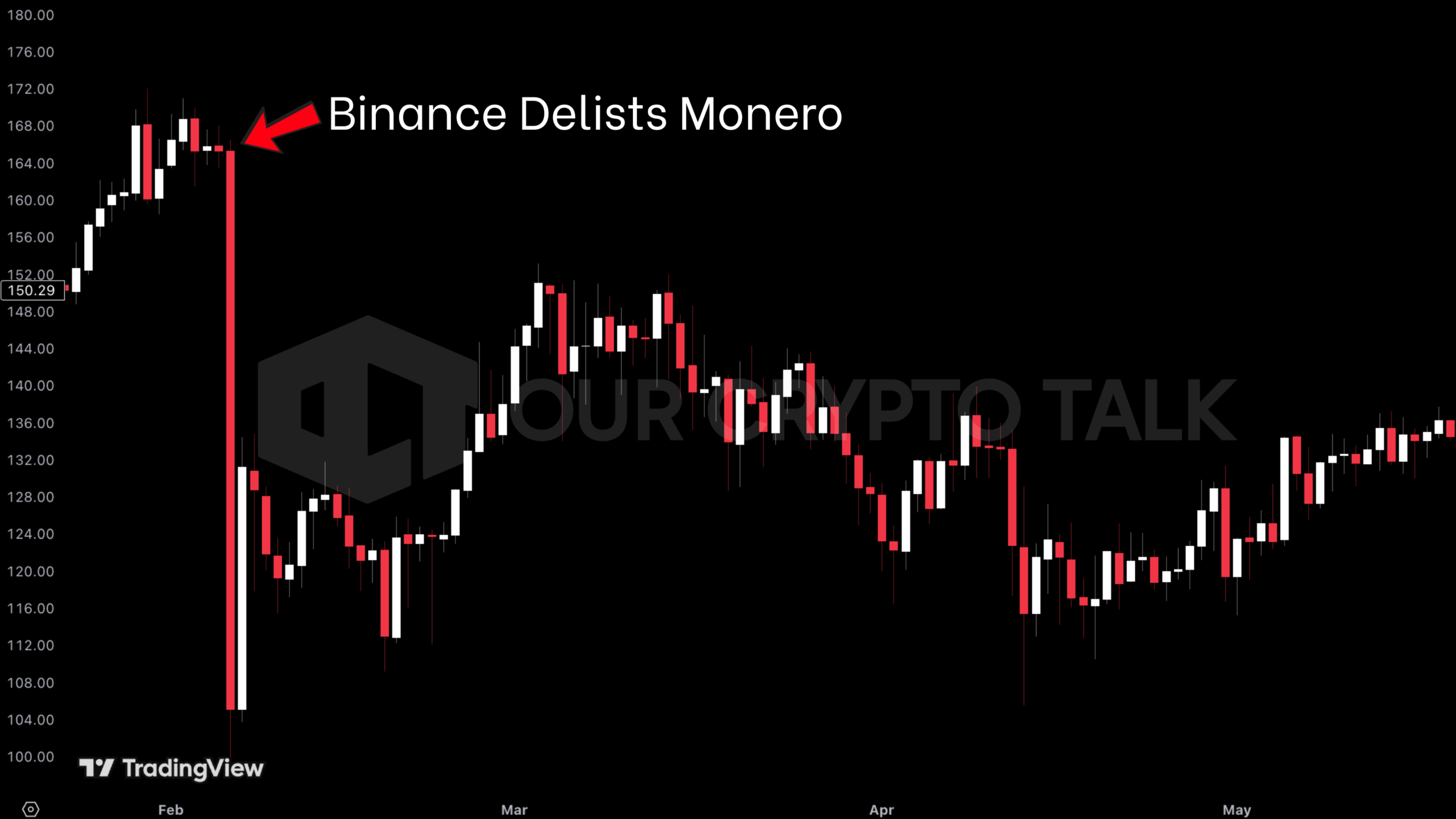
On February 6, 2024, Binance announced it would delist XMR. The token crashed 37% in 12 hours, plunging from $160 to $100. OKX had already delisted it in January. Kraken removed it for UK users in 2021. Huobi followed in 2022.
But Monero bounced. Within 24 hours it recovered 23% to $130. By June 2024, just four months later, it was back above $160. XMR recovered its full pre-delisting price without any major exchange relisting it.
Why did Monero survive when WAVES, OMG, and LINA did not? Three reasons. First, genuine transactional demand — people use it for privacy, not speculation. Second, a decentralized community that does not depend on exchange visibility. Third, liquidity migrated naturally to atomic swaps, peer-to-peer platforms, and DEXs.
Compare Monero's outcome to WAVES. Both delisted from Binance in 2024. WAVES is now down 97% from ATH with no recovery in sight. Monero recovered fully within months. The difference was not marketing or VC backing. It was genuine demand from real users who needed the product regardless of where it traded.
If the only reason people hold your token is because it sits on Binance, you have a listing — not a project.
— OCT Research, May 2026
Monero (XMR) crash and recovery after Binance delisting. Unlike most tokens, XMR fully recovered within 4 months without any exchange relisting.
XMR PRE-DELIST
$160
Feb 5, 2024
XMR CRASH LOW
$100
–37% in 12 hours
24H RECOVERY
$130
+23% bounce
FULL RECOVERY
4 months
No relisting needed
§ 08
Binance's Vote to Delist: When the Community Decides Your Fate
In April 2025, Binance launched a Vote to Delist program. The exchange let its own users vote on which tokens should be removed. 14 tokens were delisted in the first batch. Over 93,000 valid votes were cast after filtering fraudulent accounts.
TROY received the most votes at nearly 5,000. The market reaction was instant carnage. TROY crashed 59%. HARD dropped 59%. NULS fell 48%. UFT lost 46%. Every single token in the batch saw double-digit losses within hours.
The controversial part: FTT (the FTX token) received 11.1% of votes in the second round but was not delisted. Binance responded that votes are not the sole deciding factor and internal reviews still apply. This inconsistency made many question whether the program represents real governance or a PR exercise.
For projects, the Vote to Delist adds a new dimension of risk. Your community now has a direct mechanism to push you off a platform. Community management is no longer optional. It is a survival requirement.
Binance Vote to Delist — April 2025 Results
#
MV
Asset
Price
24h %
7d %
Volume
Cap
01
TROY
TROY
-59%
+%
02
Status
SNT
-42%
+%
03
UFT
UFT
-46%
+%
04
HARD
HARD
-59%
+%
05
NULS
NULS
-48%
+%
06
BADGER
BADGER
-33%
+%
07
VIDT
VIDT
-37%
+%
08
CREAM
CREAM
-35%
+%
§ 09
The 2026 Delisting Wave: Real DeFi Projects Are Not Safe
If 2025 taught us that memecoins get delisted, 2026 is teaching a harder lesson.
Look at Binance's April 1, 2026 batch: Loopring (LRC), a legitimate Ethereum Layer 2 with zkRollup technology. Radiant Capital (RDNT), a cross-chain lending protocol that once held over $100 million in TVL. Neutron (NTRN), a Cosmos-based smart contract platform. These are not rug pulls. These are projects that built real products but failed to sustain the volume thresholds exchanges now demand.
The April 23 batch went further. Beefy Finance (BIFI), one of the most recognized yield aggregators in DeFi, was removed. Orchid (OXT), listed since 2019, was cut. Wanchain (WAN) was dropped. Each had working protocols and active smart contracts on multiple chains.
The upcoming May 27 batch includes Harvest Finance (FARM) and Enzyme (MLN), two of DeFi's earliest yield and asset management protocols. Kraken is also removing FARM in its May 29 batch, meaning the project loses two major exchanges in the same week.
The message from 2026 is unmistakable: having a working product does not protect you from delisting. What protects you is a working product that people actively use in sufficient volume. Exchanges are businesses. If your token is not generating fees for them, you are taking up a slot that could go to something more profitable.
Meanwhile, the listing side tells the opposite story. Morpho landed on Binance with a market cap above $870 million because it has real lending activity. Pi Network got its first Tier 1 listing on Kraken because it has millions of active users. Virtuals Protocol debuted on Coinbase because the AI agent narrative generates real trading volume. The exchanges are not anti-project. They are pro-activity.
Binance 2026 Spot Delisting Batches — What Got Cut and Why
April 1 Batch
8 tokens removed
April 23 Batch
6 tokens removed
May 27 Batch
5 tokens upcoming
Notable tokens
LRC, RDNT, NTRN, SXP, FORTH
BIFI, OXT, WAN, MDT, FUN
FARM, MLN, SYS, ATA, PHB
Category
L2, DeFi Lending, Cosmos L1
Yield Aggregator, VPN, Cross-chain
Yield, Asset Mgmt, L1
Peak TVL / significance
LRC $200M+ TVL, RDNT $100M+ TVL
BIFI multi-chain pioneer, OXT since 2019
FARM DeFi OG, MLN since 2017
Primary removal reason
Volume below threshold
Sustained low liquidity
Volume and activity decline
Also on Kraken?
No
No
FARM yes — delisted same week
Recovery odds
Low
Very low
Near zero for most
§ 10
What Projects Should Actually Care About (Instead of Listings)
A listing without fundamentals is just a countdown to a delisting.
Multi-exchange distribution. If 80% of your trading volume sits on one exchange, you are one blog post away from disaster. Spread liquidity across Binance, Coinbase, Kraken, OKX, and at least two decentralized exchanges. Notice how FARM is being delisted from both Binance and Kraken in 2026 simultaneously. If your only other option is a small DEX pool, your project is in serious trouble.
Real usage, not just speculation. Monero survived every delisting because people actually use it for transactions every day. Ask yourself honestly: if every exchange removed your token tomorrow, would anyone still need it? If the answer is no, you have a speculative token, not a project.
Consistent development activity. Exchanges check your GitHub. They look at commits, active contributors, and release frequency. A project with no meaningful dev activity for six months is an automatic delisting candidate. Ship code. Ship it often. Ship it publicly.
Transparent communication. Multiple delisted projects cited poor public communication as a contributing factor. Run regular updates. Publish roadmaps with specific dates. Respond to exchange inquiries within hours. Silence is the single biggest red flag a review team can see.
Volume sustainability over volume spikes. The 2026 delistings make this crystal clear. Projects like Loopring and Beefy Finance had real volume at their peak. But volume faded as narratives shifted. Exchanges do not care about your 2022 volume. They care about last month. Build recurring usage, not hype cycles.
Decentralized liquidity as a safety net. Every serious project should maintain liquidity pools on Uniswap, SushiSwap, or equivalent DEXs from day one. If you get delisted from three centralized exchanges tomorrow, your community should still be able to trade without friction or delay.
§ 11
The Bottom Line: Build for Independence, Not for Listings
Every project in Web3 chases the same goal: get listed on a top exchange. But the data from 2019 through 2026 does not support that as a strategy. Not even close.
Listings are temporary. Exchange standards change every quarter. Regulatory landscapes shift overnight. In 2026, even well-built DeFi protocols with real on-chain activity are losing their exchange homes because the volume game changed under their feet.
The projects that survive delistings share three traits: real utility that exists beyond speculation, distributed liquidity across multiple venues, and a community that does not need exchange validation to stay active. Monero has all three. BSV had none. XRP survived because Ripple could afford to fight. WAVES could not. Loopring and Beefy had the tech but not sustained activity, and now face the same fate.
Stop optimizing for exchange listings as your primary milestone. Start optimizing for exchange independence as your survival strategy. Build a product people use regardless of where it trades. Build liquidity pools that no centralized entity can shut down. Build a community that stays loyal even when the biggest exchange in the world decides to walk away from you.
Where These Tokens No Longer Trade
Selected tokens delisted from major exchanges, 2024–2026. 24h vol prior to removal shown.