Deep Dive
10x or Zero: Inside theTwo Crypto Gambles
The Real Guide to Crypto’s Two Fastest Paths to Wealth


The Real Guide to Crypto’s Two Fastest Paths to Wealth
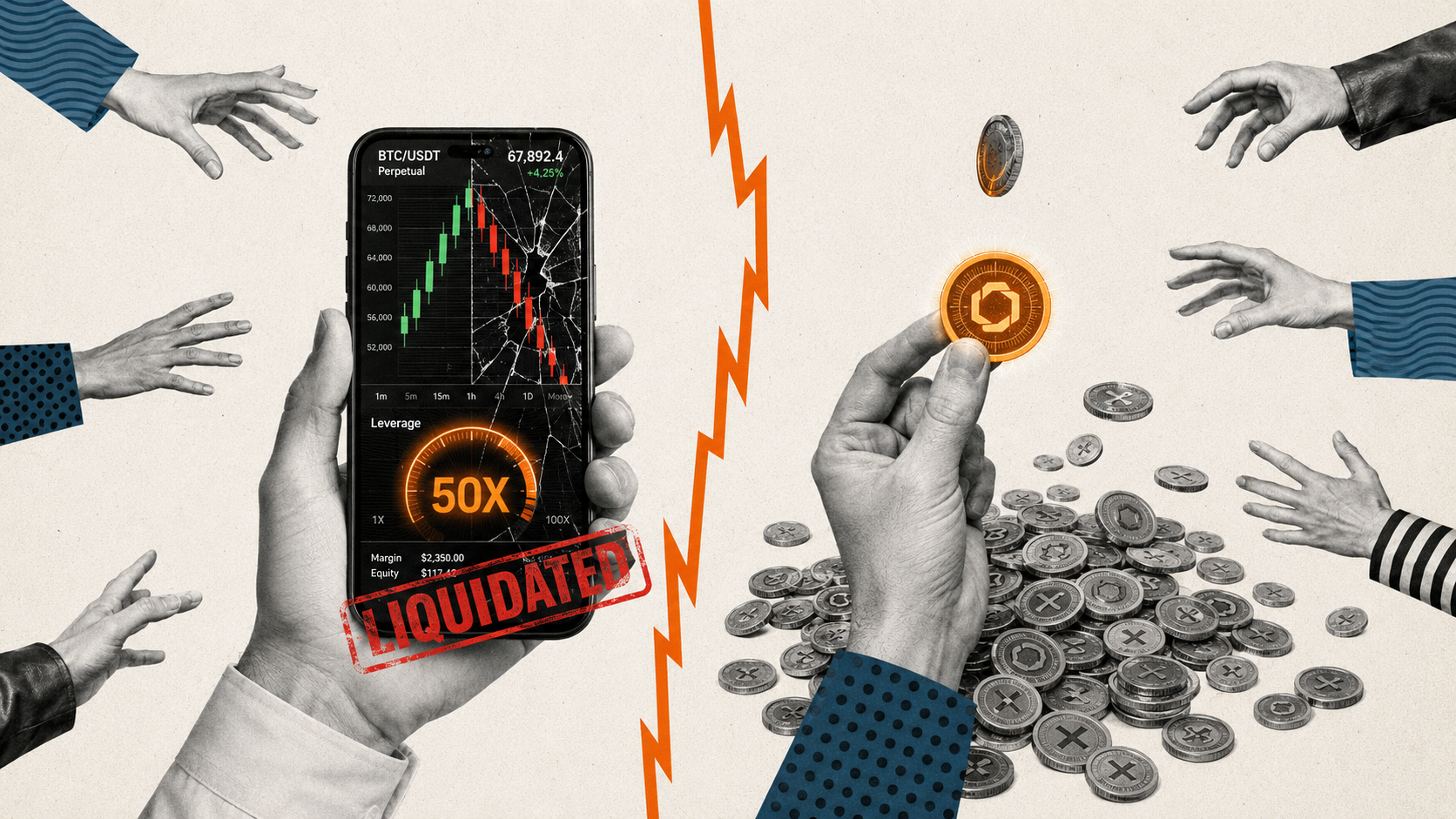
Here is the situation most crypto retail traders are actually in. Not the ones they post about. The real one.
You have a few hundred dollars, maybe a couple of thousand. Bitcoin is at $100,000 and your $500 buys you 0.005 BTC. Even if BTC doubles, you make $500. That does not change your life. It does not pay off debt. It does not cover a month of rent. So you start looking for something else.
In crypto, two options keep showing up everywhere you look. The first is leverage trading: use borrowed capital to control a bigger position, amplify your gains on directional moves, and turn a $500 margin into a $5,000 profit on a 10x bet. The second is low cap gems: find a project at a $5 million market cap before the crowd does, buy early, and ride it to $500 million.
Neither of these is irrational. BTC at $100,000 does not produce life-changing gains for someone with $500. That is not pessimism. That is arithmetic. For a $500 account to become $50,000, you need a 100x. You need leverage or you need early entry into something illiquid. There is no third path that works at that math in any reasonable time horizon.
The market knows this. That is why perpetual futures platforms do billions in daily volume from retail accounts. That is why pump.fun processed millions of token launches in 2024 and 2025. The demand is not irrational. It is the logical output of a math problem that small capital cannot solve any other way.
This report covers both strategies with real data and real case studies. No cheerleading. No scare tactics either. Just the full picture so you can make an informed decision about where your capital actually goes and what you are genuinely up against when you use either approach.
The math of small capital forces the hand. You either borrow to amplify, or you go early to find the multiplier. There is no third path that produces a 10x in months on a $500 account.
Leverage trading sounds simple until you have used it. Then it sounds terrifying. Both reactions are correct.
Here is the basic mechanic. You deposit margin and use it to control a much larger position. At 10x leverage, $500 controls $5,000 worth of BTC. A 10% move in your favor doubles your money. A 10% move against you wipes you out completely. That is the version most people understand before they start.
What most people do not understand before they start: perpetual futures. On Binance, Bybit, and Hyperliquid, you are not buying or selling the actual asset. You are taking a directional bet and paying or receiving funding rates every 8 hours depending on whether the market is net long or net short. In a bull run, long positions pay short positions. At high leverage, that funding rate drag matters before the price has moved anywhere near enough in your favor.
The liquidation price is the number you need to know before you enter any trade. Not after. Before. At 10x leverage, your liquidation is roughly 10% away from entry. At 20x, it is 5%. At 50x, it is 2%. Crypto moves 3 to 5% in a single hour regularly. At 50x leverage, you are one candle away from zero on a completely normal day.
Over 80% of Binance Futures retail traders operate at 20x leverage or higher. That is not occasional 20x on special trades. That is their standard mode. The mismatch between the leverage most retail traders use and the leverage that is survivable over time is the single biggest reason most accounts end in losses. The exchange is not doing anything wrong. The math just runs.
There is also a liquidation cascade mechanic you need to understand. When prices fall, long positions get liquidated. Those liquidations create forced market sell orders. Those sell orders push the price down further, which liquidates more longs. It becomes self-reinforcing fast. October 10, 2025 is the clearest documented example: $3.21 billion liquidated in a single minute. Over 1.6 million traders affected in one event.
The blowup stories are not edge cases. They are the median outcome. But leverage does produce real winners. Here is what separates them.
The Reddit DCA trader case from October 2025 is the one that should stick with you. Six years of dollar-cost averaging into Bitcoin. A portfolio built slowly, carefully, with discipline. Then: leveraged perpetuals to accelerate gains during what looked like a bull cycle. Caught in the October 10 cascade. Net worth collapsed to roughly one month's salary. No stop losses. Position sized on optimism rather than liquidation math. Six years of the right strategy, undone in hours by switching to one that requires skills they did not have.
The qwatio case is different and in some ways worse. A documented $12.5 million loss across a single week on crypto perpetuals. The pattern was not one bad trade. It was the same oversized position re-entered four or five times in a row after each liquidation. Every time the account was rebuilt or topped up, the response was to get back to even immediately. This is the revenge trading loop. It is the most common way large accounts blow up. Not in one catastrophic trade. In four consecutive emotional ones.
Now the success story, because it is real. Bitcoin went from roughly $25,000 in early 2023 to above $126,000 by late 2025. A trader with $2,000 to $5,000 in margin at 10x leverage, correctly positioned long on BTC perpetuals with a trailing stop during that run, could realistically have turned that margin into $20,000 to $50,000 in gains.
The Hyperliquid whale case from early 2026 is the high end. A 5x leveraged long on BTC and ETH combined with a 10x long on SOL generated $40 million in unrealized profit. That is not luck. That is a correct macro thesis executed with leverage that was aggressive but not suicidal. The difference between that outcome and the Reddit trader's outcome is not intelligence. It is position sizing, stop discipline, and a liquidation price that was calculated before entry, not discovered by surprise.
The pattern across every documented leverage success story in this cycle: 5x to 20x maximum leverage, not 50x to 100x. Stops set and not moved. Profits taken before reversals, not held hoping for more. The traders who won did not use leverage more aggressively than the ones who lost. They used it less aggressively and stuck to their plan when the market moved against them.
Leverage does not kill accounts. Leverage combined with no stop losses, oversized positions, and the emotional need to recover losses immediately kills accounts. Those three things together are what 80 percent of retail traders do.
Low cap gem investing is the most seductive strategy in crypto because the logic is airtight and the failure rate is brutal at the same time.
The logic is genuinely compelling. A project with a $5 million market cap only needs to reach $500 million to give you a 100x return. A project with a $50 million market cap needs $5 billion for the same result. Enter earlier, need less movement. It is correct. The problem is not the math. The problem is finding the ones that actually make the move and getting out before they give it all back.
Pump.fun built a new category of low cap investing on Solana. Anyone can launch a token in minutes, no technical knowledge required, using a bonding curve where early buyers pay the lowest prices and every subsequent buyer pushes the price higher. The platform processed millions of token launches in 2024 and 2025. CoinGecko confirmed 11.6 million token failures in 2025 alone.
The graduation rate, meaning tokens that reach any meaningful market cap threshold, stayed below 1% throughout 2025. Think about what that means for your capital allocation strategy. For every 100 tokens launched, fewer than one crosses the finish line. The other 99 go to zero, often within hours. If you are buying pump.fun launches randomly, you are playing a game where 99% of individual bets lose.
The meme coin market cap hit $150 billion at its January 2025 peak. Real money moved through this space. Real gains were made. But the total number of crypto projects exploded from 428,000 in 2021 to nearly 20.2 million by end 2025. More than half of all tokens ever listed on GeckoTerminal are now inactive. The winners are real. They are sitting inside a mountain of corpses.
Your downside in low caps is capped at 100% of what you put in. No margin calls. No liquidation cascades. But your upside requires finding the right token before the crowd and exiting before the dump. Both of those require skill, network, and timing. Most retail investors have all three in the wrong sequence: they arrive after the crowd and hold through the dump.
Three case studies. Two of them worked for someone. One of them is the story that $107,000 worth of sizing mistakes tells best.
FARTCOIN launched on pump.fun in October 2024 with an effective market cap in the single-digit thousands. By January 2026 it reached approximately $2.4 billion. Early buyers who found it on the pump.fun trending leaderboard and exited near the peak made thousands to tens of thousands of percent. That is real. The catch is that most buyers were not early. They entered at $100 million, $500 million, $1 billion on the way up. Those buyers experienced a very different version of the same token. The top 1% of early holders captured most of the actual gains.
$MOTHER (Iggy Azalea) launched in mid-2024 at sub-$1 million market cap and hit $240 million in two weeks on celebrity-driven hype. Early buyers who sold near the peak made hundreds to low thousands of percent. What happened next: the token fell 80%, settling near $50 million. The pump was fast. The dump was faster. Most buyers who saw news coverage of the launch had already missed 80% of the gains before they clicked buy.
Then there is the $COW case. $109,900 put into $COW at what looked like a reasonable entry. Exit value: $2,630 after the collapse. That is a 97.6% loss on over $100,000. This is not a small account lesson. This is a reminder that sizing matters enormously in low cap plays. Putting over $100,000 into a meme token with no exit plan is not a strategy. It is a hope. And the market does not honor hope.
What do these three cases tell us? FARTCOIN and $MOTHER confirm that the gains are real for early buyers with exit discipline. $COW confirms that position sizing without an exit plan destroys accounts at any size. The strategy works at the portfolio level across many small bets, not at the concentrated single-token level. Diversify across 5 to 10 positions. Size each one so a 100% loss on any single token is survivable.
The celebrity launch pattern deserves its own warning. Celebrity-driven tokens create extremely sharp entry windows and even sharper exits. The window between launch and peak is often days. The window between peak and 80% drawdown is even shorter. If you are reading about a celebrity launch in the news, you are almost certainly not early enough. The people who made money on $MOTHER were in the first 48 hours, not the first week.
Meme coins get the headlines. But the 2023 to 2024 cycle produced something more interesting: projects with actual technology that behaved like lottery tickets at early entry prices.
Render Network (RNDR) entered 2023 as a genuine DePIN infrastructure project connecting GPU owners with artists and AI builders needing compute power. Early buyers who found it at $0.04 and held to the March 2024 ATH of $13.57 made roughly 340x. Today the token trades at around $1.57, down 88% from that peak. The product still works. The narrative is still intact. The price reflects the reality that most altcoins follow BTC liquidity cycles more than their own fundamentals in the short term.
Bittensor (TAO) is the best example of a conviction play that rewarded patience. At $30 in May 2023. At $795 in April 2024 on the back of the AI x crypto narrative catching fire. That is a 26x in under 12 months for anyone who held through a lot of sideways action and noise. The current price around $210 represents a 73% drawdown. This is the trap most retail investors fall into: buying at $400 on the way up, holding through the top, exiting at $200 on the way down, losing money on a project that was actually a 26x from the real entry point.
Kaspa (KAS) is the extreme case. All-time low $0.00017 in early 2023. ATH $0.207 in July 2024. That is 1,200x from the absolute bottom. Even from $0.001, a still very early entry, it was a 200x. Today KAS trades around $0.030, down 85% from the ATH but still thousands of times above its 2022 price. The people who made life-changing money on KAS were not the ones who bought at $0.10 in March 2024. They were the ones sitting in a ghost chain with a tiny community two years earlier.
The pattern across every narrative token in the 2023 to 2024 cycle is identical. Extreme gains from the real entry point. Extreme drawdowns from the ATH. Most retail investors experienced the second half because the first half happened before the narrative was visible to them. By the time RNDR, TAO, and KAS were in every crypto newsletter, the 10x to 100x was already in the past.
What does this actually tell you about how to play the next cycle? You need to be in the project before the story is written. The story is what brings in the liquidity that creates the return. If you are reading about the story, you are arriving after the best entry. The thesis-driven investor who finds KAS at $0.001 because they believe in proof-of-work and blockDAG architecture before anyone else cares is the one who makes 200x. Not the person who sees KAS trending on CoinMarketCap in 2024.
| # | MV | Asset | Price | 24h % | 7d % | Volume | Cap |
|---|---|---|---|---|---|---|---|
| 01 | ~$0.030 | +0.00017% | +0.207% | ~1,200x peak gain / -85% from ATH | |||
| 02 | ~$166M MC | -1% | +4% | 1,000x+ from entry / -75% MC from ATH | |||
| 03 | ~$1.57 | +0.04% | +13.57% | ~340x peak gain / -88% from ATH | |||
| 04 | ~$210 | +30% | +795% | ~26x peak gain / -74% from ATH |
The pattern across every narrative token in the 2023 to 2024 cycle is identical. 10x to 1,200x from the real entry point. 70 to 88 percent drawdown from the ATH. Most retail investors experienced the second half, not the first.
You found a low cap gem. You bought early. The price is up 50x. And now you cannot sell. This is the story the upside screenshots never include.
A token with a $10 million market cap might have only $200,000 to $500,000 in actual daily trading volume. If you try to sell a $50,000 position, you are moving 10 to 25% of daily volume yourself. Your sell order moves the price against you as you exit. The quoted price is not the price you get. This is not a technical edge case. This is standard mechanics in any low-liquidity market.
The slippage on large exits from small liquidity pools can eat 5 to 20% of your gains before you have even pressed the button. On a 50x gain, that is still a great outcome. But on a 5x gain that you are trying to exit quickly as price starts reversing, slippage can turn a profitable trade into a breakeven or worse.
In a market downturn, liquidity in low cap tokens does not thin out. It disappears entirely. Bid side collapses. Spreads widen to 10, 20, 30%. Market makers pull out. If you are trying to exit a meaningful position in a low cap during a broad market sell-off, you may simply not be able to get out at any price resembling the displayed quote. This is not a rare event. It happened across hundreds of tokens in every major correction from 2022 through 2025.
The practical check before you enter any low cap position: look at the 24-hour trading volume, not just the market cap. A $10 million market cap token with $50,000 daily volume cannot absorb a meaningful exit without destroying the price. If your planned position size represents more than 10% of daily volume, you have a liquidity problem that no amount of thesis conviction will solve when you need to get out fast.
You could show most retail traders the statistics in this report before they start and it would not change their behavior. That is not stupidity. That is psychology.
A Kraken survey from late 2024 found that 84% of crypto holders had made decisions based on FOMO and 81% had made decisions based on FUD. 63% said their emotional decisions had negatively impacted their portfolios. These are not edge cases. These are the majority of the market acting against their own financial interests repeatedly, knowingly, and not stopping.
FOMO in crypto is not passive. It is actively manufactured. Social media feeds filled with green candles, profit screenshots, and alpha calls from anonymous accounts whose losses are never posted. You see the wins constantly. The losses are private. The information environment is structurally optimistic about every bad strategy, all the time. The person who lost $107,000 on $COW is not posting about it. The person who made $200,000 on FARTCOIN is posting about it every week.
Novice traders, those with under 12 months of experience, report FOMO-driven trades in roughly 78% of their decisions. Traders with over 3 years of experience report the same in only 31% of decisions. Experience does not make people immune to emotion. It gives them more reference points for what happens when they act on it. The expensive lesson is the lesson that sticks.
After a liquidation or a token collapsing 80% in a day, the natural human response is not to step back and reassess. It is to recover the loss immediately. This produces the revenge trade in leverage: a bigger position than the last one, entered from emotion rather than analysis, to get back to even faster. In low caps it produces the chase: jumping into the next pump.fun launch because you missed the last one, entering at a price that is already 10x off the bottom.
Data from the October 2025 crash analysis of 88,620 anonymized trades showed that recovery was faster and margin control improved for traders who checked risk levels before entering, not after getting liquidated. The discipline to stop after a loss is the skill most retail traders never develop because the market never forces them to. There is always another trade. Until there is not.
84 percent of crypto holders have made decisions based on FOMO. 63 percent said those decisions hurt their portfolios. These are not small numbers. These are the majority of the market acting against their own interests repeatedly.


| Leverage Trading Perpetuals, Binance/Bybit/HL | Low Cap Gems pump.fun / narrative tokens | |
|---|---|---|
| Retail loss rate | 70%+ accounts net negative over 12 months | 90%+ tokens go to zero in 12 months |
| Maximum gain potential | 5x to 10x on capital from correct directional move | 100x to 1,000x+ for true early entry |
| Ideal time horizon | Minutes to days. Funding rates punish holds. | Hours to months. Narratives define windows. |
| Maximum loss | 100% of margin per trade. Can re-enter. | 100% of position. Capped at what you put in. |
| Skill requirement | High. TA, position sizing, liquidation math, emotional control. | Moderate. Narrative reading, community signals, exit discipline. |
| Consistent 10x for under $1,000 | Possible in a trend with correct leverage. Not repeatable. | Extremely rare. Power law distribution. Most lose. |
| Biggest edge killer | Revenge trading after liquidation | Holding through the dump waiting for new ATH |
| Platform risk | Exchange hacks. Bybit $1.46B stolen Feb 2025. | Smart contract rugs, liquidity removal, developer abandonment |
| Best historical outcome for small capital | $40M Hyperliquid whale (5x to 10x leveraged bull run macro bet) | KAS 1,200x from 2023 bottom. FARTCOIN $10K MC to $2.4B. |
The core dynamics of both strategies have not changed. What has changed is the platform landscape and some important shifts in who is still playing.
Hyperliquid ended 2025 with approximately 1.4 million users, a 4x year-over- year increase. It has processed trillions in cumulative volume and added permissionless RWA perpetuals in October 2025 covering gold, oil, and stock indices. The Bybit hack in February 2025 ($1.46 billion stolen in one of the most sophisticated attacks in crypto history) accelerated the migration from centralized to decentralized perps platforms. If your leverage platform can be drained overnight, the on-chain alternative starts looking rational.
Pump.fun saw a notable data shift in April 2026. After months of consistent net losses for the majority of active wallets, April data showed 73.3% of active traders were profitable. The active wallet count had dropped from a 2025 peak of 5.2 million to a smaller, potentially more experienced cohort. The platform also added legal overhang from a lawsuit alleging unregistered securities exchange operations. No platform-wide bans emerged, but the regulatory pressure from MiCA in Europe and U.S. scrutiny creates real uncertainty for pure meme coin launchpads going into 2027.
The broader altcoin market illustrated the risk perfectly. RNDR, TAO, and KAS made 26x to 340x gains in 2023 to 2024, then spent most of 2025 giving back 70 to 88% of those gains. The technology did not fail. Render held RenderCon 2026 in Hollywood. Bittensor continued subnet expansion. Kaspa continued development. The technology working and the token price recovering are two completely different things that most retail investors treat as the same thing. They are not.
This is not financial advice. What follows is drawn from the patterns of people who have survived both strategies long enough to come out ahead. There are not many of them, but they exist and they share common habits.
After a liquidation, stop for 24 hours minimum. The data is clear on revenge trading. It produces bigger losses, not recoveries. Size your position so the worst case is survivable. If a single trade can wipe you out, the position is too big regardless of the leverage multiple. This sounds obvious. Over 80% of retail traders do not do it.
Check the 24-hour trading volume, not just the market cap. A $10 million market cap token with $50,000 daily volume cannot absorb a meaningful exit without destroying the price. Do not hold through dumps waiting for new highs. The data on 2023 to 2024 narrative tokens shows 70 to 88% drawdowns from ATH across every project. Taking 50% gains off the table on the way up is better than watching 100% evaporate on the way down.
Diversify across 5 to 10 positions rather than concentrating in one. The $COW case ($109,900 in, $2,630 out) is not an outlier. It is the median outcome for concentrated low cap bets. The strategy only works at the portfolio level, not the single-token level. The market does not care about your starting capital or your timeline. It cares about whether your risk management is better than your emotions. For most retail traders, it is not. That is why 80 to 90% lose. You can decide to be in the other group. The data tells you exactly what that requires.





