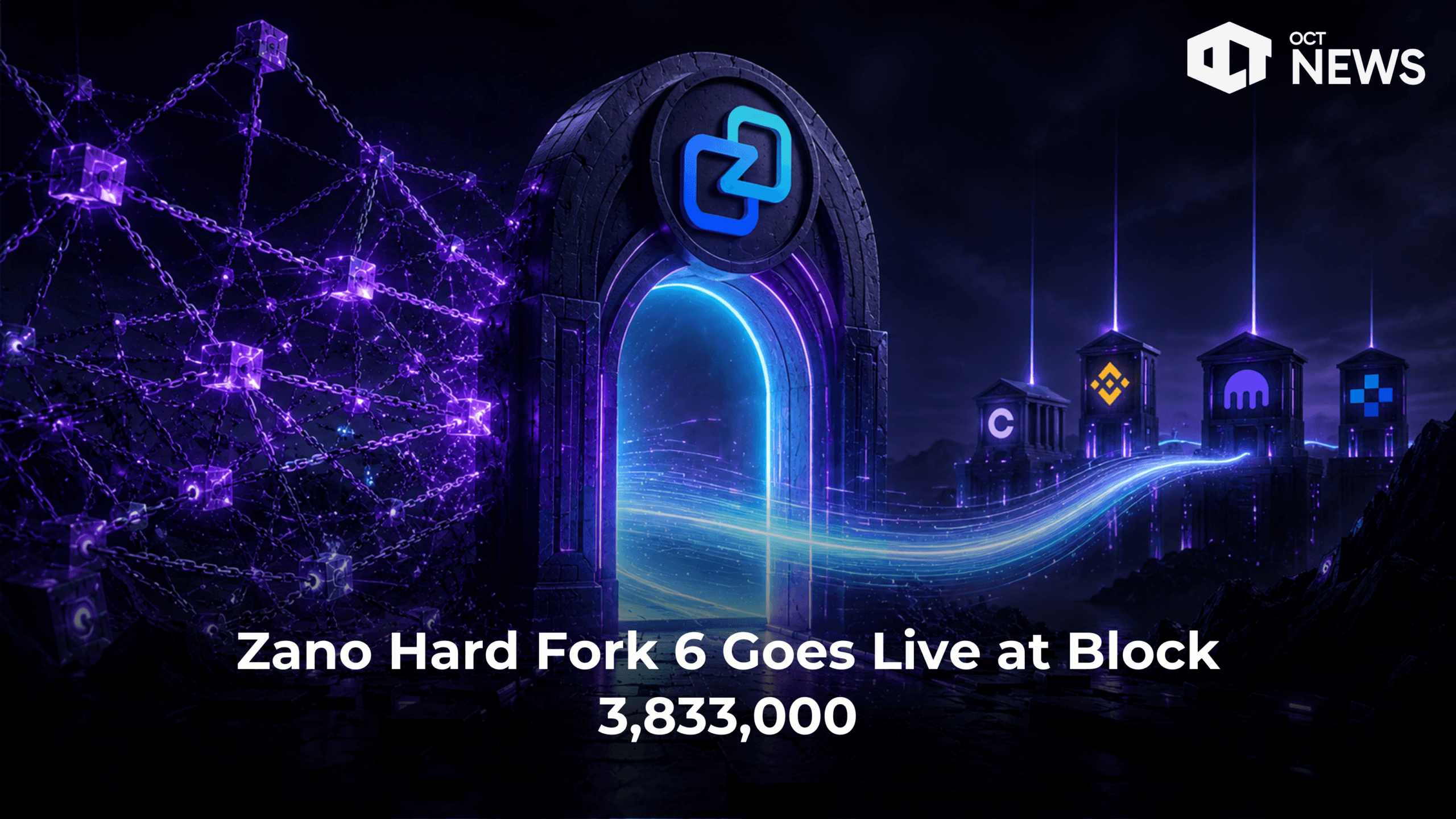
Zano Hard Fork 6 goes live at block 3,833,000, introducing Gateway Addresses for easier exchange, bridge, and DeFi integration.

Author: Akshay
High attention and emotional sentiment detected.
27th August 2026 – Zano Hard Fork 6 went live on mainnet at block height 3,833,000, and the privacy chain now runs its biggest upgrade in over a year. The official Zano project account announced the activation at 16:49:32 UTC on 26 August 2026. The headline change is a new account-based address type called Gateway Addresses.
High Signal Summary For A Quick Glance

MISTEX
@Mistex_io

@zano_project Awesome!! Congratulations to the team!🚀
Hard Fork 6 is LIVE 🔥 Zano just passed block 3,833,000 and yet another huge upgrade is now active on mainnet. What changes: 🔹 Gateway Addresses are live. Services like exchanges and bridges can now integrate Zano by reading a single account balance, instead of scanning the https://t.co/CBouKA1XVy
08:15 PM·Aug 26, 2026

Maria Amalia Rojas
@mariamalia_r
@zano_project Congratulations guys!! This is huge! 👏
Hard Fork 6 is LIVE 🔥 Zano just passed block 3,833,000 and yet another huge upgrade is now active on mainnet. What changes: 🔹 Gateway Addresses are live. Services like exchanges and bridges can now integrate Zano by reading a single account balance, instead of scanning the https://t.co/CBouKA1XVy
04:59 PM·Aug 26, 2026
The activation height was locked into signed code months earlier. Zano’s GitHub release v2.2.1.501 set the trigger at ZANO_HARDFORK_06_AFTER_HEIGHT = 3833000. So the fork was not a surprise. The team counted down to it for weeks.
Gateway Addresses are the reason the upgrade matters. They give services a single, readable on-chain balance instead of forcing them to scan the chain for hidden outputs. The prefixes are gwZ for standard and gwiZ for the integrated form.
Registration is permissionless, so no one approves who gets one. Each registration burns 100 ZANO. On a gateway transfer, the amount and the asset ID are public, which is the tradeoff that makes services comfortable.
The fork shipped more than one feature, though. It also added tighter fork-choice rules, intrinsic per-output payment IDs capped at 8 bytes, and hardened wallet-file encryption. Alongside those, the release brought P2P denial-of-service hardening with SOCKS5 and Tor proxy support, a mining-pool block simulation mode, and a reworked decoy selection.
Timeline: Zano’s protocol evolution across six mandatory hard forks, progressing from early consensus and staking changes to Atomic Swaps, Zarcanum privacy upgrades, bridge-compatible signatures, and Gateway Addresses.
Zano activates its first mandatory hard fork at block 194,624, introducing a new fork-choice rule alongside smoother difficulty adjustment and stricter staking requirements. The protocol upgrade establishes the foundation for subsequent height-gated network changes.
Zano activates HF2 at block 999,999, marking the second height-gated protocol upgrade. Surviving official material does not identify a specific branded product feature for this fork, so the milestone is best treated as a consensus and protocol-version transition rather than assigned an unsupported feature name.
The third hard fork activates Atomic Swaps at approximately block 1,082,577. The upgrade adds trust-minimized cross-chain exchange functionality and represents Zano’s first major interoperability-focused protocol milestone.
Zano activates Zarcanum at block 2,555,000, introducing hidden-amount Proof of Stake and Confidential Assets. The upgrade also implements 100% transaction-fee burning, increases ring size from 11 to 16, and incorporates Bulletproofs+ for stronger confidential transaction construction.
The fifth hard fork activates at block 3,076,400, adding Ethereum-style EVM signatures that allow threshold-signature bridge infrastructure to connect with Zano’s Confidential Layer. The upgrade also removes obsolete transaction formats as the network prepares for broader interoperability.
Zano activates HF6 at block 3,833,000, bringing Gateway Addresses to mainnet. The account-model address system is designed for exchanges and bridges, with features including a 100 ZANO registration burn, per-output payment IDs, and tighter fork-choice rules.
Zano’s next major protocol milestone is Zenith / HF7, currently targeted for 2027. The planned upgrade is expected to move the network toward a pure Proof-of-Stake architecture, although it has not yet been activated and remains a roadmap milestone.
A normal Zano address is a CryptoNote-style stealth address. Coins sit as hidden outputs, so a wallet must scan the chain with a view key and rebuild its spendable balance. For an exchange, that means weeks of custom engineering and a full rescan after any crash.
A Gateway Address works like an account instead. The chain stores a descriptor and a directly readable balance for it. As a result, a service can simply read the balance through an RPC call and restart instantly.
The owner key can be a Zano Schnorr key, an EdDSA key, or even a secp256k1 ECDSA key. So an Ethereum-style key, a multi-party setup, or a threshold signer can authorize spends. Owners can also rotate the key later.
According to the team, standard wallets stay exactly as private as they were before the fork. Stealth addresses still hide the receiver, ring signatures still hide which input was spent, and Bulletproofs+ still hide amounts. Gateway Addresses are built for services, not for everyday users.
Even when someone sends to a gateway, the sender stays hidden through stealth addresses and ring signatures. Only the amount arriving at the gateway is visible. Mobile users needed to do nothing, while unpatched desktop full nodes simply will not follow the new chain.
Not everyone frames it as a clean win, however. Analysts at House of Chimera call Gateway Addresses a transparent door into a private chain, comparing them to Zcash transparent deposit addresses. They warn that activity could leave Zano for public chains and may not return.
Gateway Addresses also unlock Zano’s Bridgeless system. That system is meant to move native $ZANO across to Ethereum, TON, and Solana as wZANO, replacing an older centralized wrapped-token bridge. The gateway acts as the lock address the bridge needs.
Still, an unlock is not the same as a live listing. The team says talks with THORChain, Maya Protocol, and Near Intents were underway before activation. Yet no signed integration shipped at the same moment as the fork.
Growth lead Quinten van Welzen leaned into that pitch hours before the height. “Nothing is standing in the way of a $ZANO THORChain integration anymore,” he wrote, adding that the community was ready whenever the venues were.
The price tape was calm on activation day. ZANO traded around $8.30 on 26 August, up roughly 1% on the day, with a market cap near $128 million, according to CoinGecko. Circulating supply sat near 15.4 million tokens.
The bigger move actually came earlier. On 24 August, two days before the fork, ZANO spiked to highs above $9 while the team posted its final countdown. So the market seems to have priced the anticipation before the switch flipped, not after.
Meanwhile, major outlets stayed quiet. Bitcoin.com News and TheStreet covered the June countdown, yet CoinDesk, The Block, Messari, and Decrypt published nothing on the activation. That absence is worth noting for readers weighing how widely the news traveled.
The team was honest that the hard part starts now. “The hardest barrier to Zano adoption just came down,” the activation post read, before adding that the work of getting exchanges and bridges integrated begins today. In other words, the protocol is live but the adoption is not.
A few things stay unverified for now. No confirmed on-chain gateway registration has surfaced yet, and no HF6-specific security audit was published. Zano’s own docs also still label Gateway Addresses as testnet only, a process lag the team will need to fix.
The real test is whether integrations actually ship in the coming weeks. If THORChain, Maya, or a centralized exchange goes live soon, Zano Hard Fork 6 could mark a genuine turn toward wider adoption. If nothing lands, the “that part starts today” framing will age fast. This article is not financial advice.
Our Crypto Talk is committed to unbiased, transparent, and true reporting to the best of our knowledge. This news article aims to provide accurate information in a timely manner. However, we advise the readers to verify facts independently and consult a professional before making any decisions based on the content since our sources could be wrong too. Check our Terms and conditions for more info.



Zano