Succinct Labs launches ZCAM iPhone app to prove photos and videos are real using cryptographic signatures at capture.

Author: Akshat Thakur
Steady attention without excessive speculation.
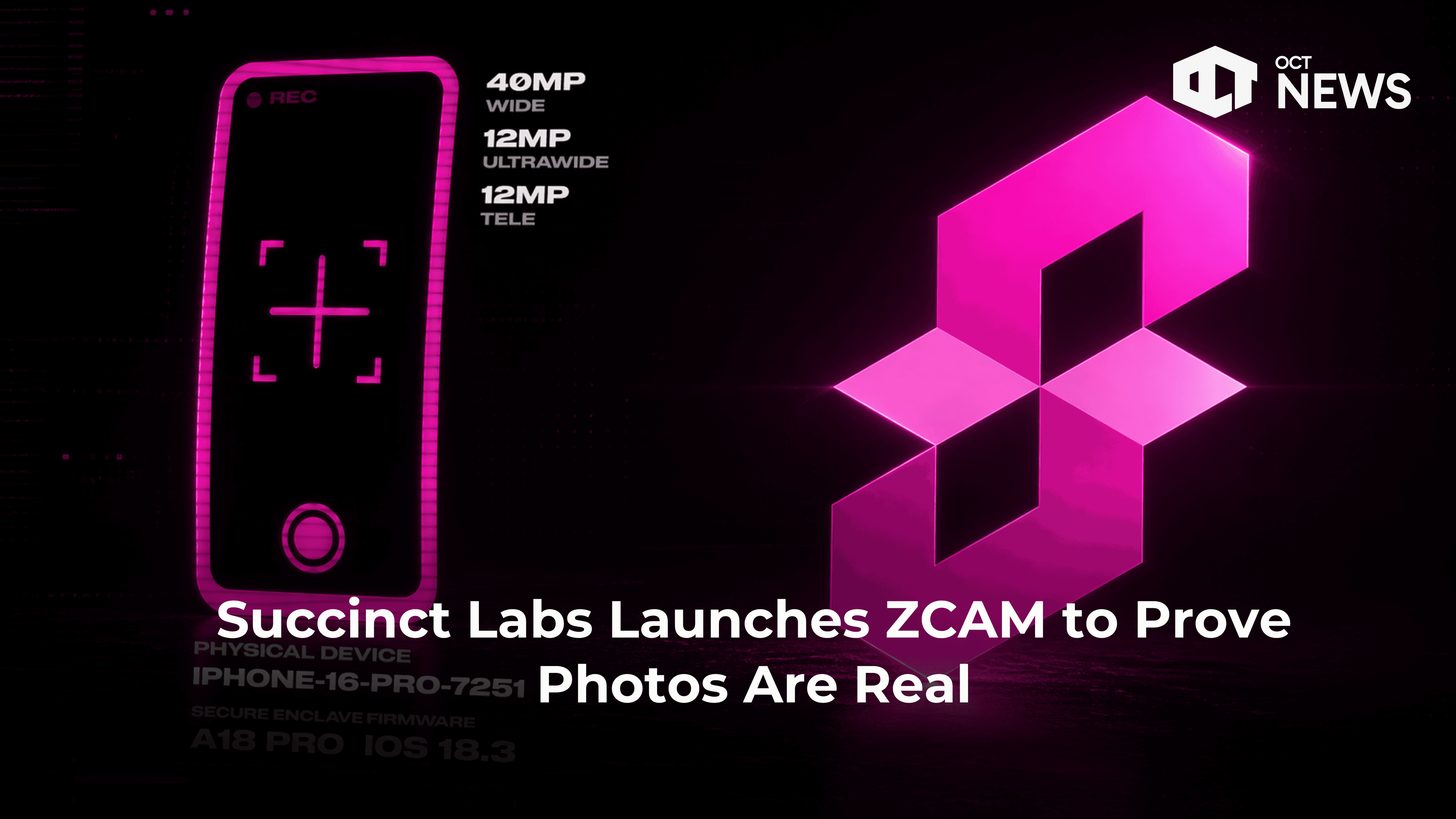
24th April 2026 – Succinct Labs launched ZCAM, an iPhone camera app that cryptographically proves photos and videos are authentic and unaltered at the moment of capture.
High Signal Summary For A Quick Glance

Zachary Dash
@ZacharyDash

@SuccinctLabs @bittybitbit86 Cool concept and problem space How do you prevent/know if someone took a picture of an AI image though?
Today, we're launching ZCAM, an iPhone camera app to Prove What’s Real. ZCAM cryptographically signs photos and videos at the moment of capture. Anyone can independently verify the content came from a real device and hasn't been altered or AI-generated. https://t.co/nHAYqVK1mW
08:22 PM·Apr 23, 2026

Aaron Guan
@aaronguan
@SuccinctLabs *takes a picture of a screenshot*
Today, we're launching ZCAM, an iPhone camera app to Prove What’s Real. ZCAM cryptographically signs photos and videos at the moment of capture. Anyone can independently verify the content came from a real device and hasn't been altered or AI-generated. https://t.co/nHAYqVK1mW
07:39 PM·Apr 23, 2026

CandF1010
@Scofiel15662444
@SuccinctLabs what if the original photo is a picture of AI-generated materials?
Today, we're launching ZCAM, an iPhone camera app to Prove What’s Real. ZCAM cryptographically signs photos and videos at the moment of capture. Anyone can independently verify the content came from a real device and hasn't been altered or AI-generated. https://t.co/nHAYqVK1mW
05:37 PM·Apr 23, 2026
The company announced ZCAM on April 23 via X, alongside a detailed blog post explaining the technical architecture. Instead of trying to detect AI-generated fakes after the fact, ZCAM takes the opposite approach. It proves what is real at the point of creation.
The app is now available on the App Store for iOS. Early access requires invite codes shared in replies to the announcement thread.
AI-generated images and videos have reached a point where humans and algorithms struggle to tell them apart. An iProov study found that only 24.5% of people can identify high-quality video deepfakes. Just 0.1% of participants correctly classified every sample.
Succinct Labs tested seven commercial AI detectors and reported that simple edits like blur, compression, or added noise reduced detection rates by up to 96%. Some detectors dropped to 4% accuracy. That data comes from Succinct’s own benchmarks and has not been independently verified.
Deepfake volume is also surging. The number of deepfake files grew from 500,000 in 2023 to a projected 8 million in 2025, according to data compiled by Keepnet Labs. Deloitte estimates that generative-AI-enabled fraud losses in the U.S. could reach $40 billion by 2027, up from $12.3 billion in 2023.
ZCAM creates a cryptographic chain of custody the moment it captures a photo or video. The process starts when the user opens the app and takes a shot.
First, ZCAM hashes the raw pixel data from the iPhone’s camera sensor before any processing or compression occurs. Then the app signs that hash using a private key generated and stored inside Apple’s Secure Enclave. This is a hardware security module on modern iPhones that protects keys from extraction.
Apple’s App Attest service then issues a cryptographic attestation. That attestation binds the signing key to the ZCAM app and to the specific device. As a result, the signature proves that the content originated from legitimate hardware running the verified application.
Finally, the system packages the hash, signature, and attestation into a C2PA manifest and embeds it directly into the media file. C2PA is an industry-standard format developed by Adobe, Microsoft, Google, and BBC to certify the provenance of digital content. The coalition now has over 6,000 members.
Any viewer or platform can then verify the file independently. They re-compute the hash, check the signature, and validate the attestation. If even a single pixel is altered, the hashes won’t match, and the proof fails.
Earlier media verification systems relied on post-capture watermarking or centralized servers. Both approaches can be bypassed or require trust in a third party.
ZCAM uses existing consumer hardware and an open standard for verification. The cryptographic proof travels with the file, so no platform or authority needs trust. Anyone with access to the C2PA specification can verify the content on their own.
Samsung shipped C2PA support on the Galaxy S25 in January 2025, but that implementation focuses on labeling AI-assisted edits rather than proving original capture authenticity. ZCAM specifically targets the moment of capture and signs the raw sensor data before any processing begins.
Key milestones in Succinct Labs and ZCAM Launch
Succinct Labs introduces OP Succinct, enabling OP Stack rollups to upgrade to validity proofs using zkVM-based verification.
Succinct develops tools to combat AI misinformation, combining ZK cryptography with hardware-backed identity and open standards.
ZCAM debuts as a camera app that signs media at capture using secure hardware, enabling tamper-proof verification of authenticity.
Succinct Labs is an applied cryptography company founded in 2022 and based in San Francisco. The team raised $55 million in a combined seed and Series A round in March 2024. Paradigm led the round, with participation from Robot Ventures, Bankless Ventures, and Geometry.
The company is best known for SP1, a high-performance zero-knowledge virtual machine. The Succinct Prover Network launched on mainnet in August 2025 and now supports over 35 protocols, including Polygon, Mantle, and Celestia. It has processed more than 5 million proofs and secures over $4 billion in digital assets.
ZCAM is Succinct Labs’ first consumer-facing product. The company’s tagline, “Prove what’s real,” previously applied to blockchain infrastructure. Now it extends to everyday media capture.
Succinct also released a ZCAM SDK so developers can integrate the same provable capture into their own apps. The company noted in its announcement that the SDK is currently “unaudited and not production-ready,” with a reference implementation available on GitHub.
Balaji Srinivasan, former Coinbase CTO, has publicly advocated for this approach. His argument is that AI makes everything easy to fake, but cryptography makes it hard again. ZCAM’s architecture aligns directly with that framework.
If adopted widely, the SDK could create a network effect where ZCAM-signed media becomes the expected standard for high-stakes content. Journalists, fact-checkers, and social platforms could require or prefer cryptographically verified media for credibility.
ZCAM proves that pixels are authentic, but it does not prove that a photo tells the full story. A cryptographically signed image can still be misleading if taken out of context or paired with a false caption.
The app also requires users to open a third-party camera instead of their default iPhone camera. That friction could limit adoption among casual users. Android support is not yet available, which excludes roughly half the global smartphone market.
The signing infrastructure depends on Apple’s Secure Enclave and App Attest service. Decentralized nodes handle verification, but Apple controls the signing layer. As of launch, ZCAM has not publicly disclosed any independent security audit.
The regulatory environment is aligning with ZCAM’s approach. The EU AI Act takes effect in August 2026 and mandates transparency labeling for AI-generated content. C2PA’s assertion format directly satisfies that requirement. CISA also recommended C2PA adoption for U.S. government media pipelines in January 2025.
Android support is a stated priority. The SDK, once audited and production-ready, could bring cryptographic capture to apps beyond ZCAM itself. Longer term, the technology could expand to video streaming, live events, and decentralized storage protocols.
Succinct Labs has already demonstrated the ability to ship production-grade cryptography at scale through its Prover Network. ZCAM tests whether that expertise translates into a consumer tool that shifts the balance against AI-generated misinformation. The app is live, the proof mechanism is public, and the first cryptographic camera for everyday use is now available.
Our Crypto Talk is committed to unbiased, transparent, and true reporting to the best of our knowledge. This news article aims to provide accurate information in a timely manner. However, we advise the readers to verify facts independently and consult a professional before making any decisions based on the content since our sources could be wrong too. Check our Terms and conditions for more info.