
Stablecoins milestone: $7.2T monthly volume tops ACH and Visa for the first time, signaling rapid adoption in global payments.

Author: Kritika Gupta
High attention and emotional sentiment detected.
9th April 2026- The stablecoins milestone reached a historic level in February 2026 as adjusted monthly transaction volume climbed to $7.2 trillion, surpassing both the U.S. ACH network and Visa for the first time. According to blockchain analytics platform Artemis, this marks a historic turning point for digital dollar infrastructure and highlights how stablecoins have evolved into a 24/7, borderless payment rail that operates independently of traditional banking hours and intermediaries.
High Signal Summary For A Quick Glance

Soil
@soil_farm

@Cointelegraph ACH (Automated Clearing House) is one of the core systems moving money across the U.S. banking system. Reaching this kind of scale is a strong signal of where stablecoins are headed. At SOIL, we see the next step as making that liquidity productive through stablecoin yield.
🚨 UPDATE: Stablecoins hit $7.2T monthly volume, surpassing U.S. ACH and Visa. https://t.co/YcR6mqyIhB
08:16 AM·Apr 9, 2026

OneSwap.ai
@oneswap_ai
@Cointelegraph Big volume number, but the real unlock is when users get ACH-level trust with crypto-native speed at the point of swap. If the quote slips, routes poorly, or KYC surprises show up late, mainstream users still feel like the rails are broken.
🚨 UPDATE: Stablecoins hit $7.2T monthly volume, surpassing U.S. ACH and Visa. https://t.co/YcR6mqyIhB
05:29 AM·Apr 9, 2026

normy
@web_normycry
@Cointelegraph Everyone focused on volume but the real question is what chains can actually support regulated stablecoins at scale, one of the Chains that stands out for me is @Concordium what chains do you guys have in mind???
🚨 UPDATE: Stablecoins hit $7.2T monthly volume, surpassing U.S. ACH and Visa. https://t.co/YcR6mqyIhB
04:20 AM·Apr 9, 2026
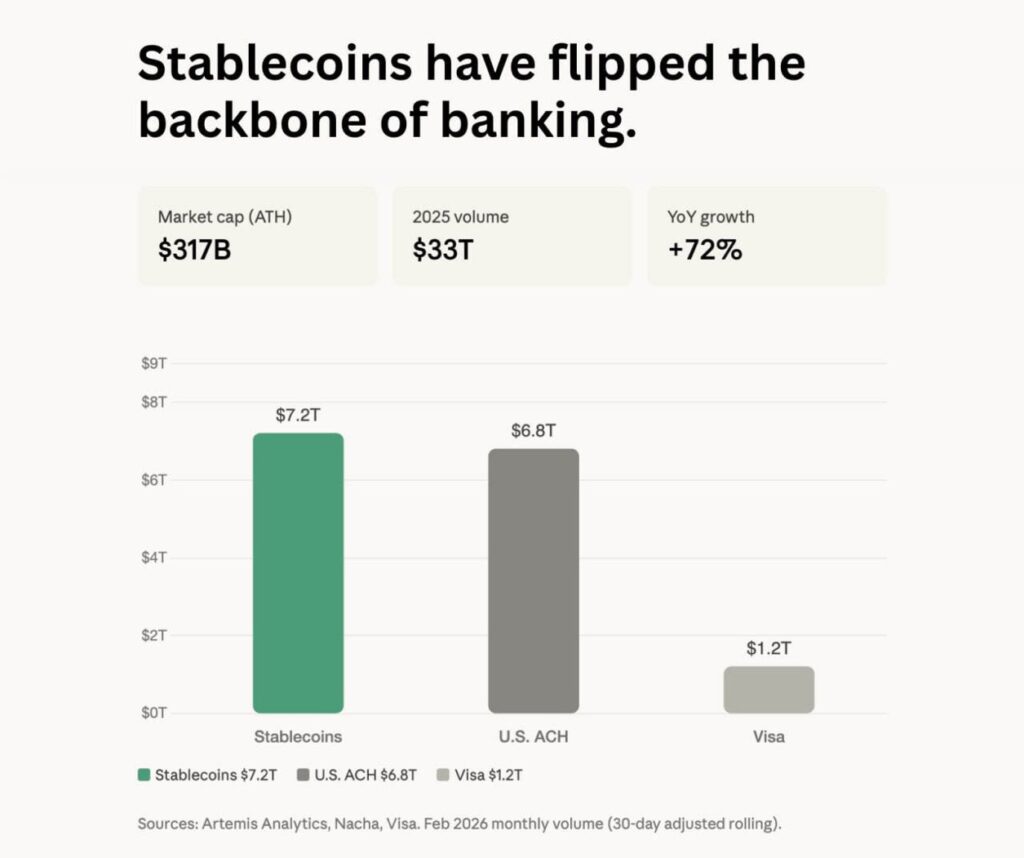
Several converging factors drove this breakthrough. First, real-world utility expanded rapidly, particularly in business-to-business settlements and cross-border transfers. Industry estimates now suggest that nearly 60% of stablecoin volume comes from B2B flows, where companies increasingly use on-chain dollars for treasury transfers, supplier payments, and international settlements.
Second, faster and cheaper blockchain networks accelerated adoption. In particular, networks such as Solana have become increasingly important because they offer low transaction fees, fast finality, and continuous settlement. As a result, they are more suitable for high-frequency payment activity than many legacy financial rails.
In addition, improving regulatory clarity in major jurisdictions has strengthened institutional confidence. Regulatory progress in the United States and other key markets has encouraged banks, fintech firms, and payment providers to actively explore stablecoin integrations. Furthermore, enterprise integrations have played a major role in this growth.
Relative positioning against past stablecoin volume milestones
The milestone has drawn significant attention across both traditional finance and crypto markets. Analysts at firms such as GSR and Standard Chartered increasingly describe stablecoins as core financial infrastructure rather than speculative crypto instruments. The market narrative has shifted from viewing stablecoins merely as trading tools to recognizing them as a global payments layer.
The contrast with traditional systems is becoming increasingly clear. Stablecoins move value instantly, globally, and around the clock, while reducing intermediary costs and bypassing banking-hour limitations. By comparison, ACH still relies on batch processing windows, while card networks such as Visa continue to depend on legacy issuer-acquirer infrastructure.
At the same time, some analysts have urged caution. Raw stablecoin volume figures can occasionally overstate real economic usage because they may include exchange settlement and DeFi activity. However, Artemis specifically uses adjusted rolling volume metrics, which filter out non-economic flows and therefore provide stronger evidence of genuine utility growth. As a result, market participants increasingly view this milestone as validation that stablecoins are moving beyond speculation and into real financial operations.
This shift carries major implications for global finance. In the near term, stablecoins are becoming a credible alternative for cross-border remittances, corporate treasury settlements, supplier payments, and payroll flows in emerging markets. This is particularly important for remittances, where high fees and settlement delays have historically created significant friction in a market worth tens of billions of dollars annually.
Looking further ahead, this milestone could reshape how money moves globally. Standard Chartered now projects that the stablecoin market cap could reach $2 trillion by 2028, which would imply substantial expansion from current levels. If this trajectory continues, stablecoins could increasingly serve as a foundational settlement layer for both crypto-native and traditional financial institutions.
Our Crypto Talk is committed to unbiased, transparent, and true reporting to the best of our knowledge. This news article aims to provide accurate information in a timely manner. However, we advise the readers to verify facts independently and consult a professional before making any decisions based on the content since our sources could be wrong too. Check our Terms and conditions for more info.