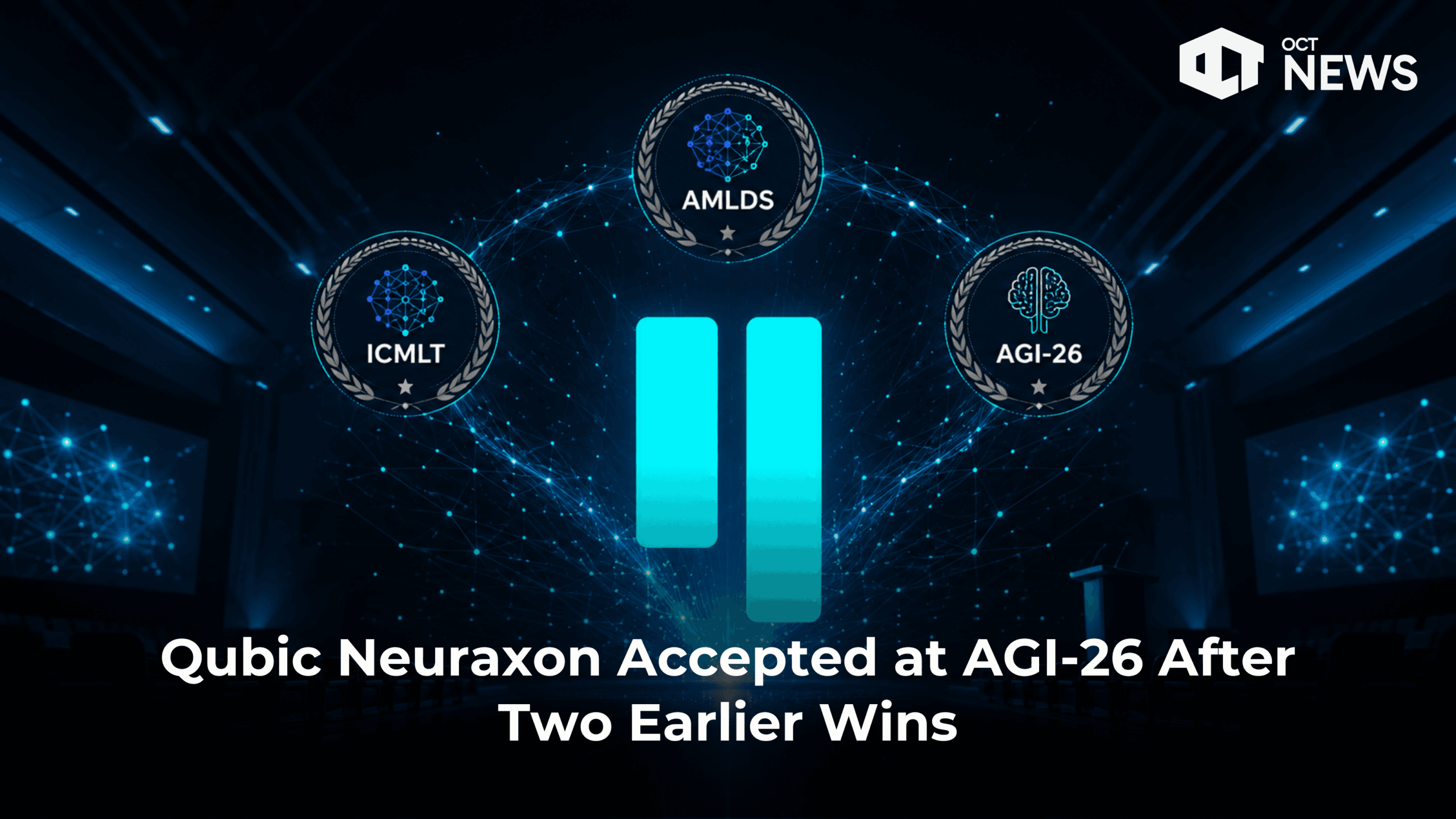
Qubic Neuraxon secured a third peer-reviewed AI paper acceptance at AGI-26, extending its 2026 academic run after ICMLT and AMLDS recognition.

Author: Akshay
1st June 2026. Qubic’s research arm has landed a third peer-reviewed paper at AGI-26. The 19th Annual Conference on Artificial General Intelligence runs July 27-30 in San Francisco.
High Signal Summary For A Quick Glance

Kween_
@Emmacrypto_33

@_Qubic_ Berlin best presentation then AGI acceptance?
Qubic Science just had its Neuraxon V2.0 paper accepted at AGI-26 in San Francisco. That makes three academic acceptances so far this year. ICMLT in Berlin, where it won best presentation of the evening session. AMLDS in Japan. And now AGI-26. This one is different from the https://t.co/7wBw0Oq7WW
12:36 PM·Jun 1, 2026

Mario Maurio
@mar30229
@_Qubic_ The academic route is smart play
Qubic Science just had its Neuraxon V2.0 paper accepted at AGI-26 in San Francisco. That makes three academic acceptances so far this year. ICMLT in Berlin, where it won best presentation of the evening session. AMLDS in Japan. And now AGI-26. This one is different from the https://t.co/7wBw0Oq7WW
12:35 PM·Jun 1, 2026

𝙼𝚊𝚛𝚒𝚎𝚖𝚊𝚛
@MariemarSamonte
@_Qubic_ peer review from actual researchers hits different than hype
Qubic Science just had its Neuraxon V2.0 paper accepted at AGI-26 in San Francisco. That makes three academic acceptances so far this year. ICMLT in Berlin, where it won best presentation of the evening session. AMLDS in Japan. And now AGI-26. This one is different from the https://t.co/7wBw0Oq7WW
11:26 AM·Jun 1, 2026
Steady attention without excessive speculation.
This acceptance caps a strong 2026 run. It follows a Best Evening Presentation award at ICMLT 2026 in Berlin and an IEEE-associated acceptance at AMLDS 2026 in Osaka. Qubic confirmed the news in its May 28 All-Hands recap and a June 1 tweet.
AGI-26 is the only major conference built entirely around creating general intelligence. For a crypto-native project, this places its research next to established AGI work from names like Ben Goertzel and Karl Friston.
Qubic is a feeless Layer-1 blockchain. Sergey Ivancheglo, the co-founder of IOTA and NXT, launched it in April 2022. Instead of traditional hash-based mining, Qubic uses Useful Proof-of-Work (UPoW). As a result, miners dedicate CPU and GPU cycles to training AI models inside the protocol’s Aigarth system.
Neuraxon V2.0 is the core research output from that effort. David Vivancos of Artificiology Research and Dr. Jose Sanchez Garcia of UNIR University authored the paper. Both work under Qubic Science. The paper introduces a bio-inspired unit that replaces binary perceptrons with trinary logic.
The three states work like this: 1 for excitatory, 0 for neutral, and -1 for inhibitory. Essentially, this mirrors the biological rest potential in real neurons. The system also features continuous-time processing, dynamic synaptic growth and collapse, neuron death, and self-modulation.
Traditional neural networks use frozen weights and discrete forward-backward passes. Once trained, they stop adapting. In contrast, Neuraxon V2.0 creates artificial neurons that operate in continuous time.
The neutral third state acts as a buffer. In practice, it works similarly to a biological rest potential or neuromodulator. According to the paper, this approach lets the system sit at the “edge of chaos.” As a result, small-world networks can spontaneously synchronize into scale-free patterns. Consequently, the architecture may achieve greater adaptability while maintaining stability during continuous learning.
The paper also introduces “Matrioska-doll” connectivity motifs. Consequently, these nested loop structures produce rapid adaptation to changing environments. They avoid catastrophic forgetting, a well-known problem in current large language models.
Plasticity in the system is structural. Synapses form, collapse, or reconnect. Neurons can die. This mirrors how real brain development works. As a result, it could enable continual, real-time learning that today’s static LLMs cannot achieve.
The 2026 timeline tells a clear story of accelerating academic traction.
In February, Qubic Science published Neuraxon V2.0 on ResearchGate. The release included open-source code and a Hugging Face demo. Meanwhile, the GitHub repository includes CuNxon CUDA kernels for V2.0 and Multi-Neuraxon architectures.
In March, AMLDS 2026 in Osaka accepted the trinary-logic paper. Meanwhile, the IEEE-associated conference is scheduled to run from July 21-23 at Kansai University’s Umeda Campus.
Then on May 20-22, Vivancos presented Neuraxon V2.0 at ICMLT 2026 in Berlin. The paper won Best Evening Presentation. The May 28 All-Hands recap confirmed the award.
By late May, AGI-26 accepted a third paper on Multi-Neuraxon architecture. According to the researchers, “this conference sits at a higher tier than the previous venues in Japan and Berlin.” They added that it places “Qubic’s AI research alongside the most established AGI work in the field.”
Timeline: Qubic’s Neuraxon research journey from foundational publication to multiple international AI conference acceptances in 2026
The original Neuraxon preprint is published on ResearchGate, introducing a trinary-logic, bio-inspired neural computation model that becomes the foundation of Qubic’s AI research program.
Qubic publishes Neuraxon V2.0, expanding the framework with Matrioska-style small-world connectivity, continuous-time dynamics, open-source code, and public demonstrations.
The paper examining the Neutral Buffer State and trinary-logic stability is accepted for presentation at AMLDS 2026 in Osaka, becoming Qubic’s first confirmed academic conference acceptance of the year.
Qubic confirms that the expanded Neuraxon V2.0 paper has been formally accepted for presentation at ICMLT 2026 in Berlin.
Neuraxon V2.0 is presented at ICMLT 2026 in Berlin and receives the conference’s Best Evening Presentation award based on attendee voting.
Qubic announces acceptance of its third peer-reviewed paper, focused on Multi-Neuraxon architecture, for presentation at the AGI-26 conference.
Qubic officially highlights its 2026 academic achievements, confirming acceptances at AMLDS, ICMLT, and AGI-26 while showcasing the growing recognition of Neuraxon research.
The trinary-logic Neuraxon paper is scheduled for presentation at AMLDS 2026 in Japan, bringing the research before an international machine-learning audience.
The accepted Multi-Neuraxon paper is expected to be presented at AGI-26 in San Francisco, marking Qubic’s entry into one of the leading conferences focused on artificial general intelligence.
ICMLT and AMLDS are legitimate, peer-reviewed, and Scopus-indexed. Still, they sit at a different level than AGI-26. The latter is the premier venue for researchers focused specifically on human-level intelligence.
As the official Qubic tweet put it: “AGI-26 is the only major conference on earth built around a single question: How do you actually create general intelligence.” It continued: “Getting into the room where the people who take AGI seriously argue it out, in front of names like Karl Friston and Ben Goertzel, that is the milestone.”
For a crypto project, this distinction matters. Most blockchain AI projects wrap existing models or run inference tasks. In contrast, Qubic’s team presents original, bio-plausible architecture research at the field’s top AGI-specific gathering.
Despite the academic wins, the market has not reacted. $QUBIC traded at roughly $0.00000047 to $0.00000049 around the June 1 announcement. That data comes from CoinGecko. The 24-hour volume sat between $1.1M and $1.6M, with a market cap around $66-67M (rank #393-394).
According to DefiLlama, total value locked on the Qubic chain was approximately $79K. No dedicated on-chain funding pool exists for Qubic Science. Instead, the general Computor Controlled Fund supports research, governed via on-chain voting.
Price showed a mild downtrend of 2-5% over the prior week. Neither the ICMLT award nor the AMLDS acceptance triggered notable movement either.
On X, the community response has been strongly positive. For example, the official Qubic announcement tweet collected over 55 likes. Meanwhile, lead researcher Vivancos posted about Multi-Neuraxon on May 26 and received more than 479 likes.
Additionally, co-author Dr. Sanchez Garcia wrote on X: “AMLDS, ICMLT and now AGI-26… Adding Science credibility for a crypto project.” As a result, that post earned more than 150 likes.
Beyond X, community members on Reddit and Discord echoed a similar theme. In particular, many argued that peer-reviewed research separates Qubic from projects that simply label themselves “AI.”
No tier-1 crypto media outlet has covered this story yet. As of June 1, 2026, searches across CoinDesk, The Block, Messari, and Cointelegraph returned zero results. So far, reporting remains confined to Qubic’s own blog, team LinkedIn posts, and X threads.
Several details remain unclear. The team has not publicly confirmed the exact title of the AGI-26 paper. Qubic’s blog references a “Multi-Neuraxon architecture,” while the tweet links to the V2.0 preprint. The presentation format also remains undisclosed.
The researchers have not yet published specific quantitative benchmarks beyond the preprint. Energy efficiency and cross-task transfer scores are still unknown. Similarly, the timeline for integrating the new architecture into Qubic’s on-chain Aigarth system remains open.
No major public skepticism of the acceptances has surfaced so far. The conferences are verified as legitimate. Some crypto observers have historically questioned Qubic’s AI claims. Still, the peer-reviewed publications serve as direct counter-evidence to those criticisms.
The AMLDS presentation in Osaka runs July 21-23. AGI-26 follows immediately, running July 27-30 at San Francisco State University. Both events will test whether the academic momentum translates into broader recognition.
For $QUBIC holders, the next catalyst may center less on token price and more on whether mainstream AI researchers take notice. Three peer-reviewed acceptances in five months is a track record no other crypto project can match right now.
This is not financial advice. Conduct your own research before making any investment decisions.
Our Crypto Talk is committed to unbiased, transparent, and true reporting to the best of our knowledge. This news article aims to provide accurate information in a timely manner. However, we advise the readers to verify facts independently and consult a professional before making any decisions based on the content since our sources could be wrong too. Check our Terms and conditions for more info.


Harmony to ShutDown Block Explorer Wiping Pre-2025 Data
Solana Alpenglow Goes Live Cutting Finality to 150ms
IoTeX Zanzibar Upgrade Moves Staking Rewards On-Chain
Altitude Demos X9.150 QR Payment Standard With USDC
Harmony to ShutDown Block Explorer Wiping Pre-2025 Data
Solana Alpenglow Goes Live Cutting Finality to 150ms
IoTeX Zanzibar Upgrade Moves Staking Rewards On-Chain
Altitude Demos X9.150 QR Payment Standard With USDC

Qubic