

Author: Tanishq Bodh
High attention and emotional sentiment detected.
April 5, 2026 – The long-running debate between Bitcoin advocates and traditional asset supporters has resurfaced, this time centered on performance across a specific market cycle. As crypto stabilizes after recent volatility, comparisons with equities and commodities are gaining attention. Over the weekend, Peter Schiff reignited the discussion with a pointed critique of Bitcoin’s returns.
High Signal Summary For A Quick Glance

Dan Held
@danheld

@PeterSchiff https://t.co/tXsw4DaDzl

Over the past five years, the price of Bitcoin is up by just 12%. Over the same time period, the NASDAQ is up 57.4%, the S&P 500 is up 59.4%, gold is up 163%, and silver is up 181%. If the appeal of Bitcoin is its superior long-term performance, why should anyone keep HODLing it?
01:04 PM·Apr 5, 2026

CHItrader
@CHItrader
@PeterSchiff I love the way you worded it by saying, "just 12%". As if you haven't been pounding the table the last 10 years trying to convince everyone it was worthless.
Over the past five years, the price of Bitcoin is up by just 12%. Over the same time period, the NASDAQ is up 57.4%, the S&P 500 is up 59.4%, gold is up 163%, and silver is up 181%. If the appeal of Bitcoin is its superior long-term performance, why should anyone keep HODLing it?
01:04 PM·Apr 5, 2026

Michael on Bitcoin
@MichaelOnBTC
@PeterSchiff Cherry picking once again I can prove bitcoin outperformed everything
Over the past five years, the price of Bitcoin is up by just 12%. Over the same time period, the NASDAQ is up 57.4%, the S&P 500 is up 59.4%, gold is up 163%, and silver is up 181%. If the appeal of Bitcoin is its superior long-term performance, why should anyone keep HODLing it?
01:03 PM·Apr 5, 2026
Schiff posted on X that Bitcoin has gained roughly 12 percent since April 2021. He compared that to stronger performance in traditional markets, including equities and precious metals.
He cited gains of over 50 percent in major U.S. indices and significantly higher returns in gold and silver during the same period. Schiff used the comparison to question Bitcoin’s appeal as a long-term investment.
He also pointed to MicroStrategy stock outperforming Bitcoin over the same timeframe. Schiff argued that the premium investors place on MicroStrategy reflects market dynamics beyond Bitcoin itself.
Michael Saylor responded by emphasizing that timeframe selection affects outcomes. He argued Bitcoin remains a top-performing asset when measured from earlier entry points or across full market cycles.
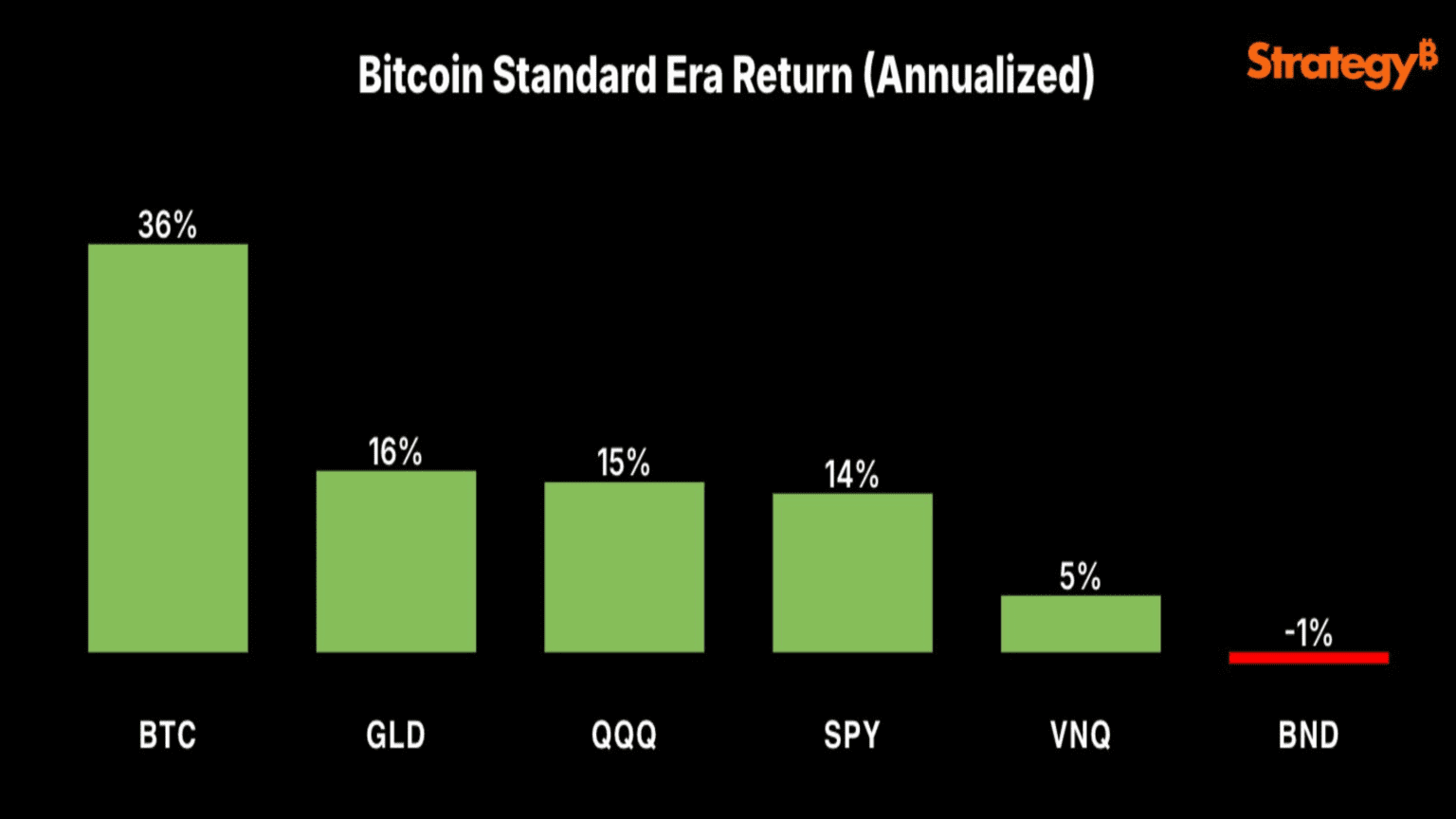
The exchange highlights a key divide in how investors evaluate Bitcoin. Critics often focus on fixed timeframes that include major peaks, while supporters emphasize long-term compounded returns.
For traders, the discussion underscores the importance of entry timing. Bitcoin’s volatility means performance can vary widely depending on the starting point.
For institutions, the debate reflects broader questions about Bitcoin’s role. Some view it as a speculative asset, while others see it as a long-term store of value similar to digital gold.
The argument also extends to equity proxies like MicroStrategy, where exposure to Bitcoin can amplify returns due to leverage and investor sentiment.
The rivalry between Schiff and Michael Saylor has persisted for years. Schiff consistently favors gold and silver, while Saylor positions Bitcoin as a superior monetary asset.
Bitcoin peaked near $60,000 in April 2021, making that period a high base for comparison. Since then, the asset has gone through multiple cycles, including sharp drawdowns and recoveries.
As of now, Bitcoin trades around $67,000, while gold and silver have benefited from macro uncertainty and inflation concerns.
The debate reflects a broader market theme. Traditional assets and crypto continue to compete for capital, with performance narratives shifting based on macro conditions and time horizons.
Our Crypto Talk is committed to unbiased, transparent, and true reporting to the best of our knowledge. This news article aims to provide accurate information in a timely manner. However, we advise the readers to verify facts independently and consult a professional before making any decisions based on the content since our sources could be wrong too. Check our Terms and conditions for more info.