
Author: Chirag Sharma
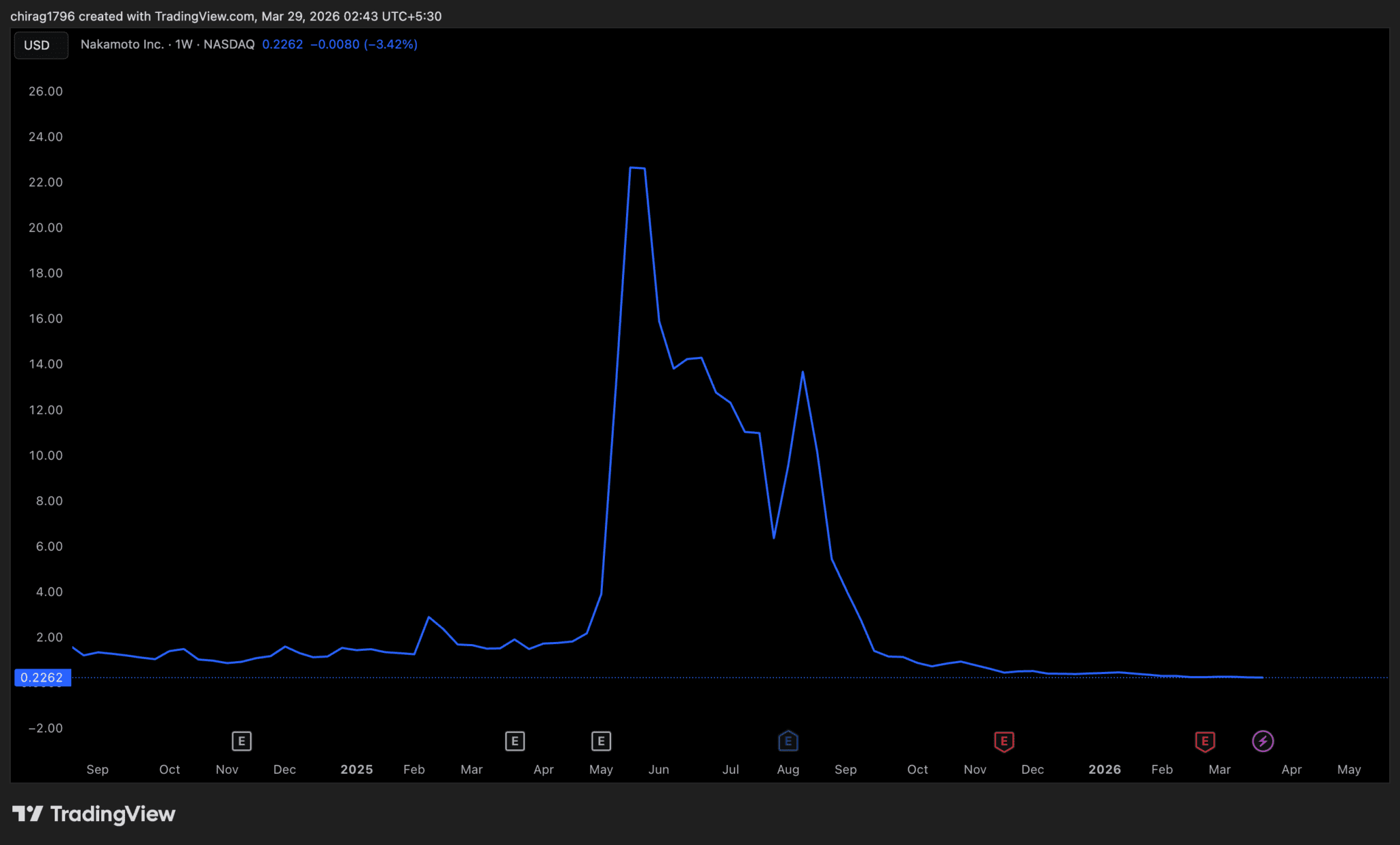
March 28, 2026 The Nakamoto stock crash has erased over 99% of shareholder value in less than a year. From a peak valuation of over $23 billion in May 2025, the company now sits near $180 million, with shares trading around $0.23. The collapse has been swift, brutal, and highly instructive.
High Signal Summary For A Quick Glance

Bandit-Red-One
@ClydeBandit

@BullTheoryio 3rd Party Risk & Founder's Delusion at it's finest. Bailey contributed his established Bitcoin-native companies and his time/reputation as founder, and ended up with a sizable equity position. But the big cash for buying Bitcoin came overwhelmingly from institutional and
Bitcoin Treasury Company "Nakamoto" is down -99.34% from its peak, erasing over $23.3 billion from its market cap. If you invested $100,000 in $NAKA last year, today it would be worth $600. https://t.co/5K97EQGWyi
07:48 PM·Mar 28, 2026

Sjuul | AltCryptoGems
@AltCryptoGems
@BullTheoryio down that bad, almost no way back for most holders
Bitcoin Treasury Company "Nakamoto" is down -99.34% from its peak, erasing over $23.3 billion from its market cap. If you invested $100,000 in $NAKA last year, today it would be worth $600. https://t.co/5K97EQGWyi
06:25 PM·Mar 28, 2026

Jean Michel Libera
@LiberaInvest
@BullTheoryio Equating a failed treasury proxy with the underlying asset is a fundamental error in logic. The collapse of $NAKA is a failure of corporate execution and predatory dilution, not a reflection of Bitcoin. Investors who seek exposure through unproven third parties accept
Bitcoin Treasury Company "Nakamoto" is down -99.34% from its peak, erasing over $23.3 billion from its market cap. If you invested $100,000 in $NAKA last year, today it would be worth $600. https://t.co/5K97EQGWyi
05:37 PM·Mar 28, 2026
When Bitcoin corrected from its highs above $126,000, the company faced immediate paper losses of roughly $270 million. But price decline alone did not cause the collapse. The real damage came from structural decisions. Massive share dilution and insider selling amplified the downside, crushing investor confidence.
What was once marketed as a “Bitcoin treasury powerhouse” quickly turned into a leveraged bet on timing. And the market punished it accordingly.
At the center of it all is a simple strategy executed at the worst possible time. Nakamoto aggressively accumulated Bitcoin near the top of the cycle, holding over 5,398 BTC at an average price close to $118,000.
The roots of the Nakamoto stock crash go back to its 2025 transformation. Originally operating as KindlyMD, the company pivoted into a Bitcoin-focused entity through a reverse merger. It raised capital through a PIPE deal priced at $1.12 per share, attracting early investors at a steep discount.
As hype built, the stock surged above $34. But the foundation was fragile.
When lock-up periods expired, early investors and insiders began selling. At the same time, Bitcoin’s correction removed the narrative that had supported the valuation. The situation worsened in early 2026 when Nakamoto issued 365 million new shares to acquire BTC Inc. and UTXO Management. The deal was executed at $1.12 per share while the stock traded below $0.30, creating severe dilution.
Critics labeled the move self-serving. Supporters argued it was part of a long-term strategy to build a Bitcoin-native ecosystem. The market, however, focused on one thing. Supply increased. Confidence dropped. Price collapsed.
Timeline of Key Events (2025–March 2026)
Nakamoto Holdings and KindlyMD merger enthusiasm drives NAKA stock to an all-time high near $34–$35 as Bitcoin treasury narratives dominate market sentiment.
The merger with KindlyMD closes, while PIPE financing is finalized at $1.12 per share, setting the stage for the company’s treasury expansion strategy.
The company aggressively acquires 5,398 BTC at an average cost near $118,000, making its treasury strategy highly exposed to peak-cycle pricing.
PIPE lock-ups expire, insiders and early investors begin heavy selling, and the stock collapses more than 50% within days, eventually falling about 96% from its May peak as David Bailey warns shareholders of volatility.
The corporate rebrand is finalized, formally transitioning KindlyMD into Nakamoto Inc. and aligning the public identity with its Bitcoin-centric strategy.
Nakamoto announces an all-stock acquisition of BTC Inc. and UTXO Management, both tied to David Bailey, using the contractual $1.12 per share valuation.
The acquisitions officially close, about 365 million new shares are issued, and BTC Inc. plus UTXO become wholly owned subsidiaries.
Multiple outlets report the stock’s 99%+ collapse and the destruction of roughly $23.6 billion in market value, cementing the meltdown as a cautionary Bitcoin treasury story.
David Bailey files a 13D showing 17.3% ownership after the merger-related transactions and share issuance are completed.
NAKA trades in a narrow $0.22–$0.25 range, with investor attention moving toward operational integration and the upcoming Bitcoin Conference.
The Nakamoto story is bigger than one company. It exposes the risks of combining hype, leverage, and poor timing in crypto markets.
Bitcoin treasury strategies can work. But only when paired with disciplined execution. Right now, Nakamoto represents the opposite.
A high-conviction bet made at the peak, followed by dilution and loss of trust.
For investors, the lesson is clear. In crypto, narrative can build value quickly. But structure decides whether it lasts.
The Nakamoto stock crash is still unfolding, and several key factors will determine what happens next.
Our Crypto Talk is committed to unbiased, transparent, and true reporting to the best of our knowledge. This news article aims to provide accurate information in a timely manner. However, we advise the readers to verify facts independently and consult a professional before making any decisions based on the content since our sources could be wrong too. Check our Terms and conditions for more info.