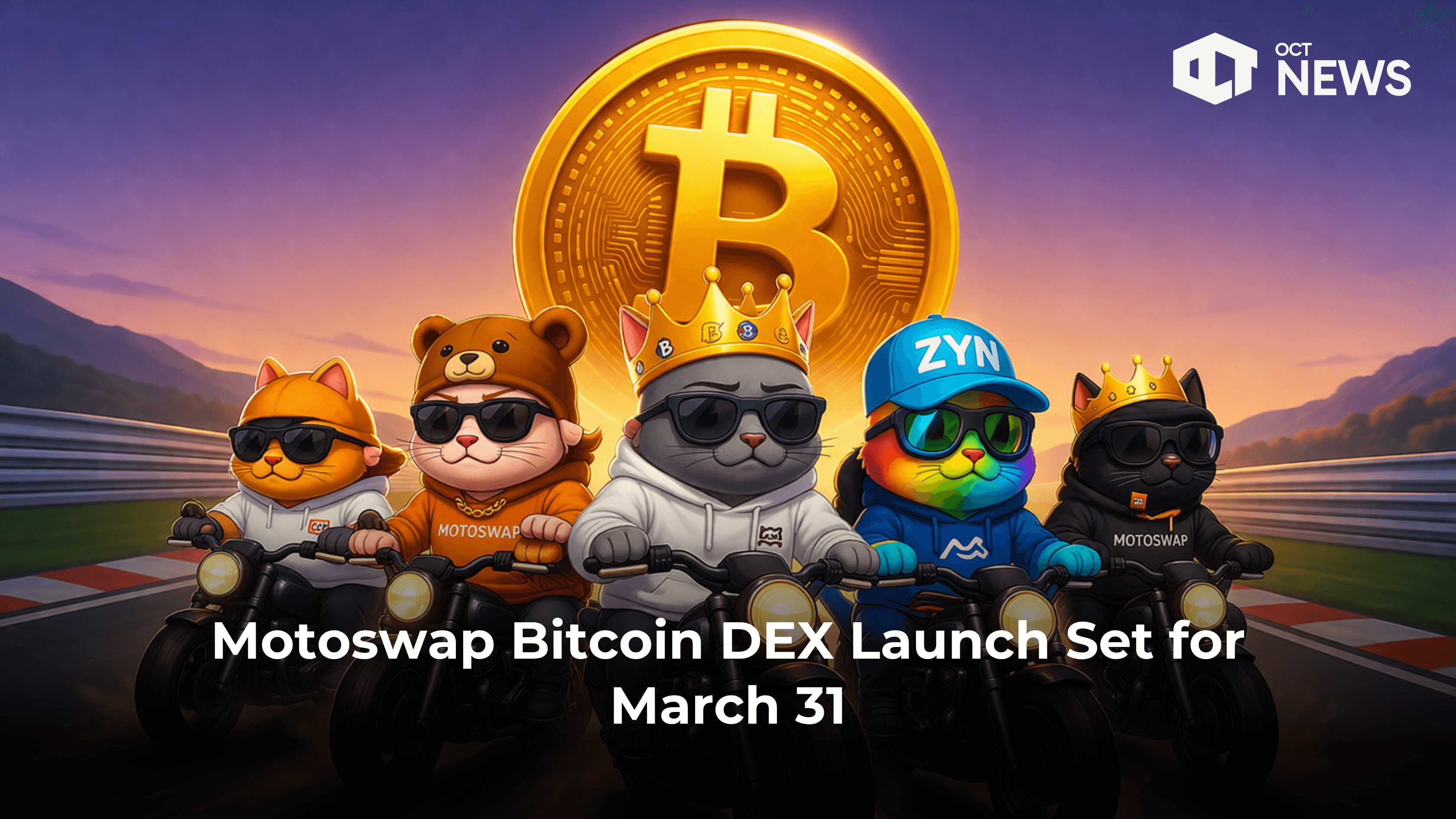
Motoswap launches the first native decentralized exchange on Bitcoin Layer 1 on March 31, enabling swaps and staking without bridges.

Author: Akshay
Steady attention without excessive speculation.
March 30, 2026. Motoswap Bitcoin DEX Launch marks the debut of a native decentralized exchange on the Bitcoin mainnet, built directly on Layer 1. The rollout introduces automated market making, staking, and liquidity provision on Bitcoin without relying on bridges or wrapped assets, signaling a shift toward trustless trading and DeFi functionality secured by Bitcoin’s base layer.
High Signal Summary For A Quick Glance

Godfather
@CuffDao

@Motoswap What time on Tuesday, I will be there!!
31.03.26. Motoswap launches on Bitcoin mainnet. Native $BTC swapping, staking, yield farming for the first time on Bitcoin L1. Launch your own token. Setup yield farms. All on the base chain without ever leaving it. The $MOTO economy opens soon 🐈⬛🛵 https://t.co/IyHBCVJg4J
12:03 AM·Mar 30, 2026
Motoswap introduces the first decentralized exchange built directly on Bitcoin Layer 1. It enables swaps, liquidity, staking, and token launches without bridges or wrapped assets. Powered by OP_NET, it supports trading of native BTC and OP-20 tokens while maintaining full self-custody. This expands Bitcoin’s role into programmable finance.
The launch follows a phased build-up from 2023 to 2026, including testnet activity, OP_NET mainnet on March 19, 2026, and staking on March 24. By March 31, the rollout was widely expected, marking the shift from testing to a live Bitcoin-native DeFi ecosystem.
A comparable milestone occurred on December 10, 2024, when Taparooswap launched as an early attempt at a Bitcoin Layer 1 AMM DEX. It enabled native swaps and liquidity pools using a metaprotocol approach, marking a proof of concept for Bitcoin-based DeFi. However, adoption remained limited, with relatively low volume and constrained functionality due to reliance on external processing and Bitcoin’s inherent limitations.
Market reaction at the time was modest, with niche enthusiasm in Bitcoin DeFi circles but no significant impact on BTC price or broader ecosystem activity. Taparooswap demonstrated feasibility but did not scale into a full DeFi stack. In contrast, Motoswap’s March 31, 2026 launch builds on this foundation with a more integrated architecture, positioning it as a more advanced step toward native Bitcoin DeFi.
Timeline: Motoswap progression from testnet phases to full Bitcoin L1 DeFi activation
Motoswap undergoes extensive public testnet iterations, including swaps, staking, farming, and token launches with “break the testnet” campaigns.
Testnet activity snapshot closes, determining eligibility for future rewards and allocations.
OP_NET mainnet launch is delayed to March 19, with wallet registration extended to onboard more users.
Bitcoin L1 smart contracts activate, enabling OP-20/OP-721 tokens, permissionless deployments, and initial DeFi primitives with Motoswap as flagship.
Staking goes live, allowing users to earn a share of swap fees (0.2%), introducing the first yield layer.
Motoswap fully launches on Bitcoin mainnet with native $BTC OP-20 swaps, liquidity pools, token deployments, and initial yield farm tools.
Liquidity mining incentives are expected to activate, rewarding LPs and boosting early TVL growth.
OP-20S stablecoin standard rollout aims to introduce native Bitcoin-based stable assets, expanding DeFi utility.
Focus shifts to on-chain metrics such as TVL, swap volume, and fee generation to validate early traction and sustainability.
Taparooswap’s December 2024 launch followed a clear “hype-then-fade” cycle typical of early Bitcoin DeFi experiments. The $TAP token saw a strong pre-launch rally, reaching peak levels around early December 2024, but quickly reversed after launch as real usage failed to match expectations. By 2025–2026, the token had declined sharply, losing most of its gains despite the milestone of a live Bitcoin L1 DEX.
Sentiment on Crypto Twitter initially turned positive, with the launch seen as a breakthrough for native Bitcoin DeFi. However, enthusiasm cooled within weeks as issues with speed, liquidity, and usability became clear. The event confirmed that L1 DeFi on Bitcoin is technically possible, but it did not drive sustained ecosystem growth. Instead, it served as an early proof of concept that newer models like Motoswap now aim to build on.
Immediate focus after the March 31, 2026 launch will be on real on-chain activity and early adoption signals. Key milestones include the first native BTC and OP-20 swaps, liquidity pool formation, and staking-driven fee distribution, followed by $PILL liquidity farming expected in early April 2026 and stablecoin integration planned for Q2 2026. Initial metrics such as TVL, swap volume, and fee accrual will determine whether the platform can sustain momentum beyond launch hype.
However, the first 7–14 days remain critical as execution and market risks come into play. Challenges include untested smart contract infrastructure on Bitcoin, potential regulatory scrutiny around token launches and DeFi activity, and competition from faster Layer-2 solutions. Low adoption, technical issues, or delayed roadmap delivery could weaken sentiment, while strong early liquidity and usage would validate the model and support broader Bitcoin DeFi growth.
Our Crypto Talk is committed to unbiased, transparent, and true reporting to the best of our knowledge. This news article aims to provide accurate information in a timely manner. However, we advise the readers to verify facts independently and consult a professional before making any decisions based on the content since our sources could be wrong too. Check our Terms and conditions for more info.


Ledger Probes User Fund Losses Tied to Reseller CryptoBilis
Why Provenance Blockchain (HASH) Is Up 39.6% Today?
Halborn Clears XMAQUINA RCM Audit With Zero Critical Bugs
Fidelity Scoops $354M Bitcoin, ETH & SOL in 20 Days
Ledger Probes User Fund Losses Tied to Reseller CryptoBilis
Why Provenance Blockchain (HASH) Is Up 39.6% Today?
Halborn Clears XMAQUINA RCM Audit With Zero Critical Bugs
Fidelity Scoops $354M Bitcoin, ETH & SOL in 20 Days