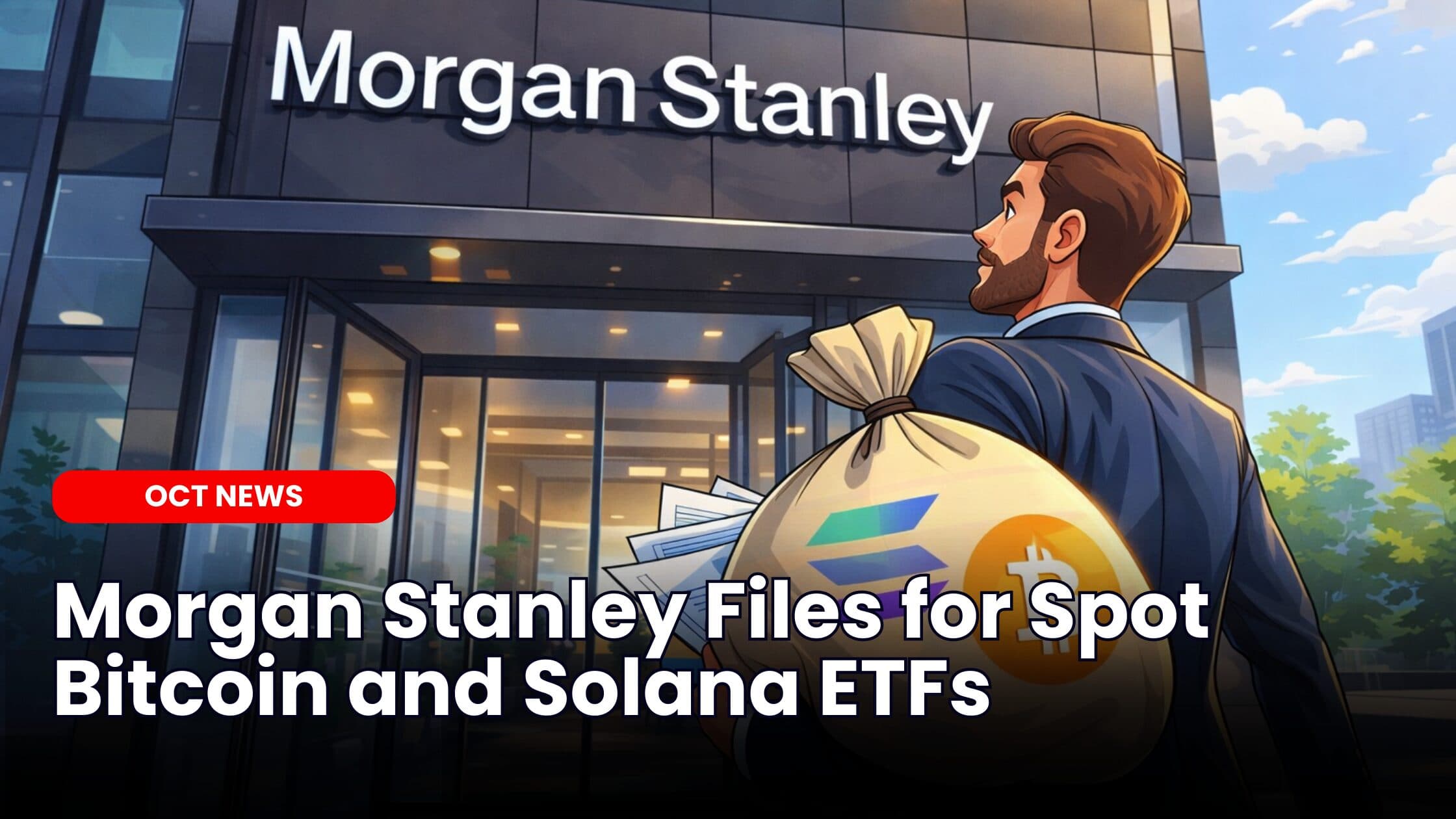
Morgan Stanley files for spot Bitcoin and Solana ETFs, marking a major shift as Wall Street moves from crypto access to direct issuance.

Author: Chirag Sharma
January 6, 2026 Morgan Stanley has officially filed S-1 registration statements with the U.S. Securities and Exchange Commission to launch two spot crypto ETFs : a Bitcoin Trust and a Solana Trust. For a Wall Street giant overseeing roughly $6.4 trillion in assets, this is not just another product launch. It is a structural shift in how traditional finance engages with crypto, moving from passive distribution to direct issuance.
High Signal Summary For A Quick Glance

ɱɑყɑɱɑεʂƚɾ
@mayamaster

@solana @MorganStanley This is huge news
BREAKING: @MorganStanley filed its first crypto ETFs ever: a Bitcoin ETF and a Solana ETF 🔥 https://t.co/RAlKv98q2O
02:47 PM·Jan 6, 2026

RayRay
@rayray_1_
@solana @MorganStanley MS stepping in with a SOL ETF = real institutional rails for SOL, liquidity and exposure ramping up
BREAKING: @MorganStanley filed its first crypto ETFs ever: a Bitcoin ETF and a Solana ETF 🔥 https://t.co/RAlKv98q2O
01:48 PM·Jan 6, 2026
The filings, submitted earlier today, seek approval for spot ETFs that would track the real-time prices of Bitcoin and Solana.
If approved, investors would gain direct exposure to BTC and SOL through familiar brokerage accounts, without needing to self-custody or interact with on-chain infrastructure. According to the filing documents, digital assets would be held with qualified custodians, with Coinbase widely expected to play a role, and the funds are likely to list on major U.S. exchanges such as the NYSE or Nasdaq.
What makes this filing different is not the structure. It is the issuer.
Until now, Morgan Stanley offered crypto exposure by distributing ETFs from asset managers like BlackRock and Fidelity. Filing its own ETFs marks the bank’s first step into issuing proprietary crypto products, placing it directly in the arena.
How this filing compares to earlier Solana ETF launches (2025)
While a Bitcoin ETF filing from a major bank is significant, the Solana ETF is the real signal embedded in this announcement.
Solana’s ecosystem has expanded rapidly over the last two years, driven by growth in DeFi, consumer-facing apps, NFTs, and payments infrastructure. Spot Solana ETFs from firms like Franklin Templeton and VanEck were approved in mid-2025 and collectively accumulated around $800 million in assets by early 2026.

Morgan Stanley entering this space changes the scale of the conversation.
With a vast base of high-net-worth individuals, institutional allocators, and wealth-management clients, even a small allocation shift could translate into billions in potential inflows. That dynamic is why the market reacted immediately.
At a deeper level, this filing bridges two worlds that have historically operated in parallel.
For retail investors, it lowers friction. Exposure to Solana no longer requires navigating wallets, bridges, or exchanges. It becomes another ticker in a brokerage account.
For institutions, it provides a compliant, familiar vehicle issued by a trusted Wall Street brand, simplifying portfolio integration.
For the Solana ecosystem, it enhances credibility, improves liquidity, and strengthens the case for long-term application development, from payments to consumer-scale dApps.
Over time, these regulated inflows may also reduce volatility, shifting crypto closer to other macro-driven asset classes.
Timeline: How This Development Evolved
U.S. regulators approve the first spot Bitcoin ETFs, opening the door for institutional crypto adoption.
Regulated access expands beyond Bitcoin as spot Ethereum ETFs get approved.
Asset managers including Franklin Templeton and VanEck file and launch spot Solana ETFs.
Solana ETFs begin trading and collectively accumulate roughly $800M in assets.
Market speculation grows around major banks entering the crypto ETF space.
Morgan Stanley files S-1 registrations for its own spot Bitcoin and Solana ETFs.
SEC review period begins, with potential approval decisions expected by mid-2026.
The path forward is not without uncertainty.
The SEC has up to 240 days to review the filings, though recent precedent suggests a faster timeline under a more crypto-friendly regulatory environment. Key variables include custody arrangements, market conditions, and broader political signals around digital assets.
If approvals arrive by mid-2026, launches could follow shortly after, potentially opening the door for additional bank-issued ETFs tied to assets like XRP or Cardano.
Our Crypto Talk is committed to unbiased, transparent, and true reporting to the best of our knowledge. This news article aims to provide accurate information in a timely manner. However, we advise the readers to verify facts independently and consult a professional before making any decisions based on the content since our sources could be wrong too. Check our Terms and conditions for more info.


ZachXBT Worst Countries Ranking Hits Canada, UK, India
Swift Blockchain Ledger Goes Live With First Bank Trade
POSCO Drives Trade Receivables Tokenization on Injective
Goldman Sachs XRP ETF Holdings Rebound to $86.5 Million
ZachXBT Worst Countries Ranking Hits Canada, UK, India
Swift Blockchain Ledger Goes Live With First Bank Trade
POSCO Drives Trade Receivables Tokenization on Injective
Goldman Sachs XRP ETF Holdings Rebound to $86.5 Million