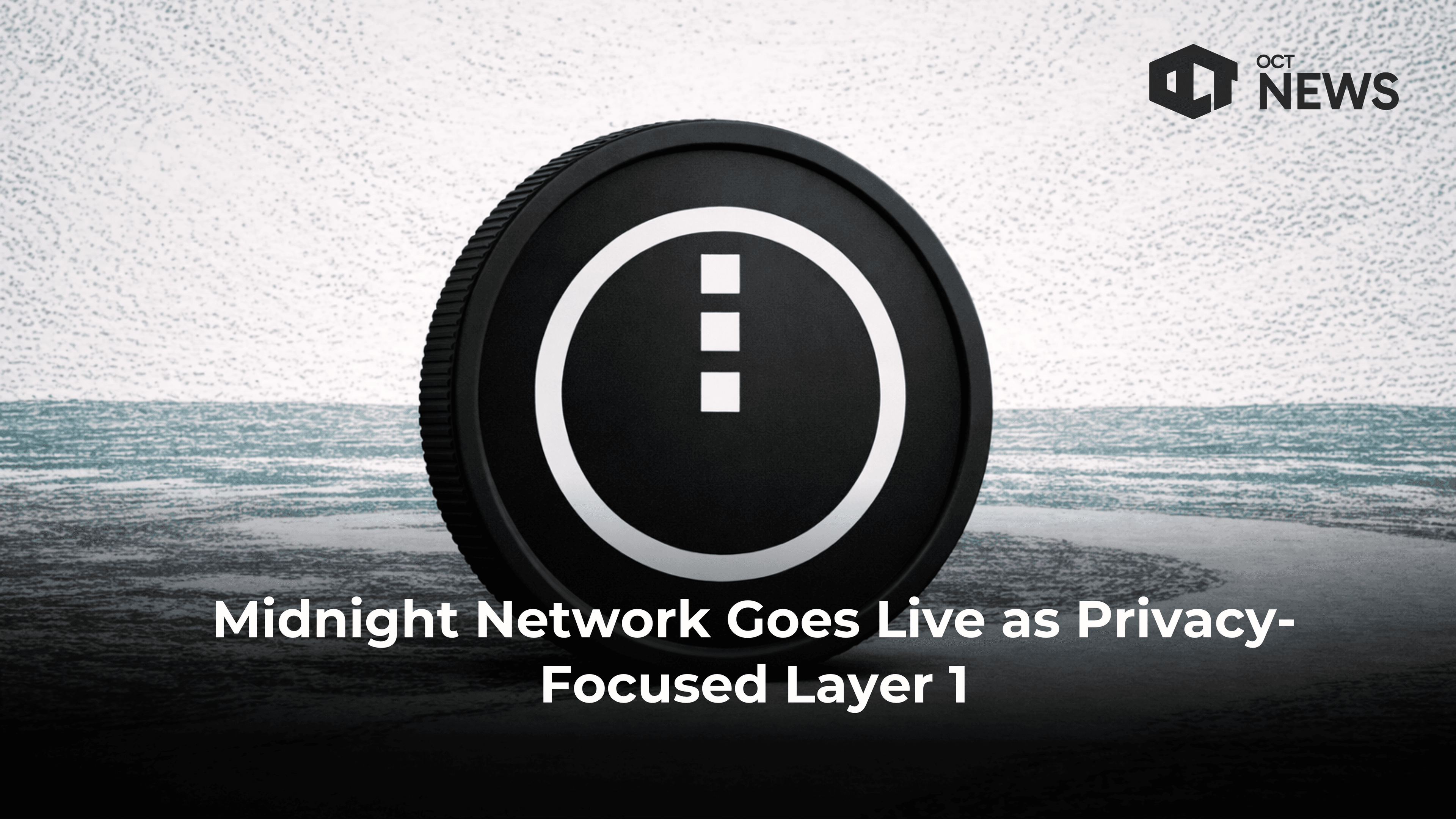
Midnight Network goes live with programmable privacy features, aiming to bring real-world assets and compliant applications on-chain.

Author: Akshat Thakur
Steady attention without excessive speculation.
March 31, 2026- Midnight Network Goes Live as a new Layer 1 blockchain designed to bring programmable privacy into real-world applications. The launch introduces a hybrid architecture that attempts to solve a long-standing limitation in crypto: enabling sensitive data to exist on-chain without exposing it publicly.
High Signal Summary For A Quick Glance

Hoss
@HOSS_ibc

@MidnightNtwrk Supercool to see. It actually gives me a reason to go check out Cardano as well.
https://t.co/knFD3swEln
07:40 PM·Mar 30, 2026
Midnight Network Goes Live following an official announcement confirming that the genesis block has been produced and the network is now operational.
The system introduces a model where developers can control visibility at the transaction level, combining public and private states within a single ledger. This marks a shift away from fully transparent blockchain design toward selective, programmable privacy.
Midnight originated within the Cardano ecosystem before evolving into a standalone Layer 1 focused on privacy. Earlier blockchain generations solved different problems.
Bitcoin introduced digital scarcity. Ethereum enabled programmability. Cardano focused on scalability and governance. Privacy remained largely unresolved.
Most blockchains expose transaction data by default, making them unsuitable for many real-world use cases such as enterprise finance, identity systems, and regulated assets.
This limitation has kept large portions of traditional economic activity off-chain. Midnight is built specifically to address that gap.
Key milestones in Midnight Network
Midnight originates within the Cardano ecosystem as a privacy-focused initiative exploring zero-knowledge cryptography for on-chain data confidentiality.
Evolves into an independent Layer 1 blockchain with a hybrid public/private ledger, Compact smart contracts, and the NIGHT/DUST economic model enabling programmable privacy.
Federated node operator model established with partners including Google Cloud, MoneyGram, Worldpay, Bullish, Vodafone Pairpoint, eToro, Blockdaemon, and others to ensure institutional-grade infrastructure.
Genesis block is produced, activating state continuity and permanence. Midnight introduces a fourth-generation blockchain focused on programmable privacy, real-world assets, and regulated applications.
Midnight Network Goes Live with the goal of making privacy a native feature rather than an add-on. Instead of forcing developers to choose between transparency and usability, the network allows selective disclosure of information.
This means sensitive data can remain private while still being verifiable. For institutions, this removes a major barrier.
Financial entities, compliance systems, and asset issuers often cannot operate on fully transparent ledgers due to regulatory and confidentiality requirements.
Midnight attempts to bridge that gap without sacrificing cryptographic guarantees.
The network uses a hybrid ledger model that supports both public and private data simultaneously. Zero-knowledge proofs allow transactions to be validated without revealing underlying information.
Proof generation happens on the client side, meaning sensitive data does not leave the user’s environment. Assets can exist in both shielded and unshielded forms, depending on how developers design their applications.
Selective disclosure mechanisms allow specific parties, such as regulators or counterparties, to access necessary information without exposing full transaction details.
The economic model introduces two components. NIGHT acts as the governance and utility token, while DUST functions as a renewable resource used for transaction fees.
Instead of paying fees directly with volatile tokens, users consume DUST, which regenerates over time. This approach attempts to stabilize costs while simplifying user experience.
The network is entering a phased rollout focused on stability and controlled adoption. Developers can begin deploying applications, while institutions are expected to test use cases before scaling.
The federated node model will remain in place initially, with decentralization expected to increase over time. The key signals to watch will be actual application deployment, institutional participation, and how regulators respond to the privacy model.
If those align, Midnight could expand beyond niche use cases. If not, it risks remaining a technically strong but underused network.
Our Crypto Talk is committed to unbiased, transparent, and true reporting to the best of our knowledge. This news article aims to provide accurate information in a timely manner. However, we advise the readers to verify facts independently and consult a professional before making any decisions based on the content since our sources could be wrong too. Check our Terms and conditions for more info.