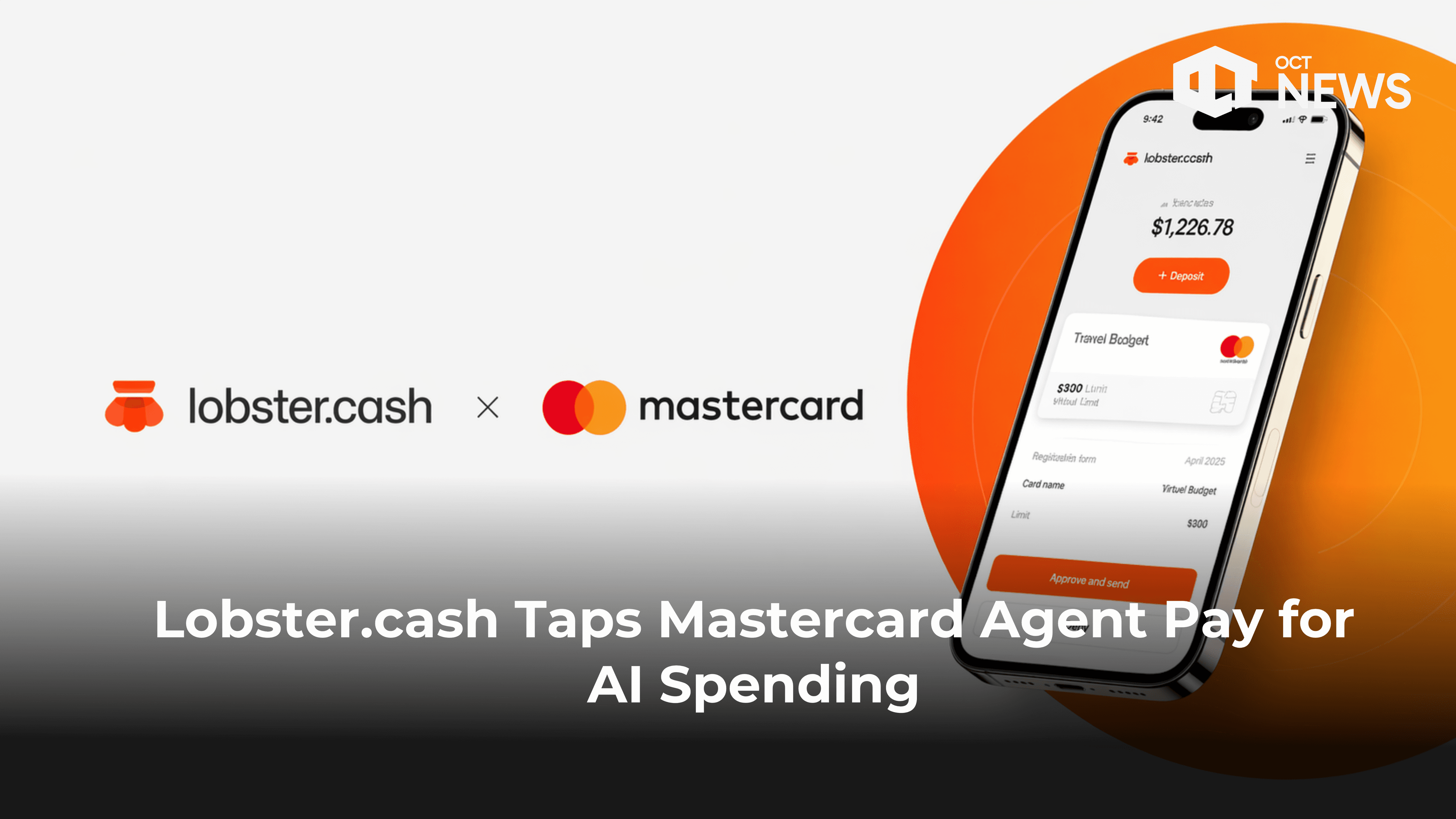
Crossmint Lobster.cash integrates Mastercard Agent Pay, enabling AI agents to make payments using existing cards without sharing credentials.

Author: Akshat Thakur
Steady attention without excessive speculation.
17th April 2026 – Crossmint’s Lobster.cash platform announced on April 16 that it is integrating Mastercard Agent Pay and Verifiable Intent. As a result, AI agents can now make purchases directly from users’ existing Mastercard cards without new wallets or credential sharing.
High Signal Summary For A Quick Glance

MyAI
@Web3__Youth

@crossmint @Mastercard this is a big step for ai agents, but how will mastercard ensure secure transactions and prevent unauthorized spending, given the autonomous nature of these agents
BIG NEWS: Your AI agents will soon be able to pay with your existing @Mastercard via lobstercash. Your card. Your agents. Your rules. Powered by Crossmint. 🧵 https://t.co/GZHLP8aUQR
04:30 PM·Apr 16, 2026

0x 👾🐸
@reachbasket
@crossmint @Mastercard Powered by Tibbir by Ribbit Capital ?
BIG NEWS: Your AI agents will soon be able to pay with your existing @Mastercard via lobstercash. Your card. Your agents. Your rules. Powered by Crossmint. 🧵 https://t.co/GZHLP8aUQR
02:53 PM·Apr 16, 2026

pontus
@PontusAndersson
@crossmint @Mastercard And they said agents couldn't use physical cards...
BIG NEWS: Your AI agents will soon be able to pay with your existing @Mastercard via lobstercash. Your card. Your agents. Your rules. Powered by Crossmint. 🧵 https://t.co/GZHLP8aUQR
02:36 PM·Apr 16, 2026
The announcement marks the first integration between Mastercard’s agentic payments infrastructure and an open AI agent payment standard. Because Lobster.cash already supports frameworks like OpenClaw, Claude Code, Devin, Hermes, and Zo Computer, the partnership immediately extends Mastercard’s reach into the AI agent ecosystem.
When a user connects their Mastercard through Lobster.cash, Mastercard Agent Pay issues a delegated authorization token. The agent then uses that token to initiate purchases. At no point does the agent see or handle actual card credentials.
Issuers retain full visibility and control throughout the process. They can set spending limits, approve merchant categories, and monitor transactions in real time. In addition, users define their own rules on amount, timing, and payment method before granting agent access.
Basis Theory serves as the secure vault for payment credentials. The company holds PCI Level 1 compliance and SOC 2 certification, so sensitive card data never leaves its controlled environment.
Verifiable Intent generates a tamper-resistant record of exactly what the user authorized. Because any participant in the transaction chain can verify that record independently, it creates a shared source of truth for merchants, issuers, and platforms.
Mastercard co-developed this framework with Google. It aligns with Google’s Agent Payments Protocol and Universal Commerce Protocol. Since Verifiable Intent is protocol-agnostic, it works across open agent ecosystems rather than locking into a single platform.
Before an agent completes a purchase, the consumer establishes intent through a biometric step. That step creates a cryptographic link between the human and the autonomous action. Consequently, every agent-driven transaction carries independently verifiable proof of human authorization.
Alfonso Gomez-Jordana Manas, co-founder of Crossmint, highlighted the practical value of existing cards. “Mastercard Agent Pay is one of the most trusted payment infrastructures designed for agentic commerce in the world,” he said in the official announcement. “Agent users don’t need a new wallet or a new card.”
Pablo Fourez, chief digital officer at Mastercard, emphasized trust and accountability. “By integrating with lobster.cash, we’re extending Mastercard’s trusted payments network to open agent platforms,” Fourez said. He also noted that consumers and issuers retain the same security and control they expect from Mastercard.
Mastercard’s official account reinforced the collaboration on X. “Building the future of global payments, together @crossmint,” the company posted.
Lobster.cash functions as an open payment standard built specifically for AI agents. Crossmint developed it so that agents gain programmatic access to payments across platforms while human oversight remains intact. Every action is auditable and bound by user-defined rules.
The stack draws on multiple infrastructure layers. Solana handles settlement speed, while Circle provides stablecoin rails. Now Mastercard brings traditional card network access. As a result, agents can transact through both crypto and fiat channels from a unified interface.
Crossmint itself provides the underlying infrastructure, including embedded smart wallets, on/off-ramps, and cross-chain orchestration. More than 40,000 clients use the platform for agentic and fintech applications. In March 2025, the company raised $23.6 million in a round led by Ribbit Capital, with backing from Franklin Templeton.
AI agents are rapidly moving from experimental tools to everyday actors that book travel, order supplies, and execute trades. Until now, giving them spending power required either new crypto-native wallets or risky credential sharing. Both approaches limited mainstream adoption.
By tapping the existing Mastercard network, however, the integration removes that friction. Billions of consumer cards become accessible to agents without any new payment setup. Since Verifiable Intent also adds cryptographic guarantees that traditional card payments never had, merchants and regulators gain an auditable trail of agent-driven activity.
That bridge between legacy finance rails and autonomous agents therefore preserves consumer protections, issuer oversight, and regulatory traceability at scale.
The integration launches first through an early-access program limited to OpenClaw agents. According to the announcement, OpenClaw has deployed more than one million agents across over 20 messaging platforms. A public waitlist is already open through the Google Form linked in the thread.
Once the initial cohort validates the experience, the team plans broader availability across other supported agent platforms. Developers can also begin testing the Crossmint SDK immediately, since it abstracts credential routing and proof generation into simple API calls.
For users, the change is invisible because they continue using the Mastercard already in their wallet. For issuers and merchants, Verifiable Intent provides richer data on agent-driven activity without disrupting existing compliance flows. The waitlist and SDK are live, and the first wave of agent-powered purchases using familiar cards could arrive within weeks.
Our Crypto Talk is committed to unbiased, transparent, and true reporting to the best of our knowledge. This news article aims to provide accurate information in a timely manner. However, we advise the readers to verify facts independently and consult a professional before making any decisions based on the content since our sources could be wrong too. Check our Terms and conditions for more info.