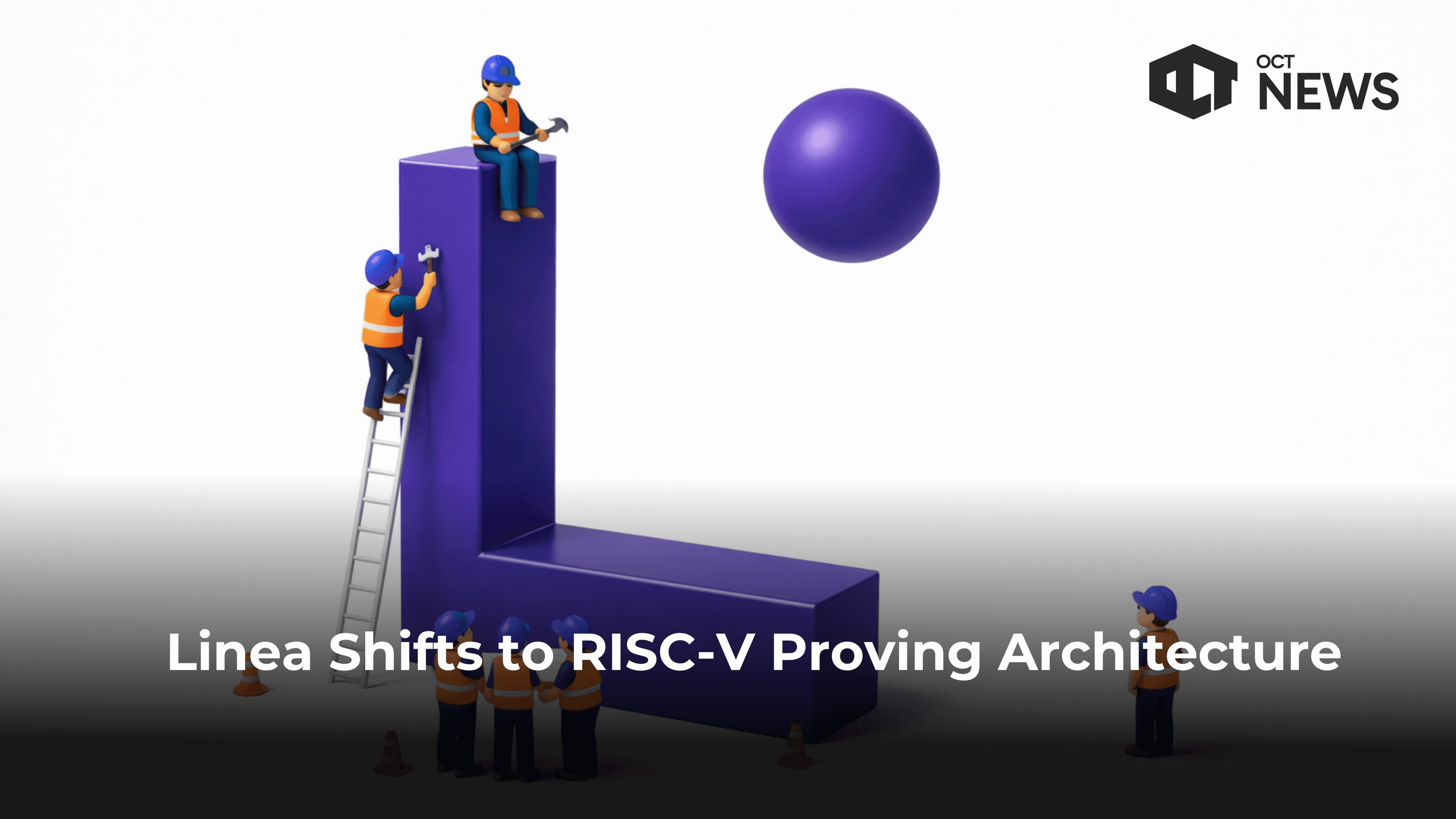
Linea shifts its zkEVM proving system to RISC-V after three years, aiming to reduce complexity and align with Ethereum roadmap.

Author: Akshat Thakur
Steady attention without excessive speculation.
March 29, 2026- Linea Shifts to RISC-V, replacing its direct EVM arithmetization approach after three years of development and marking a major change in its zkEVM architecture. The decision reflects growing pressure to reduce engineering complexity and align more closely with Ethereum’s long-term direction.
High Signal Summary For A Quick Glance

Mir
@Mir69149778

@LineaBuild @alexand_belling @eth_proofs 😂😂 Have a look at the chart once please
Our cryptographic researcher @alexand_belling revealed yesterday at @eth_proofs that Linea is moving to RISC-V. After 3 years of directly arithmetizing the EVM, producing a 1000+ page spec and one of the most rigorous proving system in production, we’re changing course. Here’s https://t.co/jXIF5mZaPT
04:44 PM·Mar 29, 2026

Elena | Contract Security Auditor
@SecurityElena
@LineaBuild @alexand_belling @eth_proofs so they spent 3 years arithmetizing the evm only to pivot to risc-v? fucking classic. coinbase alerts are more reliable than these l1 roadmaps.
Our cryptographic researcher @alexand_belling revealed yesterday at @eth_proofs that Linea is moving to RISC-V. After 3 years of directly arithmetizing the EVM, producing a 1000+ page spec and one of the most rigorous proving system in production, we’re changing course. Here’s https://t.co/jXIF5mZaPT
03:14 PM·Mar 29, 2026

Hira
@Hiraweb3
@LineaBuild @alexand_belling @eth_proofs smart move simplifying the stack opens up collaboration and speeds up progress
Our cryptographic researcher @alexand_belling revealed yesterday at @eth_proofs that Linea is moving to RISC-V. After 3 years of directly arithmetizing the EVM, producing a 1000+ page spec and one of the most rigorous proving system in production, we’re changing course. Here’s https://t.co/jXIF5mZaPT
02:43 PM·Mar 29, 2026
Linea confirmed the shift through its official X, following a presentation by researcher Alexander Belling at EthProofs. The team made it clear that maintaining EVM-specific constraints had become a bottleneck, slowing progress and consuming engineering resources.
After three years of pushing direct arithmetization, the project is now moving toward a simpler execution model.
Linea originally took one of the most ambitious approaches in the zkEVM race. Instead of abstracting execution, it directly translated EVM opcodes into polynomial constraints for zero-knowledge proofs. That decision gave it strong technical credibility and deep Ethereum equivalence.
But it came with a cost. Every Ethereum upgrade required significant rewrites across constraint modules, turning what started as innovation into ongoing maintenance overhead. The team acknowledged this directly, noting they were “fighting complexity instead of pushing the frontier.”
RISC-V offers a fundamentally different path. It is a simple, standardized instruction set with a small number of core instructions and broad developer familiarity.
That simplicity matters in proving systems. Instead of dealing with complex, evolving EVM logic, the prover now operates on a cleaner and more predictable execution layer.
It also aligns with broader direction from the Ethereum Foundation, which has been moving toward RISC-V as part of its long-term proving roadmap. This alignment reduces the risk of fragmentation between Layer 2 systems and Ethereum itself.
Linea is not rebuilding everything from scratch. Key components remain intact, including its zkC language, Vortex and Arcane proving systems, and formal verification framework. The shift happens at the execution layer.
Instead of encoding EVM opcodes directly into constraints, the system will execute RISC-V instructions and prove those computations. This results in narrower traces, faster proving initiation, and reduced need for constant rewrites.
For developers, nothing changes at the surface level. Smart contracts continue to run as before, with the RISC-V system operating underneath the EVM abstraction.
The team plans to release deeper technical details and outline the migration timeline in the coming weeks. The current system will continue running in parallel during the transition to avoid disruption.
The next phase will focus on benchmarking performance and validating the new architecture under real workloads. For the broader ecosystem, this could accelerate the shift toward RISC-V as a standard proving layer. Or it could highlight new challenges that still need to be solved.
Our Crypto Talk is committed to unbiased, transparent, and true reporting to the best of our knowledge. This news article aims to provide accurate information in a timely manner. However, we advise the readers to verify facts independently and consult a professional before making any decisions based on the content since our sources could be wrong too. Check our Terms and conditions for more info.



Linea