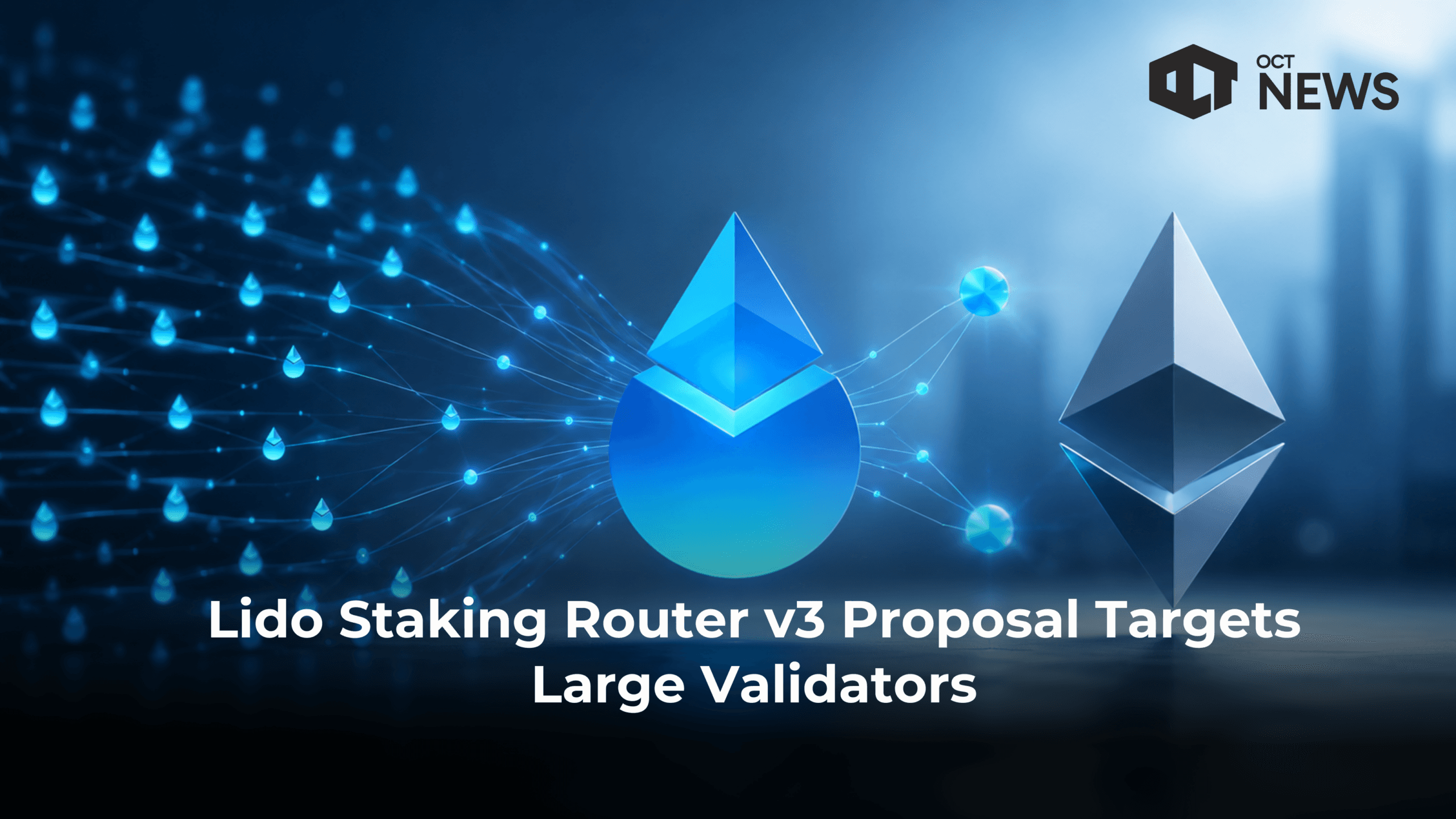
Lido Staking Router v3 proposes support for 2048 ETH validators, balance-based accounting, and EIP-7251 integration for Ethereum staking.

Author: Akshay
4th June 2026. Lido core contributors have proposed Lido Staking Router v3. It is a foundational upgrade that would bring Ethereum’s new large validators to the protocol’s core. They published the proposal, known as LIP-35, on the Lido governance forum on June 3, 2026. The official Lido account announced it the next day.
High Signal Summary For A Quick Glance

Crypto Update IO 🚀
@cryptoupdate_io

@LidoFinance Staking Router v3 is a big step, but missed the yield compression risk: reallocations could squeeze Lido’s 32 ETH validator dominance. We track consolidation velocity daily—our reports flagged a 12% drop in avg validator size post-Merge. Want the data?
Staking Router v3 unlocks a more flexible, efficient Ethereum staking protocol through reallocated stake via consolidations, large validator deposit support and lean validator management. View the full design and implementation proposal here: https://t.co/SOjw6PgtiT
08:58 AM·Jun 4, 2026

.
@mocumocu
@LidoFinance Now buyback time. $LDO new news
Staking Router v3 unlocks a more flexible, efficient Ethereum staking protocol through reallocated stake via consolidations, large validator deposit support and lean validator management. View the full design and implementation proposal here: https://t.co/SOjw6PgtiT
08:41 AM·Jun 4, 2026

CryptOpus
@ImCryptOpus
@LidoFinance Innovation unlocks future value, smart stackers are accumulating
Staking Router v3 unlocks a more flexible, efficient Ethereum staking protocol through reallocated stake via consolidations, large validator deposit support and lean validator management. View the full design and implementation proposal here: https://t.co/SOjw6PgtiT
08:12 AM·Jun 4, 2026
Steady attention without excessive speculation.
The plan is still at the review stage, so nothing is final yet. No Snapshot vote has happened, and no new contracts are live. Still, the proposal sets out a clear path toward Ethereum’s Pectra era of staking.
The Staking Router sits at the center of Lido. It routes new ETH deposits across staking modules, and it tracks rewards and fees. Today it counts validators in fixed units, because each validator holds exactly 32 ETH.
That model breaks under Ethereum’s new rules. So Lido Staking Router v3 switches to balance-based accounting. Instead of counting validators, the router tracks the actual ETH balance behind each one.
This shift prepares Lido for Ethereum’s Pectra upgrade and for EIP-7251. That change raises the maximum effective balance a validator can hold. As a result, the old 32 ETH ceiling no longer applies.
Under EIP-7251, a single validator can hold up to 2048 ETH. That is 64 times the old limit. So one large validator can earn up to 64 times the rewards of a 32 ETH validator.
To support this, Lido Staking Router v3 introduces new deposit flows. The proposal describes a pull model plus a TopUpGateway. Together they let the protocol top up larger validators over time, rather than sending a fixed 32 ETH at once.
These top-ups are not blind, though. Each one is gated by on-chain Merkle proofs of consensus-layer state. In other words, the protocol verifies the validator’s real balance before it adds more ETH. Each module will also support only one key type, either the older 0x01 keys or the new 0x02 keys.
Timeline: Lido’s progression from a permissioned staking architecture to a post-Pectra framework designed for large validators and scalable staking operations
Lido proposes the Staking Router architecture as part of Lido V2, replacing the monolithic NodeOperatorsRegistry with a modular controller capable of managing multiple validator modules.
Lido V2 goes live, bringing the first version of the Staking Router to Ethereum mainnet. The architecture enables modular validator management but initially remains permissioned and based on 32 ETH validator counts.
LIP-25 upgrades the router to support permissionless participation, enhanced security, and scalability improvements. The Community Staking Module and Simple DVT Module broaden validator diversity across the Lido ecosystem.
Ethereum’s Pectra hard fork activates EIP-7251, raising the maximum effective validator balance from 32 ETH to 2,048 ETH and introducing native validator consolidation capabilities.
The introduction of large validators and consolidation mechanisms makes count-based validator accounting increasingly inefficient, creating demand for a balance-based staking framework.
LIP-35 introduces Staking Router v3 with balance-based accounting, validator top-up support, consolidation workflows, deposit reserves, and streamlined Easy Track governance to fully support Ethereum’s post-Pectra environment.
If community feedback remains positive, Lido DAO is expected to begin the governance process with a Snapshot signaling vote on the Staking Router v3 proposal.
Security audits are expected to conclude before an on-chain DAO vote and potential deployment of the Staking Router v3 contracts.
Lido plans a phased migration process that includes validator consolidations, balance top-ups, and gradual adoption of the new accounting model.
The original Curated Module architecture is expected to be fully retired, completing Lido’s transition to its post-Pectra staking framework.
Large validators also require a way to move existing stake. For that, the proposal adds a consolidation pipeline. It migrates stake from Curated Module v1, which uses 0x01 keys, to Curated Module v2, which uses 0x02 keys.
The pipeline is delayed and proof-verified, and anyone can execute it once a motion passes. It runs through an Easy Track motion into a set of consolidation contracts. Because the flow relies on EIP-7251 consolidations, validators merge their balances instead of exiting and redepositing.
Lido has tested this path on public testnets, according to the proposal. The team frames the design as a safer way to reshape stake without taking validators offline.
The third headline feature targets day-to-day overhead. To address this, Lido Staking Router v3 adds a dedicated Easy Track factory for module settings. As a result, governance can adjust a module’s stake share limit and exit share within pre-set bounds. At the same time, the framework preserves operational guardrails and limits administrative complexity.
A new narrow permission, the staking module share manage role, controls that factory. So the DAO can tune module limits quickly, yet within safe guardrails. The proposal also adds a deposit reserve that protects buffered ETH for deposits and rebalancing.
Balance-based exits round out the set. Since accounting now follows ETH rather than validator counts, exits and rebalancing become balance-aware. As a result, the protocol can manage stake with fewer keys and less manual work.
Before vs after the proposed Staking Router v3 upgrade (LIP-35)
The upgrade arrives while Lido remains the largest player in Ethereum staking. Its share of all staked ETH sits at roughly 22 to 29 percent in recent Dune Analytics data. Lido reports about 8.9 million ETH staked through stETH.
Larger validators could make that base more efficient, because fewer keys mean less overhead for operators and the network. According to DefiLlama, Lido’s total value locked sits near $15.8 billion. The LDO token traded around $0.31 to $0.32 on June 4, with no clear move tied to the proposal yet.
There is a trade-off, though. Bigger validators concentrate more stake behind each key, so a single compromised operator could carry more slashing risk. Lido points to its modular design and proof-verified flows as mitigations. Critics of Lido’s staking share may still watch this closely.
For now, the proposal remains in community review, and the authors have invited feedback from stakeholders. Meanwhile, the four listed authors, Maksim Kuraian, KRogLA, Alexander Kolesnikov, and Anna Mukharram, continue refining the proposal. In addition, audits by Certora, Statemind, Composable Security, and MixBytes are currently underway.
If approved, a Snapshot signaling vote could follow in late June 2026. Afterward, deployment is tentatively targeted for July. Subsequently, a phased migration would run through late 2026, while a full Curated Module v1 sunset is expected around Q1 2027. For additional details, readers can review the complete proposal in the LIP-35 forum post and the accompanying GitHub spec.
None of this is financial advice. Dates and parameters remain tentative until governance votes and audits conclude.
Our Crypto Talk is committed to unbiased, transparent, and true reporting to the best of our knowledge. This news article aims to provide accurate information in a timely manner. However, we advise the readers to verify facts independently and consult a professional before making any decisions based on the content since our sources could be wrong too. Check our Terms and conditions for more info.


Securitize Stocks Launches Tokenized Equities on Solana
Stellar Settles First Institutional Repo Using Tokenized Treasury Collateral
Uniswap Aggregator Hooks Go Live & Route Fees to UNI Burn
Drift Protocol Exploit Sends $122M to Tornado Cash
Securitize Stocks Launches Tokenized Equities on Solana
Stellar Settles First Institutional Repo Using Tokenized Treasury Collateral
Uniswap Aggregator Hooks Go Live & Route Fees to UNI Burn
Drift Protocol Exploit Sends $122M to Tornado Cash

Lido DAO