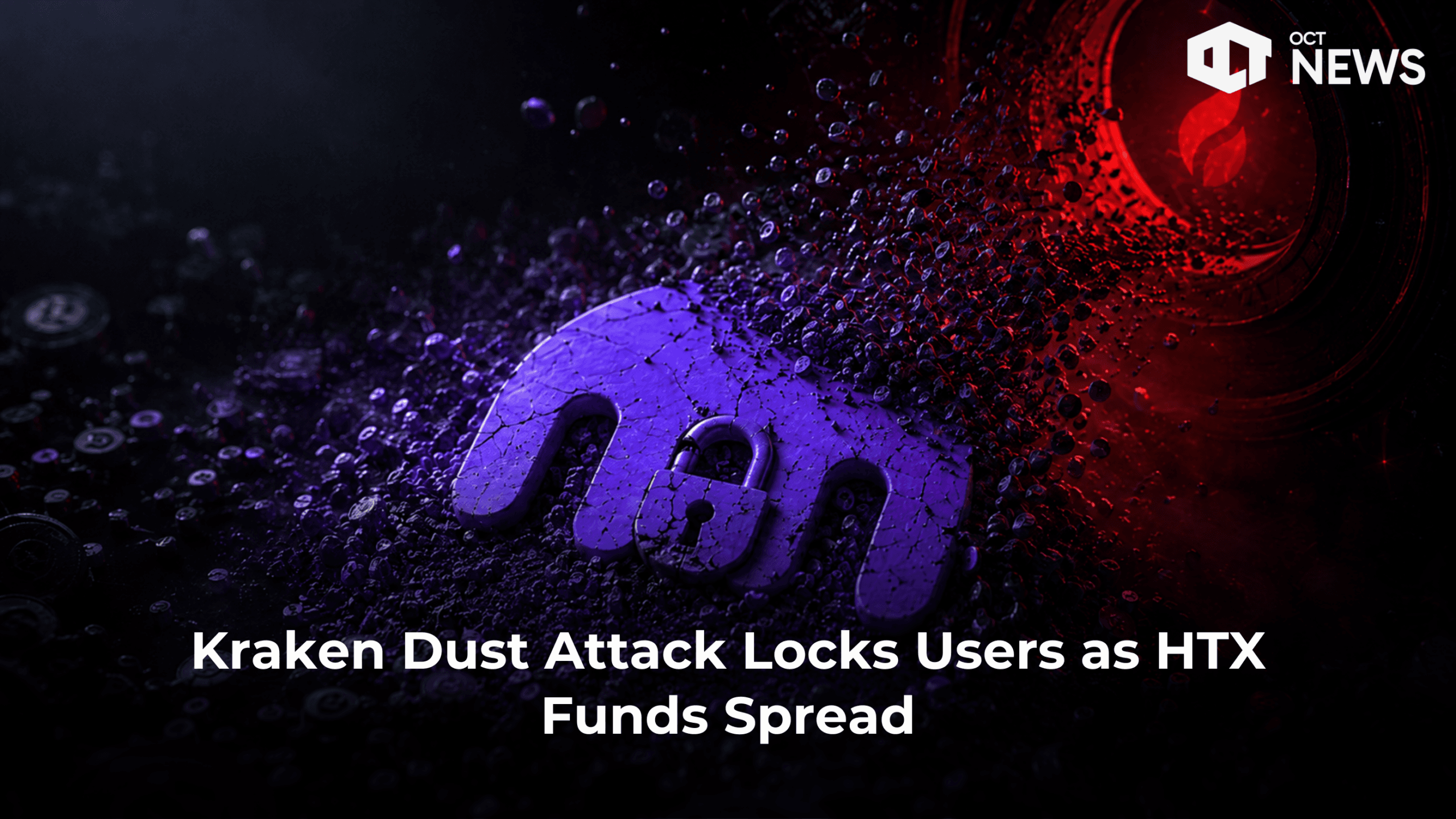
Kraken briefly froze some customer accounts after nearly 12,000 tiny HTX-linked transfers, highlighting the risks of crypto dust attacks.

Author: Akshat Thakur
25th August 2026 – Kraken customers briefly lost account access this week after an unknown sender flooded their wallets with tiny crypto transfers.
High Signal Summary For A Quick Glance

OOXXOO
@OOXXOO_01

@WuBlockchain Kraken's indiscriminate freezing of funds by ordinary users has led to a large number of male users turning to sex work.
Bloomberg: Kraken Hit by ‘Dust Attack’ as Nearly 12,000 HTX-Linked Transfers Trigger Compliance Reviews Bloomberg reported that Kraken said some customers were temporarily locked out after receiving small crypto transfers from a wallet identified by Arkham Intelligence as linked https://t.co/ZA5oONWPHY
04:46 PM·Aug 25, 2026

Casper
@CasperAlphaX
@WuBlockchain So anyone can send you $0.01 and potentially trigger a compliance nightmare? That’s a pretty serious flaw in the system.
Bloomberg: Kraken Hit by ‘Dust Attack’ as Nearly 12,000 HTX-Linked Transfers Trigger Compliance Reviews Bloomberg reported that Kraken said some customers were temporarily locked out after receiving small crypto transfers from a wallet identified by Arkham Intelligence as linked https://t.co/ZA5oONWPHY
03:03 PM·Aug 25, 2026

JBetamax
@JaimeBetamax
@WuBlockchain Obviously HTX is working with Kraken to identify accounts linked to crqziness - i wonder how many are linked to politicians and corps and ukraine stuff
Bloomberg: Kraken Hit by ‘Dust Attack’ as Nearly 12,000 HTX-Linked Transfers Trigger Compliance Reviews Bloomberg reported that Kraken said some customers were temporarily locked out after receiving small crypto transfers from a wallet identified by Arkham Intelligence as linked https://t.co/ZA5oONWPHY
02:45 PM·Aug 25, 2026
Steady attention without excessive speculation.
The Kraken dust attack ran from August 17 to August 24, according to a report Bloomberg published on August 25. During that window, one wallet sent nearly 12,000 small transfers to Kraken-linked addresses. Most were worth only a few cents or a few dollars.
Arkham Intelligence links the sending wallet to HTX, the exchange formerly known as Huobi. So when the dust landed, some Kraken customers found their accounts temporarily frozen.
Kraken has since restored access to the affected accounts. Meanwhile, the exchange continues to hold or freeze the funds it flagged as sanctioned. It also says it is working with authorities.
Kraken has not published an exact count of locked customers. Instead, it describes the impact only as “some” accounts and a “temporary” or “brief” lockout. The precise duration also remains unclear.
Kraken had already warned about HTX flows before this week. Back in May 2026, the exchange advised customers against sending transfers from Huobi or HTX. So the latest freezes followed months of caution around the sanctioned exchange.
A dust attack sends tiny, unsolicited amounts of crypto to many addresses at once. Because blockchains are public and permissionless, anyone can do this cheaply.
Traditionally, attackers use dusting to deanonymize wallets. When a recipient later spends the dust, clustering tools can link their addresses together. This case points to a different goal.
Here the risk comes from where the funds allegedly originated. Modern exchanges screen every deposit for exposure to sanctioned entities. So even unwanted dust can flag an address under AML and clustering rules.
As a result, an exchange may lock a whole account while it reviews the exposure. The recipient never asked for the funds. Still, the inbound transaction creates an on-chain link that compliance systems must check.
Analysts call this risk association “taint.” Once a tainted deposit lands, clustering algorithms group the interacting addresses together. So a few cents of dust can trigger the same review as a large suspicious deposit.
This attack did not happen in a vacuum. The United Kingdom sanctioned Huobi Global SA, the entity behind HTX, back in May 2026. Regulators tied the move to suspected facilitation of Russian sanctions evasion. Reports connected the case to entities such as A7 and Garantex.
Related European Union measures followed over the summer. By around August 23, transaction restrictions had tightened further. Because of that pressure, exchanges such as Bybit, OKX, Binance, and Kraken moved to restrict or review HTX-linked flows.
According to Kraken, the timing was not a coincidence. A spokesperson told Bloomberg the transfers appear designed to spread sanctioned money across compliant platforms.
“The recent dust attack originating from HTX-owned wallets appears to be an attempt to spread funds sanctioned by the U.K. and the European Union across other platforms and undermine trust across the industry,” the spokesperson said. The attackers, they added, may have expected sanctioned funds to lock recipient accounts entirely.
Key milestones in the HTX Dust Attack on Kraken Users
Transfers begin from a wallet identified by Arkham Intelligence as HTX-linked (based on HTX proof-of-reserves disclosure). Exact time of first transfer unverified.
The HTX-linked wallet sends nearly 12,000 small transfers (mostly cents to a few dollars) to Kraken-linked addresses, confirmed by Etherscan and Arkham Intelligence data.
Kraken’s compliance and AML systems auto-flag the incoming transfers due to HTX linkage and sanctioned-funds risk. Some affected customer accounts are temporarily locked out.
Kraken restores access to all affected accounts before public reporting, while continuing to hold and freeze the sanctioned funds and coordinating with relevant authorities.
Bloomberg quotes a Kraken spokesperson on the dust attack, ~12,000 transfers, temporary locks, and account restoration. Wu Blockchain amplifies the story on X at 14:39 UTC.
Account access remains restored; sanctioned funds continue to be held. HTX denies initiating the transfers and is investigating possible address misattribution or third-party activity. No regulatory resolution reported yet.
HTX rejects that account. The exchange denies initiating the transfers. Instead, it says it is investigating possible address misattribution or malicious third-party activity.
That leaves the core question open. Arkham labels the wallet as HTX-linked, reportedly based on an address from HTX’s proof-of-reserves disclosure. However, a public label does not prove who controls a wallet today.
Andy Zhou, chief executive of security firm BlockSec, compared the incident to poisoning a user’s transaction history. Because anyone can send assets to any address, he noted, the tactic costs the attacker very little.
The Kraken dust attack also builds on an earlier, smaller wave. Around August 18, reports described roughly 166 dust transfers from an address labeled “HTX 48” on Etherscan. Some of those transfers also reached Kraken addresses.
During that first wave, users complained about frozen accounts. One reported freeze reportedly involved $4.2 million, though Kraken has not confirmed that figure. HTX denied involvement then too, and Justin Sun called some reports fabricated.
Open coverage still does not name the exact wallet or transaction hashes behind the full 12,000-transfer series. The precise tokens and total value also remain unverified. So the two waves are related, yet the larger one is not fully documented on-chain.
For now, Kraken says the affected accounts are back online. Yet the funds stay frozen, and the investigation continues alongside authorities.
The episode shows how permissionless transfers can turn compliance tools into an attack surface. Because a sender needs no permission, screening systems must sort real risk from weaponized noise. That challenge will not disappear soon.
Kraken customers who received unexpected dust should avoid moving it and watch for official guidance. This article is informational only and not financial advice. Always verify account notices through Kraken’s official channels.
Our Crypto Talk is committed to unbiased, transparent, and true reporting to the best of our knowledge. This news article aims to provide accurate information in a timely manner. However, we advise the readers to verify facts independently and consult a professional before making any decisions based on the content since our sources could be wrong too. Check our Terms and conditions for more info.


Ledger Probes User Fund Losses Tied to Reseller CryptoBilis
ZachXBT Infiltrated Lazarus Laundering Ring Behind Bybit Hack
Kelsier Ventures As 1,000 Wallets Fell From $300M to $2M in LIBRA
Base Vault Exploit Drains $6M in wstETH Via Whitelist
Ledger Probes User Fund Losses Tied to Reseller CryptoBilis
ZachXBT Infiltrated Lazarus Laundering Ring Behind Bybit Hack
Kelsier Ventures As 1,000 Wallets Fell From $300M to $2M in LIBRA
Base Vault Exploit Drains $6M in wstETH Via Whitelist