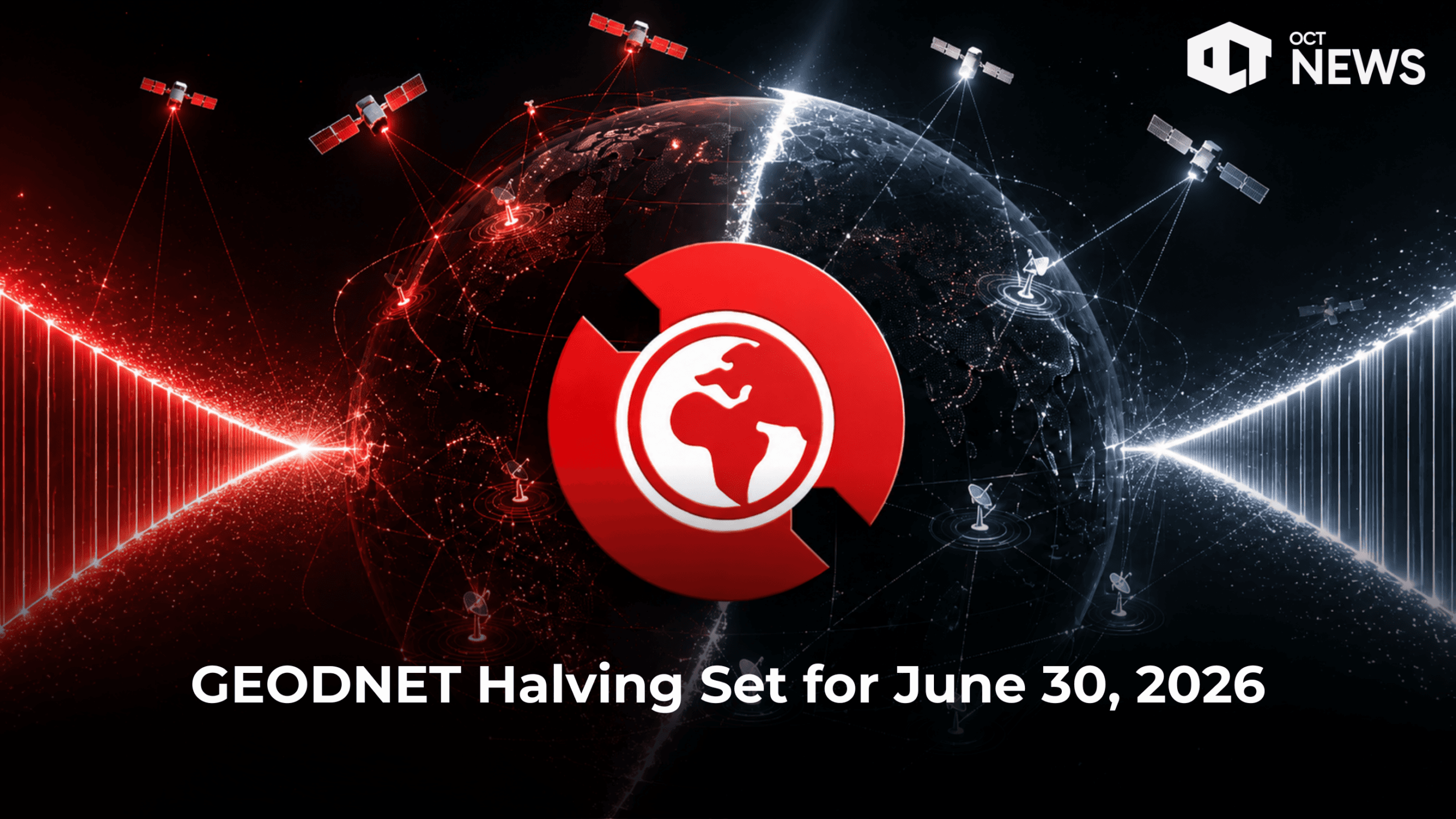
GEODNET’s next scheduled halving is set for June 30, 2026, with the reduced base reward rate taking effect from July 1, 2026.

Author: Sahil Thakur
24th June 2026 – GEODNET’s next scheduled halving is set for June 30, 2026, with the reduced base reward rate taking effect from July 1, 2026. The event will cut the maximum daily base reward for eligible GEODNET miners from 12 GEOD per day to 6 GEOD per day, marking a 50% reduction in core mining emissions.
Unlike some crypto halving events that depend on block height, governance votes, or one-off proposals, GEODNET’s halving follows a fixed annual schedule. The project’s tokenomics documentation states that base rewards halve every year on June 30, making the 2026 event part of a pre-set emissions model rather than a newly approved change.
High Signal Summary For A Quick Glance
Steady attention without excessive speculation.
During the current reward period, which runs from July 1, 2025 to June 30, 2026, the maximum base reward for the relevant miner tier is 12 GEOD per day. From July 1, 2026, that base reward drops to 6 GEOD per day.
The change primarily affects base-station and satellite miner rewards, which are the core emissions paid to operators running GNSS/RTK reference stations. Actual miner payouts can vary depending on several network rules, including data quality, uptime, hex occupancy, and other reward multipliers.
There is no primary-source confirmation that referral rewards are directly halved by this mechanism. Staking and other reward streams are also mentioned separately in GEODNET materials, but they are not clearly tied to the June 30 halving cut.
GEODNET’s halving model has followed a consistent annual pattern since the early mining period.
The reward schedule moved from approximately 2 GEOD per hour, or around 48 GEOD per day, before the June 2023 halving. It then fell to 1 GEOD per hour after June 30, 2023, followed by 0.5 GEOD per hour, or around 24 GEOD per day, after the June 30, 2024 halving.
The June 30, 2025 halving reduced the maximum base reward to 12 GEOD per day, and the upcoming June 30, 2026 event will reduce it again to 6 GEOD per day.
This fixed annual reduction is designed to slow token emissions over time while encouraging earlier network participation.
For miners, the immediate impact is straightforward: the base GEOD reward rate is being cut in half. That means station operators may see lower token-denominated earnings unless the reduction is offset by improved data quality, stronger token prices, increased network demand, or other revenue-linked incentives.
For token holders, the halving reduces the rate at which new GEOD enters circulation. This may become more important because GEODNET also uses a revenue-based buyback-and-burn model, where 80% of RTK data fees are directed toward token buybacks and burns.
The combination of lower emissions and growing usage-based burns has become a key part of the project’s long-term tokenomics narrative. Community discussions around the event have largely focused on whether the halving, combined with buybacks and burns, could push GEOD toward net-deflationary tokenomics if network revenue continues to grow.
The 2026 halving comes as GEODNET has continued to expand its global footprint. The project has grown from its early base-station deployment phase into a large DePIN network with tens of thousands of miners across more than 160 countries.
GEODNET claims to operate one of the world’s largest RTK networks, with its infrastructure supporting real-time precision positioning services. The project has also seen rising attention following recent exchange listings, including Coinbase in June 2026, and continued growth in protocol revenue.
Around June 23–24, 2026, GEOD was trading near $0.239, with a market capitalization of roughly $107 million, 24-hour volume near $1.86 million, and a circulating supply of about 449.5 million GEOD. Recent market performance showed gains of around 15.5% over 24 hours, 20.3% over seven days, and 59.3% over 30 days.
While many community members frame the halving as bullish for supply dynamics, the event also raises questions about miner profitability.
At a lower base rate of 6 GEOD per day, some operators may need higher token prices or stronger network-linked revenue to maintain the same dollar-denominated earnings. If rewards fall too sharply, there is a possibility that less profitable stations could go offline, which could affect network coverage or data quality in certain regions.
However, there is currently no clear evidence of widespread organized pushback from miners. Most recent discussion around the 2026 halving has focused on the long-term supply impact, the buyback-and-burn mechanism, and the possibility of GEOD moving toward more sustainable tokenomics.
Several important details will only become clear after the halving takes effect.
The exact total daily emissions after July 1 will depend on the number of active miners, data quality scores, uptime, hex rules, and other reward factors. It is also unclear whether the halving will meaningfully affect miner retention, station uptime, or network expansion.
Another open question is how quickly GEODNET’s revenue and burns can grow relative to reduced emissions. If burns begin to exceed new token distributions, the project’s tokenomics could shift toward net deflation. But that outcome depends on actual network usage, revenue growth, and miner behavior after the reward cut.
GEODNET’s June 30, 2026 halving is not a surprise event or governance-driven change. It is part of the project’s fixed annual emissions schedule.
From July 1, 2026, the maximum base mining reward will fall from 12 GEOD per day to 6 GEOD per day, reducing new supply while putting more pressure on miner economics. For GEODNET, the key test will be whether growing network demand, buybacks, burns, and token market performance can offset the lower reward rate and support continued expansion of its real-world infrastructure network.
Our Crypto Talk is committed to unbiased, transparent, and true reporting to the best of our knowledge. This news article aims to provide accurate information in a timely manner. However, we advise the readers to verify facts independently and consult a professional before making any decisions based on the content since our sources could be wrong too. Check our Terms and conditions for more info.


Geodnet