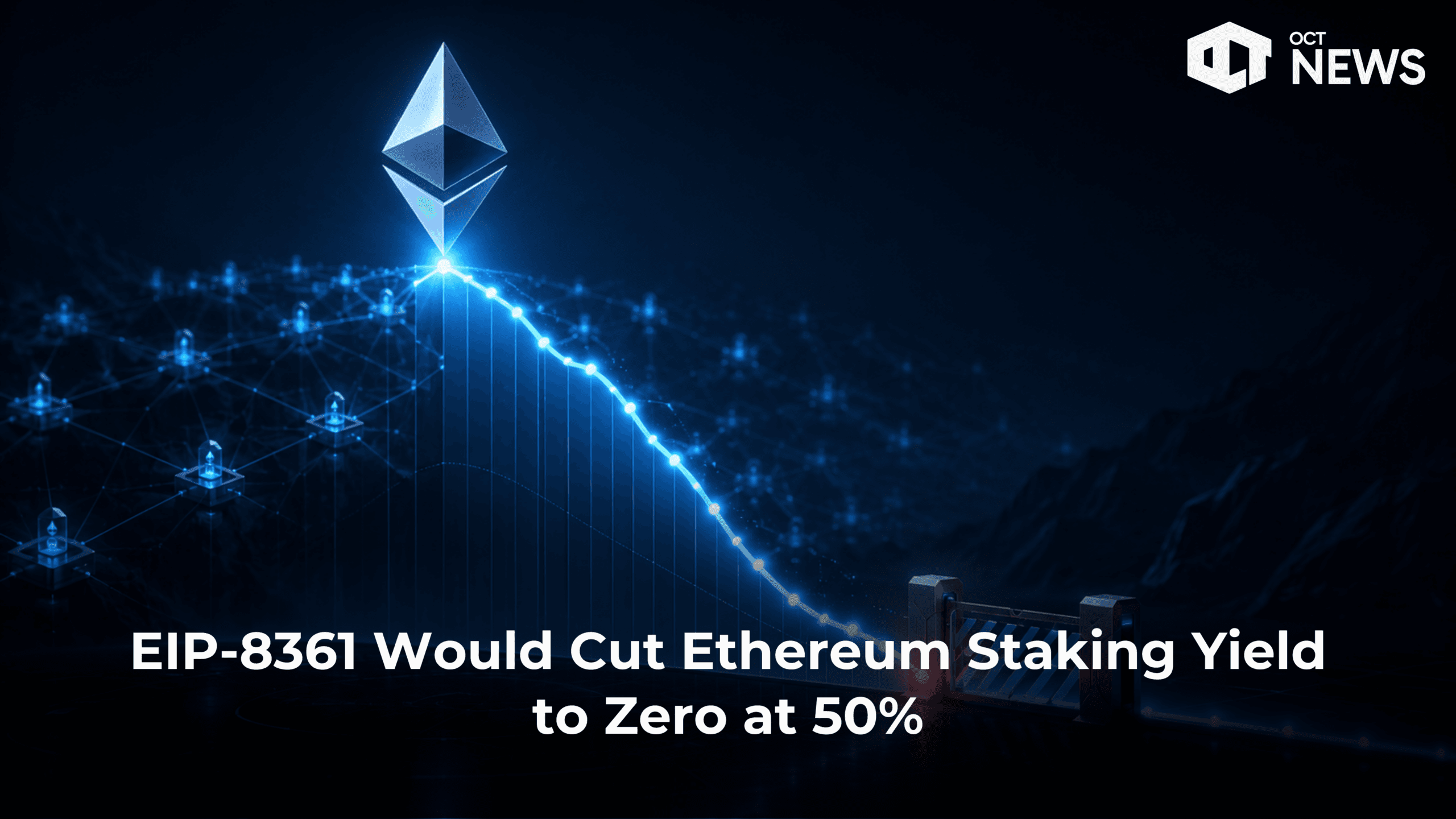
EIP-8361 proposes cutting Ethereum staking yield to zero at 50% staked by burning validator rewards. Here's what it means for ETH stakers.

Author: Akshat Thakur
Steady attention without excessive speculation.
4th August 2026 – A new draft proposal called EIP-8361 targets Ethereum staking yield. It would drive that yield to zero once stakers lock up half of all ETH.
High Signal Summary For A Quick Glance

0xPermaBull 🦇🔊🐬
@dividend_fire

@zoomerfied For people not understanding the rationale behind it Minimum viable issuance is the argument (pay as little as possible for security assuming it's safe enough). If 50% of ETH is staked that extremely secure and Ethereum doesn't need to pay more for security because not more
[ ZOOMER ] JUSTIN DRAKE AND OTHERS CREATE EIP-8361 TO REDUCE ETHEREUM INFLATION, WOULD REDUCE STAKING YIELD TO 0% ABOVE 50% OF ETHEREUM STAKED, AND HALF STAKING YIELD TO 1% AT CURRENT STAKED AMOUNTS: X
04:16 PM·Aug 4, 2026

The Wolf Of Broad Street
@Mapo0o
@zoomerfied Dude says "no one" is locking up Eth just for a measly 2-5% on an appreciating asset so they will do it for free. Make it make sense.
[ ZOOMER ] JUSTIN DRAKE AND OTHERS CREATE EIP-8361 TO REDUCE ETHEREUM INFLATION, WOULD REDUCE STAKING YIELD TO 0% ABOVE 50% OF ETHEREUM STAKED, AND HALF STAKING YIELD TO 1% AT CURRENT STAKED AMOUNTS: X
03:38 PM·Aug 4, 2026

_gabrielShapir0
@lex_node
@zoomerfied terrible idea and a huge distraction from efforts that could drive more demand instead
[ ZOOMER ] JUSTIN DRAKE AND OTHERS CREATE EIP-8361 TO REDUCE ETHEREUM INFLATION, WOULD REDUCE STAKING YIELD TO 0% ABOVE 50% OF ETHEREUM STAKED, AND HALF STAKING YIELD TO 1% AT CURRENT STAKED AMOUNTS: X
03:02 PM·Aug 4, 2026
Six authors submitted the proposal through GitHub on August 4, and the group includes Ethereum Foundation researcher Justin Drake. The document, titled “Tapered Issuance Burn,” is still a Draft, so nothing changes on the network yet.
The idea is simple at its core. At each epoch boundary, the network deducts and burns a fraction of every validator’s idealised duty reward. That reward covers attestations, block proposals, and sync committee work.
The burn fraction is not fixed. Instead, it rises with the staking ratio, meaning the total active balance divided by the total supply. So the more ETH people stake, the larger the share of rewards the network destroys.
According to the EIP, the burn fraction follows a set formula. It is b(f) = (f / 0.5) raised to the power 1.5, capped at 100%. As a result, the burn reaches full strength near half of the ETH supply. You can read the full spec in GitHub pull request 12081.
Today the network pays consensus rewards in proportion to 64 divided by the square root of the total active balance. Because of that math, yield falls only slowly as staking grows. Even at full participation, a positive floor of roughly 1.5% would remain.
That floor creates constant pressure to stake more ETH. EIP-8361 removes it. The burn cancels a growing slice of issuance. So net Ethereum staking yield declines faster and hits zero at a 50% staking ratio.
The math here is exact rather than approximate. At or above half of supply staked, the burn wipes out 100% of issuance. Therefore stakers above that line earn no net consensus reward at all.
Current numbers show why this matters now. About 41.6 million ETH sits staked today, or roughly 34% of the 122 million supply, according to ultrasound.money. Nominal Ethereum staking yield sits near 2.6%, almost entirely from consensus issuance.
The authors clearly anticipated a shock to staker income. So the proposal pairs the new curve with an 18-month transition period. During that window, the network temporarily lowers the base reward factor impact so the absolute cut phases in gradually.
The curve shape itself turns on from day one of any activation fork. Still, the transition matters. Stakers would start near today’s yield, then slide toward the permanent curve over 18 months.
Consider the current staking level as an example. At 33% staked, the EIP estimates a full activation would cut net yield from 2.6% to 1.2%. Co-authors have described that as a rough halving toward 1%. That framing tracks the EIP’s more precise 1.2% figure.
Key milestones in Ethereum’s Issuance Reduction Debate
Anders Elowsson publishes research on issuance levels, consensus incentives, and “minimum viable issuance,” arguing Ethereum overpays for security under the current curve.
Elowsson formalizes arguments for lowering rewards while preserving incentives and economic security in a detailed public FAQ.
Multiple yield-curve proposals surface (tempered issuance, capped issuance, Electra adjustments). Inclusion in Pectra/Electra is discussed but deferred amid industry pushback.
Drake publicly calls the current issuance curve broken and proposes “croissant issuance” — peaking near 25% stake and falling to zero at a 50% soft cap.
Staking ratio climbs toward/above 33%, sharpening the urgency. Per-duty burn mechanisms and further research continue on ethresear.ch and related forums.
“Tapered Issuance Burn” formally drafted by pintail, Jérôme de Tychey, dapplion, pa7x1, Ladislaus von Daniels, and Justin Drake.
EIP-8361 submitted via GitHub PR #12081 and publicly announced; Magicians forum discussion opens the same day.
EIP enters core-dev and editor review as a Draft; possible consideration for a future hard fork (post-Hegota or later). No target fork assigned yet.
Solo stakers keep the same micro-incentives, because performing duties still pays something. However, they face lower absolute returns and fixed operating costs that do not shrink. That combination worries home stakers the most.
Liquid staking protocols like Lido and Rocket Pool would also feel the squeeze. As base yields compress, any equilibrium above roughly 40% to 45% staked starts to look unattractive. In turn, that could slow the growth of liquid staking tokens and EigenLayer restaking.
The authors frame this outcome as a feature. In the abstract, they argue the change “removes the yield floor implicit in the current curve.” It would let the staking market settle where yield meets the risk premium stakers demand. For a positive premium, they expect that point to sit below 50% staked.
Reaction on X has been engaged but skeptical. Home stakers argue that near-zero yields hit small operators first. Their fixed costs eat a larger share of thinner rewards. Some warn of a drift toward large, professional operators.
DeFi voices raised a different concern. Aave founder Stani Kulechov called the proposal “hurtful for Ethereum.” Other lending-market participants warned that unpredictable yields could damage institutional demand and ETH borrowing markets. The timing also drew fire, because the proposal landed just before a Hegota fork planning deadline.
The authors pushed back in turn. They argue the current curve already forces yields lower through dilution and taxes solo stakers first. Moreover, they note the taper preserves execution-layer income and never pushes a correct attester into negative rewards.
Plenty remains unsettled. Editors have not merged the draft to the main EIP repository, and no hard fork has adopted it. The final saturation balance and the long-term equilibrium staking ratio are still open questions.
Some signals point to momentum, though. The client team behind Prysm has reportedly built a prototype implementation already. The Ethereum Magicians thread is active, and core researchers are debating the parameters in public.
For now, EIP-8361 reopens the long-running issuance debate rather than settling it. Watch the pull request and the Magicians forum for the next round of edits. This article is not financial advice, and staking returns depend on parameters that could still change.
Our Crypto Talk is committed to unbiased, transparent, and true reporting to the best of our knowledge. This news article aims to provide accurate information in a timely manner. However, we advise the readers to verify facts independently and consult a professional before making any decisions based on the content since our sources could be wrong too. Check our Terms and conditions for more info.



Ethereum