
DOL proposes a landmark rule allowing Bitcoin and crypto in 401(k) plans, opening retirement portfolios to alternative assets.

Author: Kritika Gupta
Steady attention without excessive speculation.
31st March 2026- The DOL Bitcoin 401(k) rule marks one of the most significant regulatory updates for retirement investing and digital assets in recent years. On March 30, 2026, the U.S. Department of Labor unveiled a proposed regulation that would make it easier for 401(k) plans to include alternative investments such as Bitcoin, other cryptocurrencies, private equity, real estate, and commodities. The proposal introduces a process-based safe harbor for plan fiduciaries, reducing litigation risk while preserving ERISA’s core prudence standards.
This matters because more than 90 million Americans rely on workplace retirement plans, with the 401(k) market representing roughly $14 trillion in assets. As a result, even modest exposure to Bitcoin or crypto-linked products could create a major new institutional capital channel. For crypto markets, the DOL Bitcoin 401(k) rule is not simply a policy update. Instead, it represents a structural bridge between digital assets and mainstream retirement finance.
High Signal Summary For A Quick Glance

Diana
@InvestWithD

🚨BREAKING: DOL OFFICIALLY PROPOSED OPENING 401(k) TO CRYPTO — XRP CAN BE INCLUDED 🇺🇸🤯🔥 The U.S. Department of Labor has FORMALLY PROPOSED a NEW RULE that could make it easier for 401(k) plans to INCLUDE alternative assets — including DIGITAL ASSETS like crypto ( $XRP, $BTC, https://t.co/ePcyMWCC0n https://t.co/IoIsJP5EXx

Once again President Trump is delivering for the American people. This landmark rule tears down bureaucratic barriers by putting digital assets on equal footing with every other asset class. Hardworking Americans can finally build real wealth in their retirement accounts 🇺🇸 https://t.co/Z4nzGkB1XH
07:20 AM·Mar 31, 2026
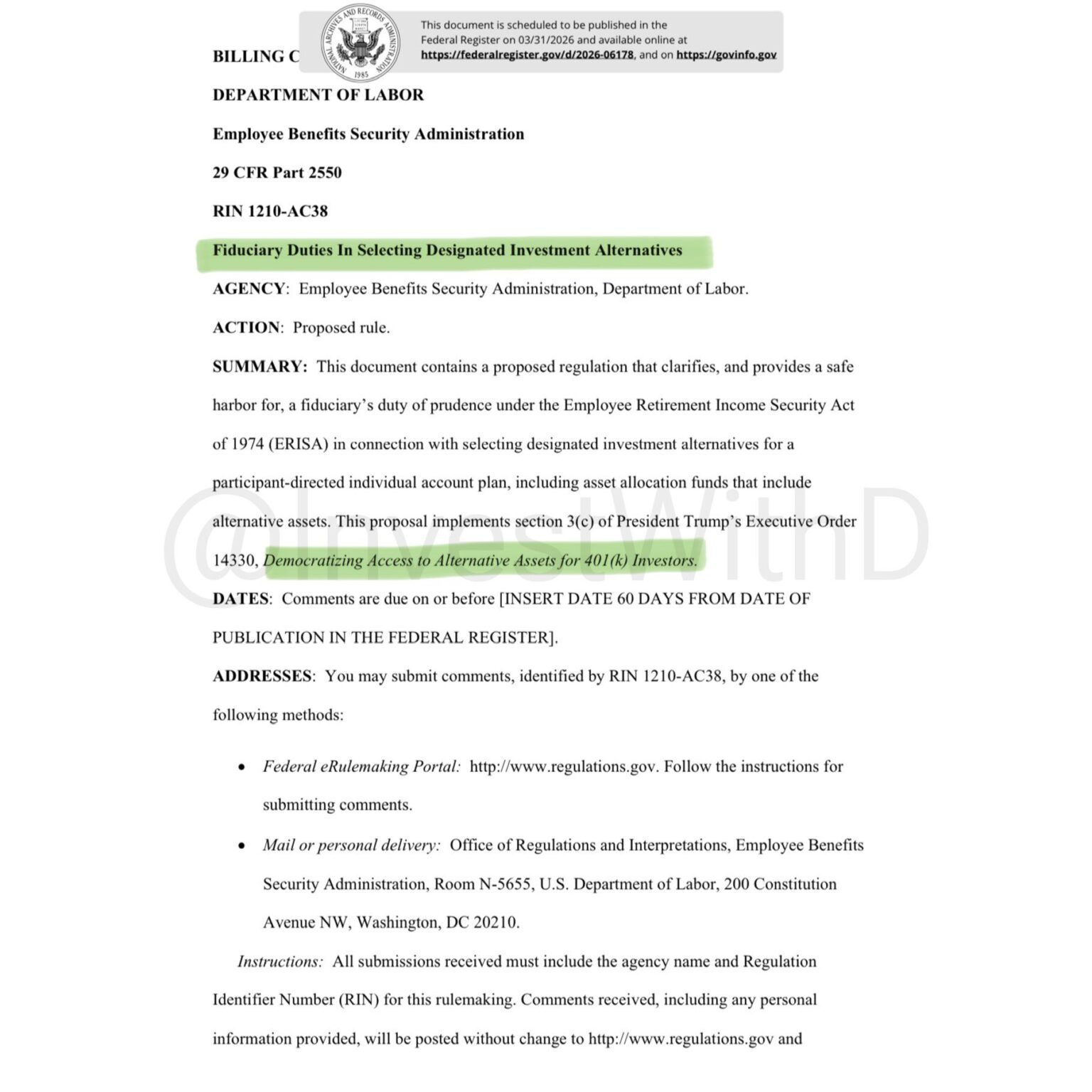
This proposal did not emerge in isolation. Instead, it directly follows President Donald Trump’s August 2025 executive order, titled “Democratizing Access to Alternative Assets for 401(k) Investors.” That order instructed the DOL to revisit prior guidance and create a more flexible framework for fiduciaries evaluating alternative assets.
Previously, the regulatory stance had been far more cautious. In March 2022, under the prior administration, the DOL issued Compliance Assistance Release 2022-01. That guidance urged fiduciaries to exercise “extreme care” before adding cryptocurrency options to 401(k) plans. The department specifically cited concerns around volatility, fraud, custody, valuation, and whether average retirement savers could fully understand the risks.
The 2022 guidance had a chilling effect on adoption. Although some providers, most notably Fidelity, had begun exploring Bitcoin options in retirement accounts, many employers and plan committees chose to stay on the sidelines. This caution intensified during the broader crypto downturn of 2022, which included the collapse of FTX and severe market-wide deleveraging.
However, the DOL reversed that position in May 2025 by fully rescinding the earlier guidance. This move restored the department’s traditional neutral stance, meaning it neither endorsed nor discouraged any specific asset class. Now, the new 2026 proposal builds on that reversal by moving from neutrality to procedural clarity.
If the rule is finalized, it could become one of the most important institutional adoption catalysts for Bitcoin in the U.S. retirement market. Even modest allocations of 1% to 5% across eligible plans could translate into substantial capital inflows over time. Rather than direct spot Bitcoin holdings in every case, exposure would likely come through regulated structures such as ETFs, professionally managed funds, balanced portfolios, or target-date products with limited crypto sleeves.
For crypto markets, this is structurally important for several reasons. First, it potentially introduces long-duration capital. Retirement money typically moves slowly and remains invested over long horizons. Therefore, this capital tends to be stickier than speculative trading flows.
Second, it strengthens Bitcoin’s position as an increasingly accepted institutional asset alongside gold, commodities, and alternative investments. Third, it may accelerate broader financial integration between crypto products and traditional wealth-management infrastructure.At the same time, the risks remain substantial.
The DOL emphasized that the safe harbor is procedural, not substantive. In other words, fiduciaries still must satisfy ERISA’s core duties of prudence, loyalty, and diversification. The rule does not grant blanket approval for crypto. Instead, it protects fiduciaries who follow a rigorous investment-selection process.
Wall Street responded positively to the announcement. Shares of major alternative asset managers such as Blackstone, Apollo Global Management, and Carlyle moved higher as markets priced in the possibility of fresh retirement-plan inflows into alternative products.
The proposal now enters a 60-day public comment period, during which retirement-plan providers, asset managers, consumer advocacy groups, fiduciary advisers, and lawmakers are expected to submit feedback on the scope of the safe-harbor framework and the treatment of alternative assets, including Bitcoin.
Following the consultation window, the U.S. Department of Labor will review comments, assess potential revisions, and move toward a final rulemaking stage. Based on the current timeline, market participants expect the rule to be finalized in late 2026 or early 2027, with implementation likely phased in across the 2027 plan year.
In the meantime, major stakeholders are already preparing for the next phase. Asset managers and ETF providers are expected to explore retirement-focused Bitcoin and diversified crypto investment products, while plan sponsors and fiduciary committees will likely begin internal compliance reviews, risk assessments, and menu-planning discussions ahead of any formal adoption.
Our Crypto Talk is committed to unbiased, transparent, and true reporting to the best of our knowledge. This news article aims to provide accurate information in a timely manner. However, we advise the readers to verify facts independently and consult a professional before making any decisions based on the content since our sources could be wrong too. Check our Terms and conditions for more info.