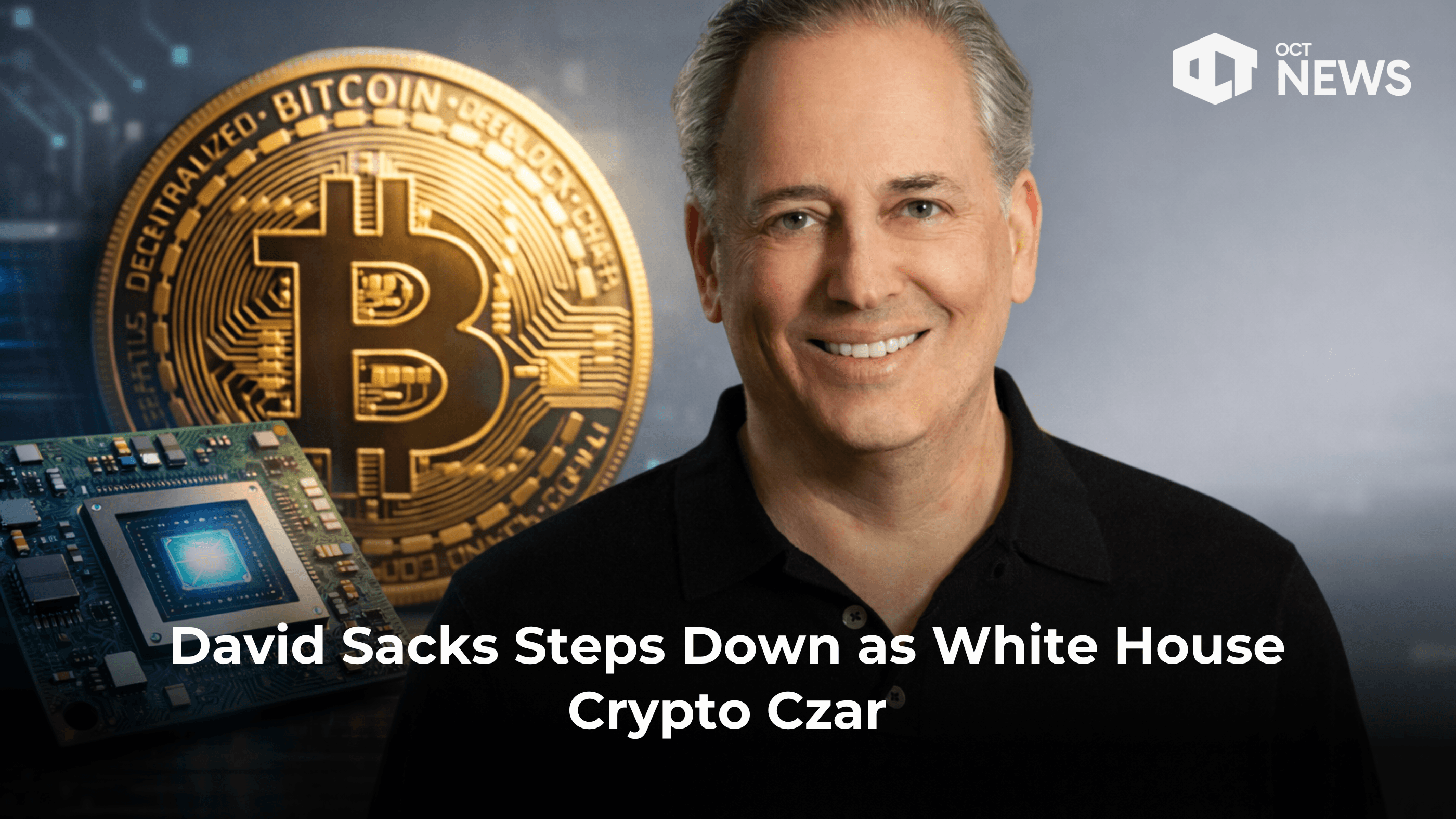
David Sacks has officially ended his role as White House AI and Crypto Czar after 14 months in the position.

Author: Sahil Thakur
27th March 2026 – David Sacks has officially ended his role as White House AI and Crypto Czar after 14 months in the position.
High Signal Summary For A Quick Glance

Cointelegraph
@Cointelegraph

🇺🇸 JUST IN: David Sacks announces his role as Trump's White House AI and crypto czar has officially ended, departing one day after being named chair of the new Presidential Council of Advisors on Science and Technology. https://t.co/cB2ZzEXkRK

10:25 PM·Mar 26, 2026

Watcher.Guru
@WatcherGuru
JUST IN: 🇺🇸 David Sacks' term as President Trump's crypto and AI czar ends.
10:03 PM·Mar 26, 2026

CNBC
@CNBC
David Sacks says his time as Trump's crypto and AI czar has ended https://t.co/mpJ5dTlRr1
09:56 PM·Mar 26, 2026
Steady attention without excessive speculation.
The Trump administration abolished the role, formally titled Special Advisor for AI and Crypto, on March 26, 2026. Sacks now transitions to co-chair of the President’s Council of Advisers on Science and Technology (PCAST), where he will take on a broader tech advisory function.
As a result, his departure closes a chapter that saw major legislative wins, executive actions, and persistent controversy over conflicts of interest.
President Trump announced the appointment on December 5, 2024, via Truth Social. He named Sacks as the person who would “guide policy for the Administration in Artificial Intelligence and Cryptocurrency.”
Sacks, the former PayPal COO and Craft Ventures co-founder, had already played a key role in shifting the Republican stance on crypto. During the 2024 campaign, he helped transform the party’s view from skepticism to strong support.
In addition, Sacks brought significant fundraising weight. He served as a vocal Trump supporter and major donor, and he maintained close ties to Elon Musk and other Silicon Valley figures.
Trump structured the role as a part-time Special Government Employee position. That limited Sacks to 130 working days per year. It also meant the appointment required no Senate confirmation and mandated no full divestment from his venture portfolio. He officially started on January 20, 2025, alongside Trump’s inauguration.
Sacks moved quickly once in office. In January 2025, Trump signed an executive order establishing the President’s Working Group on Digital Asset Markets. Sacks chaired the group and directed it to review agency treatment of crypto, recommend legislation, and promote regulatory clarity.
Then on February 4, 2025, Sacks held a Capitol Hill press conference. He outlined the administration’s shift away from SEC enforcement-first approaches, declaring that the era of “regulation by enforcement” had ended.
The GENIUS Act, a bipartisan stablecoin framework, passed with Sacks’ strong backing. He argued the legislation would unlock “trillions” in U.S. Treasury demand. Specifically, it brought over $200 billion in previously unregulated stablecoins under a clear legal structure.
Meanwhile, in March 2025, Trump signed another executive order creating a Strategic Bitcoin Reserve and U.S. Digital Asset Stockpile. The Treasury now manages more than $17 billion in seized Bitcoin on a budget-neutral basis.
At the same time, federal agencies paused or resolved probes into major exchanges like Binance, Coinbase, and Kraken. Banks also gained clearer paths for crypto custody. Sacks publicly stated that crypto and traditional banking would merge into “one digital assets industry” once market-structure rules passed.
Key milestones related to crypto regulation and industry under David Sacks
The administration created a digital asset working group under David Sacks, signaling a major shift toward a more industry-friendly federal crypto agenda.
The SEC rolled back key custody guidance and started unwinding major enforcement cases, while banking regulators reopened the door for banks to engage with crypto activities.
The White House created a Strategic Bitcoin Reserve and U.S. Digital Asset Stockpile, marking one of the strongest symbolic endorsements of crypto by the federal government.
The GENIUS Act was passed and signed, creating the first major federal crypto law and giving the stablecoin sector a formal U.S. regulatory framework.
After early wins on stablecoins and enforcement pullbacks, the administration’s push for a broader crypto market-structure bill ran into repeated negotiations and legislative deadlock.
Beyond stablecoins, Sacks coordinated with Congress on comprehensive market-structure bills. The legislation aimed to classify most tokens as commodities under CFTC oversight and provide clarity for DeFi.
Congress held hearings on the market-structure framework in early 2026, building on the FIT21 concepts from the previous session. Still, the bill had not passed by the time Sacks departed.
Sacks also hosted the White House Crypto Summit in March 2025. He used the event to push for U.S. leadership in both crypto and AI infrastructure, including data center and compute deals.
The David Sacks crypto czar role drew sharp criticism over ethics and potential self-dealing throughout his tenure.
A New York Times investigation published on November 30, 2025, reported that Sacks held over 700 tech investments through Craft Ventures. Of those, 449 related to AI. Critics, including Senator Elizabeth Warren, argued that policies he shaped directly benefited his portfolio.
For example, the administration’s AI Action Plan reportedly boosted Nvidia, potentially generating $200 billion in sales. Ethics experts described the waivers Sacks received as a “presidential pardon in advance.” That label reflected concern that the waivers allowed him to work on matters tied to his financial interests.
Before taking office, Sacks divested some holdings. He sold personal crypto positions along with Amazon, Meta, and xAI stakes. Still, he retained many indirect stakes through Craft Ventures. He called the NYT reporting a “hoax” and hired defamation lawyers in response.
Separately, questions arose about connections to Trump family crypto ventures. World Liberty Financial (WLFI), the Trump family’s crypto and stablecoin project, received a $2 billion investment from the UAE. That deal coincided with Sacks’ influence on AI chip export policies. In another case, Crypto.com saw its federal investigation dropped and then entered a roughly $1 billion partnership with Trump Media.
Sacks and his supporters maintained that he complied with all ethics rules. They argued his expertise naturally aligned with industries he had invested in. No formal findings of wrongdoing emerged during his tenure.
The broader crypto market performed well during the David Sacks crypto czar era. Bitcoin hit all-time highs, reportedly reaching around $126,000 in late 2025. It briefly surpassed silver as an asset class by market capitalization.
Institutional inflows surged on regulatory optimism. Stablecoins grew dramatically as the GENIUS Act created a legal framework for issuers. Banks also began integrating crypto services with clearer guidance from regulators.
Overall, the administration’s rhetoric and actions framed crypto as a national strategic asset. That positioning attracted both domestic and international capital to U.S. markets.
With the standalone David Sacks crypto czar position now abolished, crypto policy will likely fold into the broader PCAST advisory structure. Sacks will co-chair that council, so his influence continues in a less focused capacity.
The market-structure bill remains the biggest unfinished item. Stablecoin legislation is done. The Bitcoin Reserve exists. Enforcement has shifted. The question now is whether momentum holds without a dedicated policy champion inside the White House.
Sacks’ 14-month tenure delivered the pro-crypto policy shift that Trump promised during his campaign. It came with measurable legislative wins, market rallies, and institutional adoption. It also came with ethics controversies that never fully resolved.
The crypto industry now moves forward without its most prominent government advocate, in the role that the administration built specifically for him.
Our Crypto Talk is committed to unbiased, transparent, and true reporting to the best of our knowledge. This news article aims to provide accurate information in a timely manner. However, we advise the readers to verify facts independently and consult a professional before making any decisions based on the content since our sources could be wrong too. Check our Terms and conditions for more info.