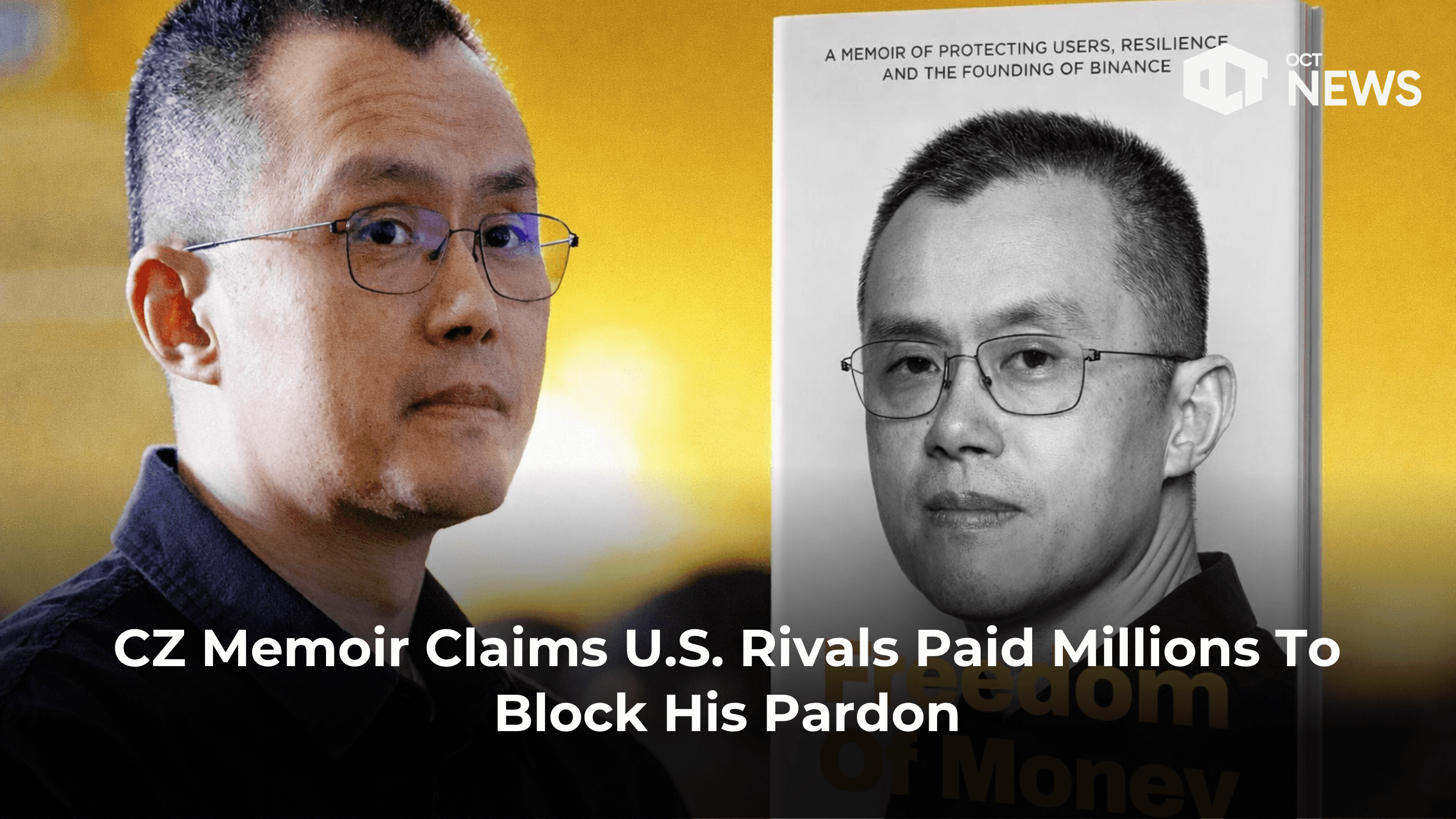
CZ in his new memoir claims U.S. crypto exchanges spent millions lobbying to block his presidential pardon.

Author: Sahil Thakur
10th April 2026 – Changpeng Zhao (CZ) claims U.S. crypto exchanges spent millions lobbying to block his presidential pardon. The allegation appears in his newly published memoir.
High Signal Summary For A Quick Glance

That Martini Guy ₿
@MartiniGuyYT

CZ SAYS US INDUSTRY RIVALS ATTEMPTED TO BLOCK HIS PARDON FROM PRESIDENT TRUMP "THEY PAID MILLIONS IN LOBBYING FEES TO BLOCK THE PARDON, IN FEAR OF BUSINESS COMPETITION." https://t.co/uCmjDcpoRc

01:30 AM·Apr 10, 2026
Steady attention without excessive speculation.
The book, titled “Freedom of Money,” went live on Amazon on April 8, 2026. It spans over 300 pages. In addition, it covers CZ’s rise in crypto, his 2023 guilty plea, and his time in federal prison. All proceeds go to charity.
In the CZ memoir, pardon-related lobbying takes center stage. He writes that “a few friends” told him rival U.S. exchanges funded negative media coverage. They also reportedly paid lobbying firms to stop his pardon.
CZ’s central allegation targets unnamed U.S. crypto exchanges. He claims they viewed his pardon as a competitive threat. Specifically, they feared it could clear the way for Binance to operate freely in the United States again.
“A few friends told me that those smear articles were funded by U.S. crypto exchanges fearing that a pardon would allow Binance to re-enter the U.S. market,” CZ wrote, according to The Block. “They paid millions in lobbying fees to block the pardon, in fear of business competition.”
CZ also alleges that critical articles in The Wall Street Journal and Bloomberg were funded by these competitors. However, he does not name any specific companies. Furthermore, he provides no supporting evidence beyond hearsay from unnamed friends.
In November 2023, CZ pleaded guilty to one count of violating the Bank Secrecy Act. He admitted to failing to maintain an effective AML program at Binance. As a result, he stepped down as CEO and paid a $50 million personal fine. Binance separately paid a record $4.3 billion penalty.
He then served roughly four months in federal prison. He was released in September 2024.
Throughout 2024 and 2025, Binance and CZ lobbied aggressively for a pardon. According to The Block, Binance reportedly spent $450,000 in a single month on one lobbying firm. That firm was run by a “hunting buddy” of Donald Trump Jr.
CZ and Binance also supported Trump-family-linked crypto ventures. These included World Liberty Financial, which generated significant revenue for the Trumps.
On October 23, 2025, President Trump granted CZ a full pardon. Trump framed the move as ending Biden’s “war on cryptocurrency.” He also said it came at the request of “a lot of very good people.”
The pardon drew sharp criticism from multiple lawmakers. Sen. Elizabeth Warren and others called it a “pay-to-play” arrangement. They pointed to the Trump family’s financial ties to crypto ventures that Binance had supported.
In contrast, Trump claimed he did not personally know CZ despite the business connections. Meanwhile, supporters of the pardon viewed it as correcting regulatory overreach against crypto.
CZ’s memoir now adds another dimension to the debate. By alleging that competitors actively lobbied against him, CZ reframes his legal troubles. He suggests they were partly driven by business rivalry rather than purely regulatory enforcement.
The memoir carries endorsements from several high-profile figures. These include BlackRock CEO Larry Fink and Bridgewater founder Ray Dalio. In addition, Bhutan’s King, HaiDiLao founder Zhang Yong, and Bitcoin millionaire Matt Roszak also backed it.
CZ has actively promoted “Freedom of Money” on X in recent days. He also posted about the audiobook version, which uses AI to read in his voice. The book is available in English and Traditional Chinese.
Notably, CZ has not elaborated further on the lobbying claim beyond what appears in the memoir itself.
As of April 10, 2026, no U.S. crypto exchange has responded publicly to CZ’s allegations. The story surfaced through outlets including The Block, CryptoNews, and FinanceFeeds. All of them reported on excerpts from the memoir.
Coinbase currently dominates the U.S. crypto exchange market. Binance.US, meanwhile, has been expanding since the pardon. The company recently hired a new CEO and restored fiat services.
As a result, the competitive landscape that CZ describes in his memoir is already shifting. Binance’s push to regain U.S. market share continues regardless of whether the lobbying claims hold up.
CZ’s claims remain unverified. The allegation relies entirely on unnamed sources and offers no documentation. Still, it adds fuel to the broader debate over crypto industry lobbying.
The role of political influence in shaping regulatory outcomes remains a sensitive topic. Whether CZ’s memoir provokes responses from competitors or shifts the public narrative, the book has already reignited discussion.
For now, the CZ memoir pardon allegation stands as one of the most provocative claims to emerge from crypto’s ongoing power struggles in Washington.
This article is for informational purposes only and does not constitute financial advice.
Our Crypto Talk is committed to unbiased, transparent, and true reporting to the best of our knowledge. This news article aims to provide accurate information in a timely manner. However, we advise the readers to verify facts independently and consult a professional before making any decisions based on the content since our sources could be wrong too. Check our Terms and conditions for more info.


Securitize Stocks Launches Tokenized Equities on Solana
OCC GENIUS Act Final Rule Sets U.S. Stablecoin Rules
Stellar Settles First Institutional Repo Using Tokenized Treasury Collateral
Kelsier Ventures Wallets Fall From $300M to Under $2M
Securitize Stocks Launches Tokenized Equities on Solana
OCC GENIUS Act Final Rule Sets U.S. Stablecoin Rules
Stellar Settles First Institutional Repo Using Tokenized Treasury Collateral
Kelsier Ventures Wallets Fall From $300M to Under $2M