The Crypto Fear and Greed Index fell to 8 on Sunday, extending its Extreme Fear streak to approximately 59 consecutive days.

Author: Sahil Thakur
Steady attention without excessive speculation.
30th March 2026 – The Crypto Fear and Greed Index fell to 8 on Sunday, extending its Extreme Fear streak to approximately 59 consecutive days.
High Signal Summary For A Quick Glance

Crypto Tice
@CryptoTice_

Extreme fear is back in crypto. And this is exactly where most people make the biggest mistake of the cycle. They see red. They feel pain. They sell. Right at the moment they should be doing the opposite. Every single time the Fear and Greed Index hit extreme fear the ones https://t.co/SPdDqeaDe7
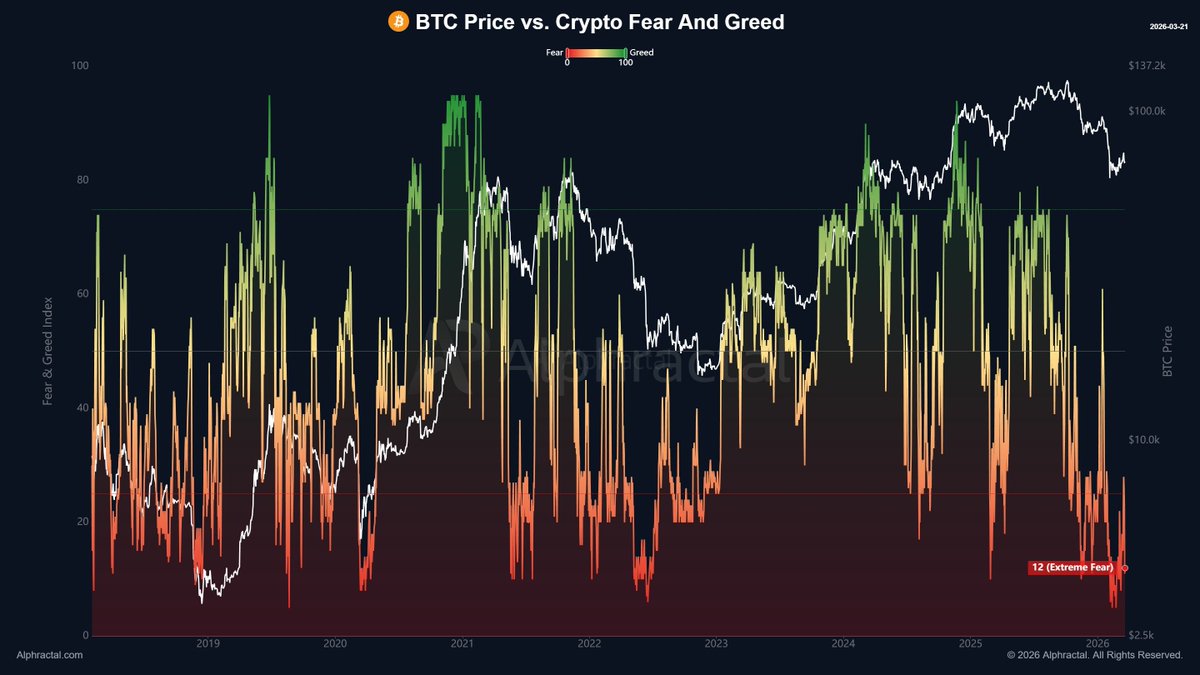
09:00 AM·Mar 24, 2026

Mister Crypto
@misterrcrypto
Crypto Sentiment falls deeper into Extreme Fear. https://t.co/zWBRM1YjUP
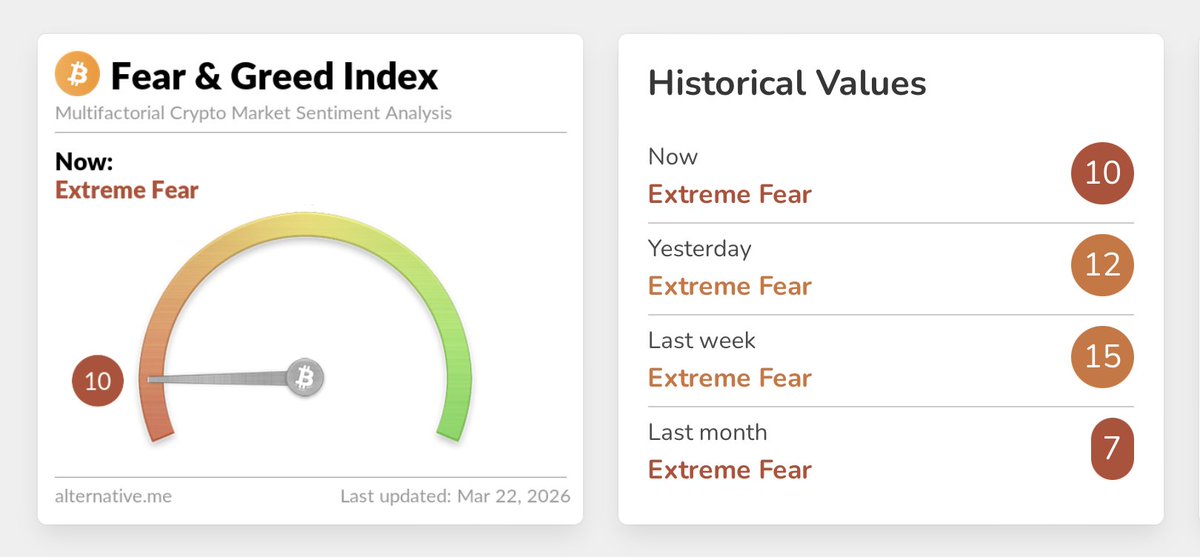
09:42 AM·Mar 22, 2026

Elja
@Eljaboom
Crypto Fear & Greed Index: 23 – Extreme Fear Are you buying or selling? https://t.co/FBE2gWteBy
02:56 PM·Mar 19, 2026
The reading comes from Alternative.me and marks the longest sustained Extreme Fear period since the index launched in 2018. Before this, the record belonged to the Terra/Luna collapse in mid-2022. Back then, the index stayed below 25 for roughly 47 days.
Yesterday’s reading was 9. Last week’s average sat around 8, while the monthly average hovered near 11. Notably, the index hit a record low of 5 on February 6, 2026.
The index tracks five weighted factors: volatility, market momentum and volume, social media sentiment, Bitcoin dominance, and Google Trends. Scores range from 0 to 100. Anything below 25 counts as Extreme Fear.
All five inputs have pointed in the same direction for nearly two months. Specifically, volatility remains elevated and trading volumes are suppressed. Meanwhile, social media sentiment reflects deep pessimism, according to Alternative.me.
The fear streak began in early February with a sharp deleveraging event. Bitcoin futures open interest dropped more than 20% in days. As a result, total crypto liquidations reached $3 to $4 billion, according to VanEck. BTC fell roughly 19% in a single week, sliding to the mid-$60K range.
That initial shock came after a late-2025 rally that pushed Bitcoin to an all-time high near $126,000. In short, the selloff stemmed from forced unwinds rather than a single catalyst.
By mid-to-late February, macro pressures compounded the damage. The Supreme Court upheld Trump’s 15% global tariffs on February 20. Because of this, inflation fears grew and expectations for Fed rate cuts were pushed back further. At the same time, risk-off flows hit crypto alongside tech stocks.
On February 28, the U.S. and Israel launched strikes on Iran under “Operation Epic Fury.” Both Trakx and CryptoTicker reported on the event. BTC dropped roughly 4% to about $63,000 in the immediate aftermath.
Oil prices then spiked above $100 per barrel on threats to the Strait of Hormuz. In response, the U.S. dollar strengthened as investors moved to safe havens. Consequently, crypto absorbed the selling pressure alongside equities.
By late March, the conflict remained active but partially priced in. A defined 4 to 5 week timeline from Trump helped contain panic. Even so, no major de-escalation occurred, and a “war premium” persisted across risk assets.
After weeks of range-bound trading between $60,000 and $72,000, BTC broke lower again in late March. Several catalysts hit at once.
On March 26 and 27, spot ETFs for BTC, ETH, and SOL all recorded net outflows simultaneously. According to Yahoo Finance, this marked a rare synchronized exit across all three products.
At the same time, the largest quarterly BTC options expiry in history played out. Deribit processed $14.16 billion in notional value. As a result, more than $450 million in liquidations followed. Max pain sat at $75,000, well above the spot price.
Because of these combined forces, BTC fell 5% to 8% in two days. It touched lows around $65,000 to $66,000.
Bitcoin currently trades near $66,000 to $67,000. That puts BTC down roughly 48% from its late-2025 all-time high of approximately $126,000.
Ethereum, meanwhile, sits around $2,000 to $2,030. ETH has underperformed BTC on a relative basis. It also faces additional headwinds, including rumors of selling tied to Vitalik Buterin, as Fortune reported.
In total, crypto market capitalization has fallen from approximately $4.4 trillion at its peak to about $2.3 trillion. Altcoins have suffered even steeper losses across the board.
The Crypto Fear and Greed Index has historically served as a contrarian indicator. In the past, prolonged periods of extreme fear preceded significant recoveries. For example, the 2022 lows came during the Terra/Luna and FTX collapses. Those lows then marked the bottom before the 2023 to 2025 bull run.
That said, past patterns do not guarantee future results. The current environment is structurally different from 2022. Spot ETFs now exist for BTC, ETH, and SOL. These products create new mechanical selling pressure through outflows. This dynamic simply did not exist in previous cycles.
The self-reinforcing loop is clear. Lower prices trigger more liquidations. Those liquidations then drive ETF outflows, which tighten liquidity and deepen fear. Breaking the cycle likely requires a shift in at least one major input. That could mean a Fed pivot, Middle East de-escalation, or a reversal in ETF flows.
Near-term catalysts are limited. However, the next Federal Reserve decision could shift rate expectations if inflation data softens. Similarly, any credible de-escalation in the Iran conflict would likely relieve the war premium on risk assets.
On the crypto-specific side, ETF flow data in early April will signal whether institutional selling has exhausted itself. A sustained reversal in inflows could therefore break the negative feedback loop.
For now, the Crypto Fear and Greed Index at 8 reflects a deeply oversold and emotionally capitulated market. Whether that translates into a buying opportunity or further pain depends on factors largely outside crypto’s control. This is not financial advice.
Our Crypto Talk is committed to unbiased, transparent, and true reporting to the best of our knowledge. This news article aims to provide accurate information in a timely manner. However, we advise the readers to verify facts independently and consult a professional before making any decisions based on the content since our sources could be wrong too. Check our Terms and conditions for more info.