Clifton Collins Bitcoin recovery advances as Irish authorities unlock 500 BTC from long-lost wallets, moving funds to Coinbase.

Author: Kritika Gupta
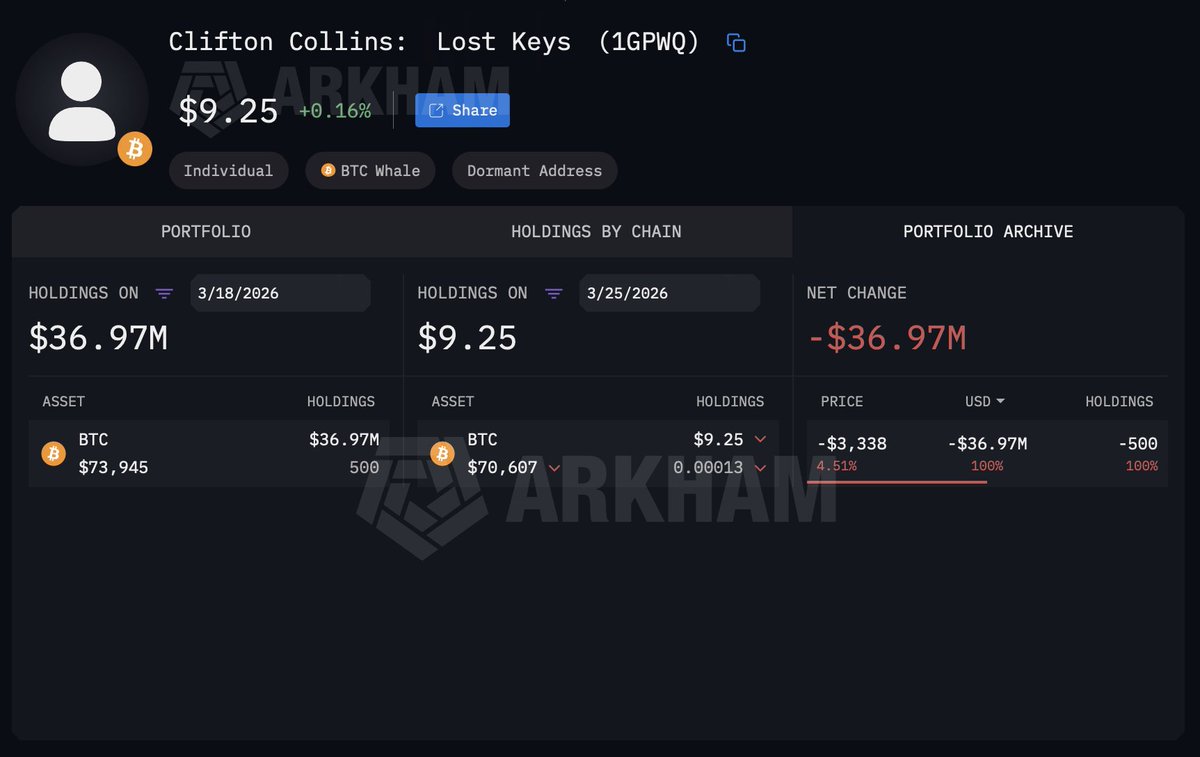
25th March 2026- The Clifton Collins Bitcoin recovery has drawn widespread attention after Irish authorities accessed part of a long-dormant Bitcoin fortune once believed permanently lost. Working in coordination with Europol, investigators moved 500 BTC worth roughly 35 million dollars to Coinbase on March 25, 2026. This marked the first confirmed activity from Collins’s holdings since 2017 and quickly drew attention from blockchain analysts and market participants.
For years, the wallets had served as one of the most cited cautionary tales about self-custody risks and the irreversible consequences of losing private keys. However, the sudden movement has reshaped that narrative. It has raised critical questions about how law enforcement managed to unlock funds widely considered unspendable and what this breakthrough could mean for the recovery of other seized or dormant crypto assets in the future.
High Signal Summary For A Quick Glance

That Martini Guy ₿
@MartiniGuyYT

🚨6,000 BTC HELD BY AN IRISH DRUG DEALER BECOMES ACTIVE AFTER 10 YEARS OF DORMANCY The Bitcoin held by Irish drug dealer Clifton Collins was believed to be permanently lost However, 500 BTC, worth about $35.44 million, was moved on 24 March at 12:51 after nearly 10 years of https://t.co/xzZdXnNfKe
03:30 AM·Mar 25, 2026
Irish authorities have revived one of crypto’s most unusual lost fortune stories after successfully accessing part of a long-dormant Bitcoin stash tied to convicted drug dealer Clifton Collins. Police, working alongside Europol, moved 500 BTC worth roughly 35 million dollars to Coinbase on March 25, 2026. These coins came from one of twelve wallets that had remained untouched since 2017 and were widely believed to be permanently inaccessible. Blockchain tracking firms quickly identified the transaction from an address previously tagged as belonging to Collins’ lost holdings.
However, after Collins’s arrest during a routine traffic stop in the Wicklow Mountains in 2017, the situation changed dramatically. While he served a five-year prison sentence, his landlord cleared out the property and disposed of his belongings at a landfill. Reports later suggested that waste from the site was incinerated overseas. As a result, authorities and observers concluded that the Bitcoin was permanently inaccessible. For years, the Clifton Collins Bitcoin recovery seemed impossible and became a widely cited example of the risks associated with self-custody.
Historically, law enforcement agencies have recovered seized or hidden crypto assets in several high-profile cases. For example, investigators accessed funds connected to dark-web markets like Silk Road by exploiting operational mistakes or weaknesses in wallet security. Nevertheless, situations involving physically destroyed private key backups rarely end in recovery. Consequently, Collins’ case became a cautionary example about self-custody risks rather than a realistic target for asset seizure.
Ireland’s Criminal Assets Bureau collaborated with Europol’s European Cybercrime Centre to unlock the first wallet. Investigators reportedly used advanced decryption resources to bypass the wallet’s security protections. The recovered 500 BTC moved on chain to Coinbase Prime during early morning hours on March 25.
Authorities have not disclosed the exact technical pathway, yet analysts suggest several plausible explanations. These include brute-forcing encrypted wallet files or identifying flaws in the original key generation process. Importantly, officials believe the same approach can help unlock the remaining eleven wallets. Courts had already ruled that the entire Bitcoin hoard represented proceeds of crime, which means the recovered funds now fall under state control.
If investigators replicate the technique successfully, Ireland could recover assets worth around 378 million dollars. Such a windfall would significantly exceed typical seizures handled by the Criminal Assets Bureau. Policymakers may direct the funds toward public services or expanded anti-crime programs. At the same time, the development sends mixed signals to the crypto ecosystem.
On one hand, it demonstrates that even seemingly lost private keys may become accessible when authorities apply significant technical resources. On the other hand, it reinforces the importance of secure backup practices and highlights vulnerabilities associated with physical storage methods. Notably, on-chain data shows no meaningful price impact following the transaction. Bitcoin continued trading near 70,000 dollars, which indicates that markets remain resilient to isolated supply movements. Collins himself has no legal claim to the funds. Authorities have not disclosed a timeline for attempting to access the remaining eleven wallets.
Our Crypto Talk is committed to unbiased, transparent, and true reporting to the best of our knowledge. This news article aims to provide accurate information in a timely manner. However, we advise the readers to verify facts independently and consult a professional before making any decisions based on the content since our sources could be wrong too. Check our Terms and conditions for more info.


Ledger Probes User Fund Losses Tied to Reseller CryptoBilis
Why Provenance Blockchain (HASH) Is Up 39.6% Today?
Halborn Clears XMAQUINA RCM Audit With Zero Critical Bugs
Fidelity Scoops $354M Bitcoin, ETH & SOL in 20 Days
Ledger Probes User Fund Losses Tied to Reseller CryptoBilis
Why Provenance Blockchain (HASH) Is Up 39.6% Today?
Halborn Clears XMAQUINA RCM Audit With Zero Critical Bugs
Fidelity Scoops $354M Bitcoin, ETH & SOL in 20 Days