Chutes SN64 Review: Explore its AI infrastructure, tokenomics, risks, miner model, and whether SN64 is worth buying in 2026.

Author: Kritika Gupta
Chutes SN64 has emerged as one of the most visible AI compute projects in the Bittensor ecosystem. It operates as Subnet 64 and provides serverless infrastructure for running open-source AI models.
Through its familiar APIs, developers can access language models, image generators, video models, embeddings, speech tools, and other AI workloads. In addition, Chutes supports private deployments and Trusted Execution Environments for sensitive workloads. The platform also claims to process trillions of tokens each month.
However, a strong product does not automatically make SN64 a strong investment.
Unlike a conventional utility token, SN64 does not have a fixed allocation for the team, investors, and community. Instead, it functions as Chutes’ subnet alpha token under Bittensor’s dynamic TAO system. Therefore, its price, liquidity, emissions, and investment risks depend heavily on Bittensor’s broader economic design.
As of mid-July 2026, SN64 trades near $14, with a market capitalization of roughly $78 million. At the same time, the token remains more than 85% below its June 2025 all-time high of $104.42.
This creates the central question for this Chutes review: does the platform’s real AI infrastructure justify exposure to SN64, or does the token remain a speculative bet on Bittensor emissions and subnet demand?
Serverless AI sounds simple from the user’s perspective. A developer sends an API request, receives an output, and pays for the compute used. However, the infrastructure behind that request is far more complex.
First, a decentralized platform must coordinate GPUs across different operators, hardware classes, locations, and network environments. It must also maintain low latency, keep popular models available, manage cold starts, route requests, verify hardware, and remove unreliable providers.
Moreover, the platform must compete with centralized companies that operate optimized data centers and control the entire software stack. Providers such as AWS, Groq, Together AI, and other AI clouds can guarantee capacity, negotiate enterprise contracts, and enforce consistent service standards.
In addition, privacy creates another challenge. Companies may want to use open-source models without exposing prompts, embeddings, proprietary data, or model weights to infrastructure operators.
Finally, token incentives must reward useful compute rather than idle hardware or speculative participation. A subnet can attract significant capital and emissions without proving that external customers generate enough revenue to support the infrastructure.
Therefore, Chutes must solve two separate problems. It must build a competitive AI product while also creating a clear economic relationship between that product and SN64.
Chutes is a decentralized serverless AI compute platform built on Bittensor. It operates as Subnet 64.
At its core, the platform allows developers to deploy and scale AI models without directly managing servers, Kubernetes clusters, GPU drivers, or cloud infrastructure. Developers can access Chutes through its Python SDK, hosted models, custom deployments, or OpenAI-compatible API.
Within the platform, a “chute” functions as a deployed application. The project compares it with a FastAPI application. Developers define endpoints, dependencies, hardware requirements, and scaling rules before deploying the application across available compute infrastructure.
Currently, Chutes supports several AI workload categories:
In addition, the platform offers Chutes Chat and Chutes Search as consumer-facing products. However, its primary value proposition remains infrastructure for developers and AI applications.
Chutes also claims to process trillions of tokens each month. Nevertheless, the project does not publish a complete independent breakdown of paid usage, free usage, internal traffic, and partner traffic. Therefore, investors should treat this figure as a company-reported operating metric rather than audited revenue data.
Chutes connects developers who need AI inference with miners who provide GPU infrastructure.
Developers can access hosted models through an OpenAI-compatible endpoint. This structure allows teams to replace or supplement another inference provider without rebuilding their entire application.
For example, developers can send chat-completion requests through the llm.chutes.ai API using standard authorization headers and familiar request formats. Chutes offers two primary deployment models.
The first model provides public inference. Users choose an available model and pay according to the number of input and output tokens they consume.
The second model provides private Chutes. Developers deploy their own code, fine-tuned model, or dedicated workload on isolated GPU infrastructure. Chutes charges private deployments by the second and applies a one-time deployment fee.
The platform can scale an application down to zero when it receives no traffic. It can also increase the number of instances during demand spikes. This structure reduces the need to pay for permanently idle infrastructure.
Miners provide the physical compute behind Chutes. They operate Kubernetes-based clusters and can combine GPUs from several infrastructure providers. Chutes recommends a mixture of hardware, ranging from lower-cost cards such as the T4 and A10 to multi-H100 systems.
Chutes calculates miner incentives using a seven-day sum of compute. It also offers bounties when miners become the first providers to support specific applications or workloads.
The system rewards available compute and reliable long-term participation. However, this also means miner rewards do not come exclusively from paying customer demand. Bittensor emissions remain an important part of the economic model.
Developers submit inference requests or deploy applications. Chutes routes those workloads to suitable infrastructure. Miners provide the GPUs and receive subnet incentives based on their contribution. Bittensor then handles the broader staking, alpha-token, and emission system surrounding SN64.
This distinction matters. Chutes operates a real product, but SN64 does not represent equity in Chutes Global Corp. Holding SN64 also does not automatically give investors a contractual claim on API revenue.
Chutes combines serverless deployment tools with decentralized GPU infrastructure.
Its architecture includes several key components:
Chutes uses a custom GPU-validation system called GraVal. The software performs matrix multiplication tests based on device information and checks available VRAM. Chutes also states that it encrypts traffic using keys that only the advertised GPU can decrypt.
This mechanism helps the network confirm that miners provide the hardware they claim to operate. It also makes it harder for operators to register false GPU capacity.
Chutes keeps selected models permanently loaded and ready to serve requests. This feature reduces cold-start delays for popular models. Cold starts create a serious problem for serverless AI because loading large model weights into GPU memory can take significant time.
However, permanently hot models also require idle capacity. Chutes must balance fast availability with the cost of keeping GPUs reserved.
Chutes supports AI inference inside hardware-backed secure environments.
TEE infrastructure isolates workloads from the host system. It also allows users to verify the execution environment before transmitting sensitive data. Chutes positions this feature for financial information, healthcare data, private research, proprietary models, and other regulated workloads.
TEE support gives Chutes an important differentiator. Many decentralized compute networks provide access to GPUs but cannot offer strong confidentiality guarantees. However, TEEs do not remove every security risk. Users must still trust the hardware vendor, attestation process, platform software, deployment configuration, and application code.
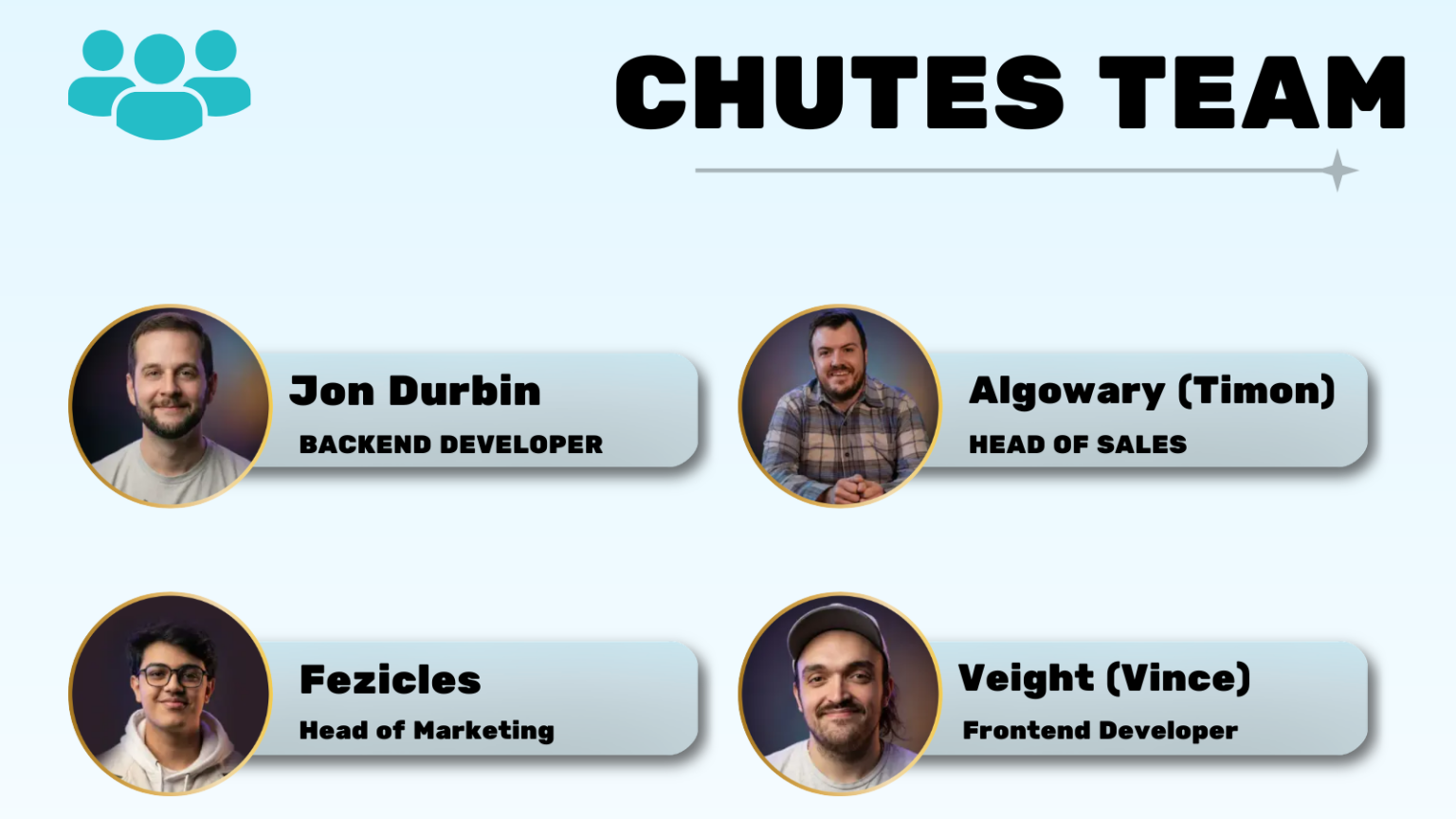
Chutes publishes its core contributors on its official website.
The public team includes Jon Durbin on backend development, Algowary on sales and customer success, Veight on frontend development, Sirouk and Cxmplex on backend development, Fezicles on marketing and community, Florian across backend and frontend, Vonkaiser on product development, and Kyle on backend and TEE development.
Jon Durbin remains the most visible figure associated with the project and has represented Chutes in technical and ecosystem discussions. Chutes Global Corp operates the subnet. TAO.app identifies the company as an International Business Corporation registered in Nevis.
The project does not prominently disclose a traditional venture capital funding round or a large list of institutional backers.
That does not mean Chutes lacks commercial relationships. Its website displays integrations or relationships with OpenRouter, Kilo, Fetch.ai, Phala, and Pax Historia. However, integrations, customers, and ecosystem relationships should not be presented as equity investors unless the companies announce an investment.
The visible team and open-source repositories improve transparency compared with fully anonymous subnet projects. However, investors still receive less corporate and financial disclosure than they would from a public company or a traditional venture-backed infrastructure provider.
SN64 is Chutes’ subnet alpha token within Bittensor’s dynamic TAO system.
It is not an independent Layer-1 token or a standard ERC-20 utility token. Bittensor creates a separate alpha token for each subnet. Users can acquire alpha exposure by moving TAO into a subnet’s liquidity and staking system.
Market demand for a subnet’s alpha token helps determine how much TAO emission the subnet receives. Therefore, SN64 connects market conviction with the resources available to Chutes miners, validators, stakers, and the subnet owner.
As of mid-July 2026, SN64 trades near $14. CoinGecko reports a market capitalization of approximately $78 million and roughly 5.4 million tokens in circulating supply. The token reached an all-time high of $104.42 in June 2025.
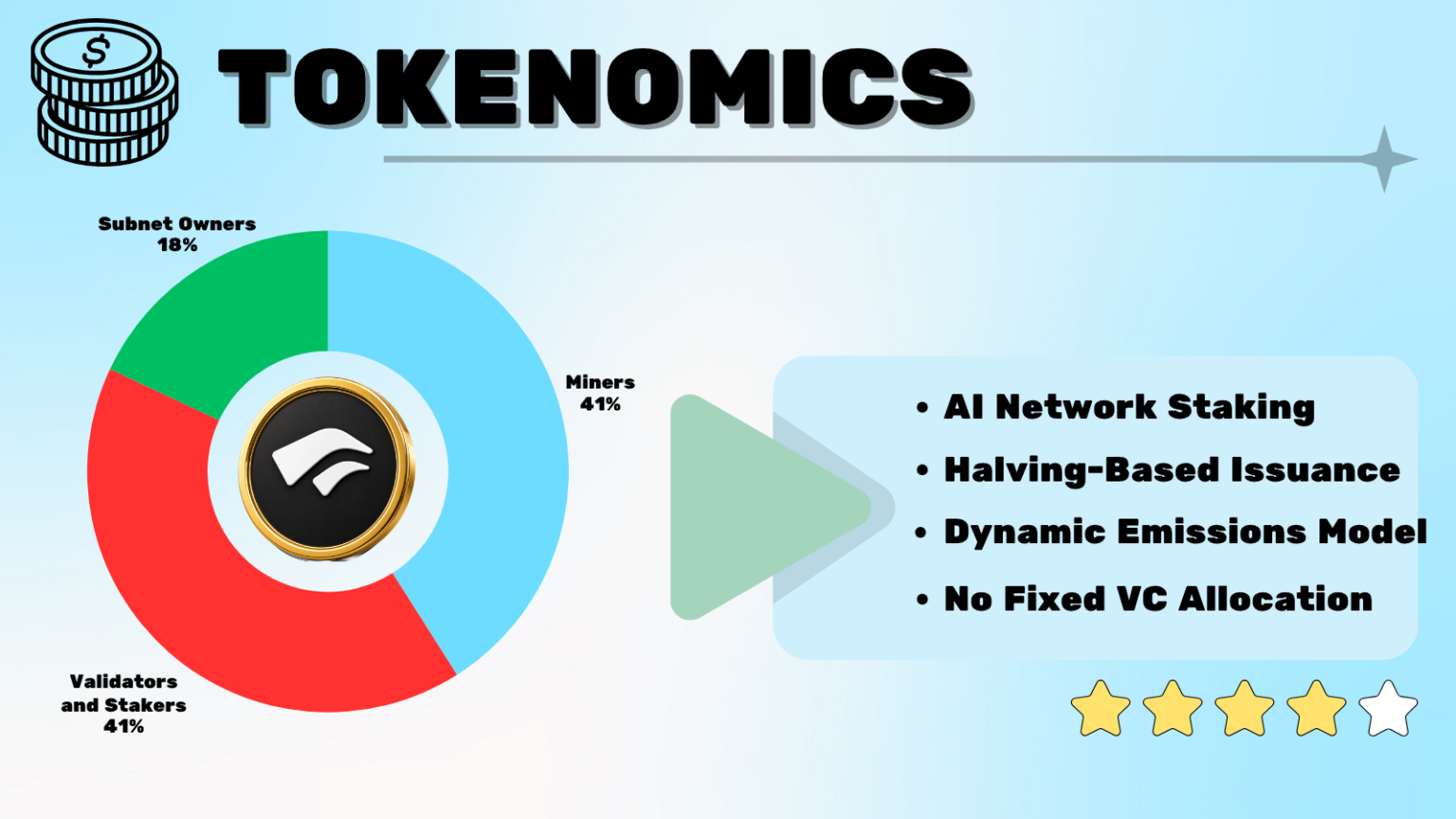
SN64 does not follow a conventional allocation model with fixed percentages for:
Instead, the Bittensor protocol issues alpha tokens over time.
Every subnet accumulates alpha emissions and distributes them among the subnet owner, miners, validators, and stakers. The exact distribution depends on Bittensor’s protocol rules and the subnet’s incentive structure.
Each subnet alpha token has a maximum supply of 21 million. Alpha tokens follow an issuance and halving structure linked to the subnet’s age and emissions. A young subnet can issue alpha into both participant rewards and its TAO-alpha liquidity pool.
This model removes the need for a conventional token sale. However, it does not remove dilution. New SN64 enters circulation continuously through protocol emissions.
SN64 does not have a standard unlock calendar with cliffs and monthly investor vesting. Instead, holders face continuous emission pressure.
Miners, validators, stakers, and the subnet owner can receive newly issued alpha tokens. These participants may hold, stake, or sell their rewards. Therefore, selling pressure depends on emissions, operating costs, staking behaviour, liquidity conditions, and market sentiment.
The absence of large scheduled investor unlocks reduces one type of risk. However, investors must monitor:
SN64 trades through Bittensor’s TAO-alpha liquidity structure. Larger trades can experience material slippage when available liquidity remains thin.
The Bittensor emission model also creates reflexive market behaviour. Rising demand for SN64 can increase its price and help Chutes attract more emissions. Falling demand can reverse that effect and weaken the subnet’s economic position.
SN64 gives holders economic exposure to Chutes within Bittensor’s subnet market.
Its main functions include:
However, SN64 has important limitations.
Chutes does not require developers to pay API bills in SN64. Its pricing page supports dollar-denominated pricing and payment through TAO. The platform does not state that SN64 holders receive direct revenue sharing, ownership rights, dividends, or guaranteed governance power.
Therefore, investors should not describe SN64 as a direct claim on Chutes revenue. The token’s value depends primarily on subnet demand, emissions, staking economics, Bittensor sentiment, and expectations about Chutes’ future importance.
Chutes has built several technical protections into its platform. First, GraVal verifies GPU hardware and available memory. In addition, Chutes encrypts traffic sent to miner infrastructure. TEE deployments also isolate sensitive workloads inside hardware-backed secure environments.
Together, these features strengthen the platform’s security model compared with a basic marketplace that sends unencrypted workloads to unknown GPU operators.
However, users still face several risks:
Meanwhile, investors face a different risk profile.
SN64 depends on Bittensor’s alpha-token architecture. Therefore, its price can fall even when Chutes continues to process AI workloads. Holders also face liquidity risk, slippage, continuous emissions, TAO volatility, subnet competition, and changes to Bittensor’s protocol.
Moreover, research has raised broader concerns about stake and reward concentration across Bittensor. As a result, concentration can weaken the assumption that every subnet operates through a widely distributed group of economically independent participants.
Therefore, Chutes may offer a credible product without making SN64 a low-risk investment.
How Chutes compares with centralized and decentralized AI compute platforms
Chutes differentiates itself through the combination of serverless deployment, open-source models, TEE support, Bittensor incentives, and an API-first product. Akash and io.net focus more heavily on supplying general compute or GPU capacity. Chutes packages the infrastructure into a managed AI product.
Centralized providers still hold clear advantages in enterprise sales, contractual service guarantees, capacity planning, compliance, and operational control. Chutes must prove that decentralization can reduce costs or improve openness without sacrificing reliability.
Chutes has a functioning product that developers can use without learning Bittensor’s internal architecture. First, its OpenAI-compatible API lowers integration friction. Developers can access new open-source models, deploy custom workloads, and pay only for actual usage.
Moreover, TEE support creates a meaningful advantage. Confidential inference can attract companies that want to use open-source AI without exposing proprietary information to infrastructure operators.
In addition, Chutes supports more than language models. Its infrastructure covers images, video, speech, music, embeddings, and custom Python workloads. As a result, the platform has several potential revenue channels.
Finally, the project has built visible integrations and claims trillions of tokens in monthly activity. If Chutes converts that activity into repeat customers and sustainable revenue, it could become one of Bittensor’s strongest commercial products. Consequently, SN64 could benefit as investors continue directing TAO toward subnets that demonstrate real-world usage.
SN64 does not provide a direct claim on Chutes revenue.
First, developers do not need SN64 to pay for API usage. Token holders also do not automatically receive profits from Chutes Global Corp. Therefore, the token lacks a clear connection to platform revenue, which weakens the value-accrual thesis.
Moreover, the subnet depends on Bittensor’s reflexive alpha-token economy. Market demand influences emissions, while emissions affect miner participation and investor expectations. During periods of strong demand, this structure can support growth. However, it can also accelerate declines when capital leaves the subnet.
In addition, SN64 trades more than 85% below its all-time high. This drawdown shows that product visibility does not protect the token from severe market repricing. At the same time, Chutes competes with companies that have larger teams, direct customer relationships, dedicated data centres, stronger compliance programs, and substantial capital.
Finally, the project does not publish enough detailed financial information to show how much revenue comes from independent paying customers. It also remains unclear how that revenue compares with the value of Bittensor emissions. As a result, investors cannot easily determine whether Chutes’ commercial growth can support long-term demand for SN64.
Chutes deserves consideration from AI developers.
It offers a familiar API, low-friction model access, custom deployments, usage-based pricing, and confidential compute. Developers can test the service without buying SN64 or operating Bittensor infrastructure.
Teams should compare Chutes with centralized providers based on latency, uptime, model availability, data privacy, technical support, and total cost.
SN64 can react sharply to Bittensor sentiment, TAO price movements, subnet rankings, emission changes, product announcements, and large staking flows. Its drawdown may create speculative opportunities. However, the alpha-token liquidity model can produce slippage and rapid price changes.
Traders should monitor SN64 against both the US dollar and TAO. A token can rise in dollar terms while losing value against TAO, or fall in dollars because TAO itself declined.
Chutes has a stronger product than many crypto AI projects. However, SN64 does not provide clean exposure to company revenue.
Long-term investors must accept several layers of risk:
A small position may suit investors with strong conviction in both Chutes and Bittensor. SN64 does not yet qualify as a low-risk or core AI infrastructure holding.
Chutes stands out as one of the more credible products in decentralized AI infrastructure.
It offers a usable serverless platform, OpenAI-compatible APIs, access to modern open-source models, private deployments, multimodal workloads, and TEE-backed confidential compute.
These features separate Chutes from subnet projects that depend almost entirely on emissions and narrative.
However, the investment case remains less clear than the product case. SN64 does not represent equity in Chutes. It does not provide a guaranteed share of platform revenue. Developers can use the platform without buying SN64. The token depends on Bittensor’s alpha-token demand, emissions, liquidity, staking behaviour, and broader TAO market conditions.
Therefore, Chutes may be worth using before SN64 becomes worth owning. The token offers a high-risk way to gain exposure to one of Bittensor’s subnets. However, investors should demand more evidence before assigning high conviction.
The most important confirmation signals include:
Until those signals improve, SN64 deserves monitoring and limited exposure rather than aggressive accumulation.
This is not financial advice. Always conduct independent research.