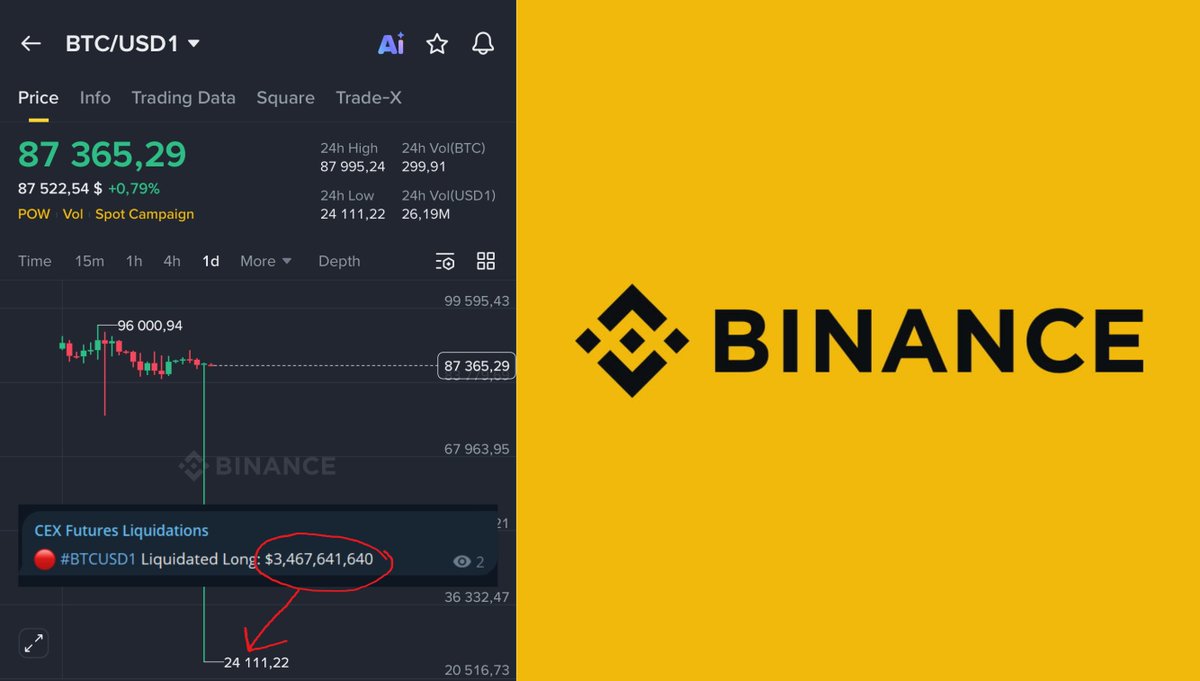
Bitcoin briefly crashed 70% on Binance’s BTC/USD1 pair during Christmas due to thin liquidity, before instantly recovering through arbitrage.

Author: Chirag Sharma
December 25, 2025 — Bitcoin briefly experienced one of its most dramatic intraday dislocations of the year after plunging more than 70% on a single illiquid trading pair on Binance. The BTC/USD1 pair collapsed to a low of $24,111 before snapping back to around $87,000 within minutes, leaving behind a historic wick on Christmas Day charts.
The event did not reflect a broader market selloff. Bitcoin’s price across major liquid pairs such as BTC/USDT and BTC/USDC remained largely stable throughout the episode, underscoring that the crash was isolated to a niche market with shallow liquidity rather than a systemic breakdown.

The flash crash occurred during holiday-thin trading hours, when global participation was muted and order books across exchanges were unusually light. According to multiple analysts, a hit the BTC/USD1 pair and rapidly consumed all available bids.

Wizzy
@WizzyOnChain

@CryptoTony__ It's a crazy manipulation
BTC/USD1 dipped below $25,000 today Crazy price action and manipulation. Can you guess the exchange? https://t.co/Gf4X4ImDN9
02:04 PM·Dec 25, 2025

Wimar.X
@DefiWimar
🚨 BREAKING A $10 BILLION CRIME JUST HAPPENED ON BINANCE ON THE $BTC/USD1 PAIR. SOMEONE OPENED A $1.8 BILLION SHORT AND IMMEDIATELY DUMPED $BTC INTO USD1 DURING LOW LIQUIDITY HOURS. LONG LIQUIDATIONS THEN CONTINUED THE DUMP, WITH LOWS AROUND $24K. TOTAL LIQUIDATIONS EXCEED $7 https://t.co/OozaCREFPB
10:59 AM·Dec 25, 2025
With limited buy-side depth, price cascaded downward in seconds until arbitrage systems intervened. Automated trading bots quickly exploited the extreme price discrepancy, purchasing BTC at distressed levels on the USD1 pair and selling into deeper markets, restoring equilibrium almost instantly.
By the time most traders became aware of the incident, the pair had already fully recovered. The only evidence left behind was a sharp wick on the chart, highlighting how quickly illiquid markets can move when stress-tested.
At the center of the episode was USD1, a relatively new stablecoin issued by World Liberty Financial. While the token has attracted attention through promotional incentives such as high-yield deposit programs, its actual trading liquidity remains thin compared to established stablecoins like USDT and USDC.
During periods of low activity, such as Christmas Day, this lack of depth becomes amplified. Even a single aggressive sell can trigger a liquidity vacuum, where prices fall rapidly until new bids emerge.
Importantly, this was not a technical failure. Binance’s matching engine and infrastructure reportedly operated normally, reinforcing that the move was purely a function of market structure and liquidity, not exchange malfunction.
Despite the dramatic headline, the broader crypto market absorbed the event without disruption. Bitcoin continued trading near $86,000–$87,000 across major venues, and total market capitalization remained above $3 trillion.
Liquidations were limited to the affected pair and estimated at under $1 million, a negligible figure compared to cascade events seen during major market downturns. Other exchanges reported no abnormal activity, further confirming the isolated nature of the crash.
For seasoned traders, the incident served less as a warning about Bitcoin itself and more as a reminder of execution risk when trading illiquid pairs, especially during holidays.
Understanding why such events occur requires a basic grasp of market mechanics. In thin markets, price does not move smoothly — it jumps.
Our Crypto Talk is committed to unbiased, transparent, and true reporting to the best of our knowledge. This news article aims to provide accurate information in a timely manner. However, we advise the readers to verify facts independently and consult a professional before making any decisions based on the content since our sources could be wrong too. Check our Terms and conditions for more info.